
 •
Rating:
•
Rating:
THE REVIEW
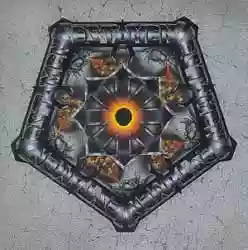
1992 is perhaps the real year of transition for Testament.
And the album in question can be seen as the so-called "bone of contention"... for the following reasons:
1) In those years, grunge was taking over the international scene;
2) Skolnick and Clemente wanted a more easy evolution of the Testament-Sound, thus setting themselves against the rest of the band;
3) Blackalbumania was like a virus affecting the thrash metal bands of that era;
4) Thrash metal itself seemed to have reached the end of the line;
5) And in summary, "The Ritual," following previous controversies, seemed to be the swan song of the "progeny" of the Bay Thrasher’s Area... (I said seemed!!).
From these reasons, one can deduce what the 5th official album represents for Testament’s entire discography and for the thrash scene in general.
The murderous rage that had characterized Chuck & family’s previous works is no more. It vanished into the darkness of the nineties, those black years for thrashers, along with the speed and power that had so strongly defined a damn heavy genre like thrash (R.I.P.)
"The Ritual" thus stands in the middle of Testament’s history. It follows the excellent "Soul of Black" and precedes (last swan song... whatevah!) the fierce "Low."
But this cannot really be called a Testament album.
In the end, Skolnick got his way: the sound is very easy listening, Billy’s voice is clean, the arrangements catchy, the sounds smooth, the rhythms accessible, and a better production compared to the past.
It's an album that struggles to reveal its true nature.
The guitars often give the impression of creating a kind of hard rock, sometimes heavier and at others cleaner and more harmonious. The bass is too often put in the background, and Clemente's double-pedal seems like a mirage. The riffs are slowed down, and only on rare occasions do they acquire a certain speed, not even remotely akin to the primal damn rapidity of execution, which so greatly contributed to the fortune of the band from San Francisco. Melodic arpeggios and riffing based on Skolnick’s intuitions and his guitar solos take command.
The tracks worth mentioning are especially "Electric Crown," with its beautiful chorus and driving rhythm, "Let Go of My World," the darkest song on the album and one that wouldn’t have looked out of place on "Soul of Black," the splendid, wonderful, unique "Return of Serenity," one of the most beautiful metal ballads in history, which alone might be worth purchasing the album.
Even the closing track "Troubled Dreams" is not displeasing, now part of the MTV-spots. The rest is nothing resonant, and nothing is remembered with great enthusiasm on this album, if we want to call it "commercial."
Neither fish nor fowl.
Loading comments slowly
Summary by Bot
Testament's 1992 album The Ritual reflects a pivotal moment when thrash metal began fading amid grunge's rise. Marked by smoother, more melodic sounds and internal band disagreements, it diverges from their classic aggressive style. While some tracks like 'Electric Crown' and 'Return of Serenity' stand out, the album as a whole feels neither fully commercial nor true thrash. It symbolizes thrash's challenging transition in the early 90s.
