
 •
Versione 1
Rating:
•
Versione 1
Rating:
THE REVIEW
“A sound editor is more important than the soloist, because he can turn a burp into a sonic epiphany.”
Chaos as a plan.
There is music that is born out of a vision, an idea, or a radical conviction; Attilio “Teo” Macero’s — a man with the stiff back of a former classical saxophonist and the gaze of one who spent half his life cutting and splicing the “stuff” of someone like Miles Davis — was that everything, absolutely everything, could be improved by editing, including (perhaps especially) reality itself.
But let's start from the beginning.
And, at the start of this story, there’s this “Third Stream” thing that Gunther Schuller invented and, somehow, Charlie Mingus ended up in with his Jazz Composers Workshop.
Playing sax in the Jazz Composers Workshop was this “spaghetti eater” from a suburb in NY State where his parents ran a nightclub, the “Macero's Tavern,” and who had solid classical training at the Julliard School of Music behind him.
At his first meeting with Mingus, Macero says: “He yelled at me for ten minutes. Then he asked if I had a cigarette. And hired me.” Now you can understand how Macero managed to handle someone as tough as Miles Davis for all those years?
Our Teo, besides, was also a good composer and, in that stuff — the “Third Stream” — which was neither Jazz nor Classical, but a third way between the two with a hefty amount of atonality sprinkled in, he fit right in. He would prove it in “Explorations,” his first record from ’53, and in a thousand other compositions for orchestra, ballets, cinema, and jazz ensembles.
But that wasn’t his path.
He found his path in ’57 when he joined Columbia Records as an editor and then as a producer. This is where the “Macero method” is born: a kind of voodoo editing ritual, a musical Frankenstein breathing thanks to the scissors (or, to be precise, razor blades and adhesive tape) of Teo Macero. The beauty lies in its invisible architecture, in the way everything is assembled — but the most incredible thing is how Macero manages to make it all seem intentional. Macero doesn’t compose: he decides what survives. In his office, there was a closet full of tapes discarded by Miles, Mingus and Monk, which he called the “jazz elephant graveyard.” Macero is the Charles Darwin of magnetic tape.
When he worked as a producer at Columbia, they say he would come into the rehearsal room, listen to a minute and a half of music, and say: “Alright, we’ve got enough. The rest we’ll do in editing.” The musicians hated him, until they heard the result. Then they still hated him, but with respect.
Macero could handle chaos the way others handle a living room.
Then Miles Davis arrived and sparks flew, the two of them set off fireworks, fought and raged (at one point Miles didn’t speak to him for nearly two years but still couldn’t stop working with him), and the music explodes, implodes, contorts, crumples in on itself; it’s the electric jazz of ’69 that made Macero the patron saint of organized chaos.
And now, take your copy of “Bitches Brew.”
I’m assuming that, if you’re slogging through this — yet another — rant of mine, you definitely have a copy of “Bitches Brew” somewhere on some shelf. And I like to assume that — if you spend time in this bar — on that same shelf there’s also “In a Silent Way,” “A Tribute to Jack Johnson,” “On the Corner,” and “Kind of Blue,” leaning up against a Davis holy card, but also — a little further on — “Time Out” by Dave Brubeck, “Ah Hum” by Charlie Mingus, “Monk’s Dream” by Thelonius Monk, and the soundtrack to “The Graduate” by Simon and Garfunkel, just to have at least a (very minimal) idea of where our Teo put his hands (and scissors).
Now throw them all in a blender and add in the “wall of sound” of Phil Spector, the diamond skies of George Martin, the genius noisy madness of Joe Meek, the musical starships of Raymond Scott and the mechanical sirens of Edgard Varèse that whistled in Frank Zappa’s ears, “Endtroducing” by DJ Shadow, and maybe you’ll have a vague idea of who Teo Macero was.
Then Teo dropped everything (but not Miles — with Miles, he’d stay tied until at least '83) and, in ’75, created his own record label: Teo Production. Because for some of the music in his head, his hands had to be free.
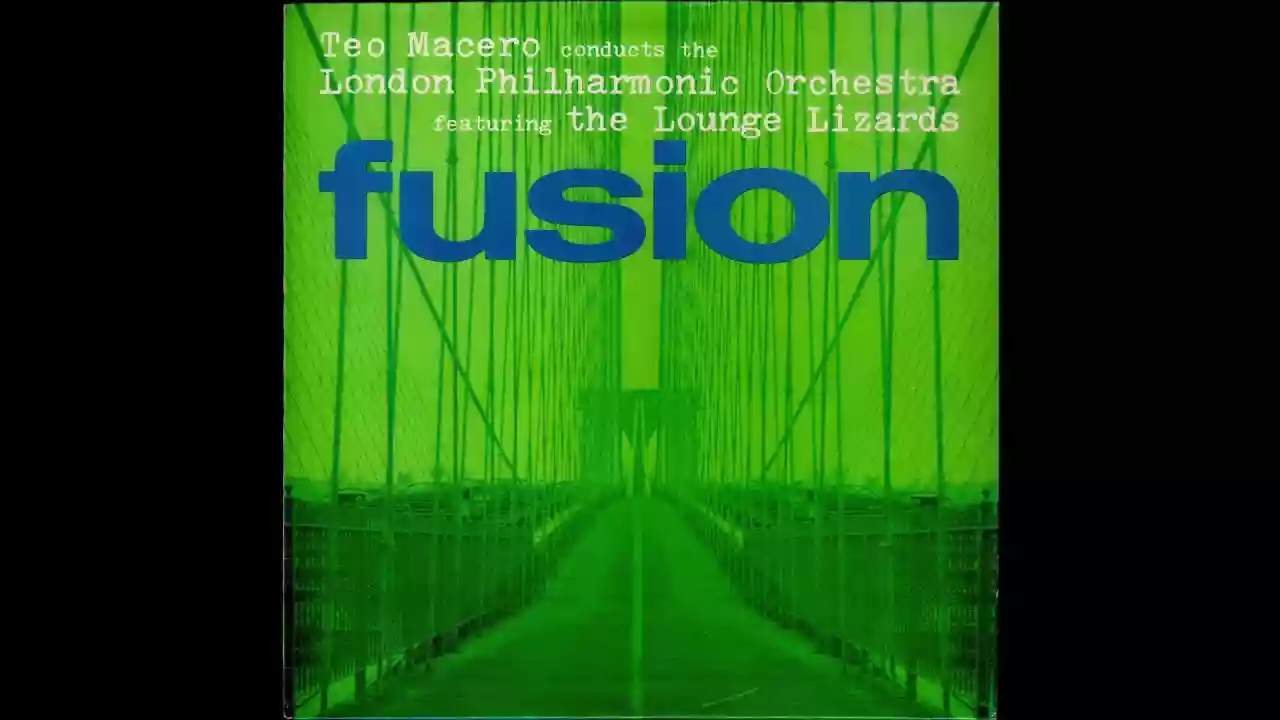
Music like that of “Fusion” (and there was never a more fitting title).
Our man had composed “Fusion” in ’56 for the Columbia University Orchestra and jazz quintet; then, in ’58, he entrusted it to Bernstein who performed it with the New York Philharmonic and a jazz quintet made up of Art Farmer, John La Porta, Don Butterfield, Wendell Marshall and Ed Shaughnessy. But it would be in ’82 that, brought together in a London recording studio, and then the following year in NY with the London Philharmonic Orchestra, the Lounge Lizards, and Ryo Kawasaky on electric guitar, he would record (and manipulate) the definitive version.
“Fusion” kicks off with an orchestral attack that seems to reassure the listener: elegant strings, full brass, an air of soundtrack before “cinematic” even became a fashionable adjective for music.
Then, however, the Lounge Lizards arrive and take everything away like a pack of savages. Here lies the genius of Macero, as in the sessions for “Bitches Brew” when — as he told it — “nobody could tell anymore who was playing what, but it didn’t matter: I’d fix everything at home, as always.” On “Fusion” he does precisely this: he cuts a piece of orchestra, puts it in reverse, glues John Lurie’s warped sax on top, and then throws in sudden silences that feel like emotional black holes. The strings of the London Philharmonic try to tune something that resembles Stravinsky, but Macero cuts, pastes, reverses, remounts them as he did in “In a Silent Way,” only here the result isn’t silent, not even by accident. So, when the Lounge Lizards come in, the album finally stops making sense and at last becomes interesting. You can almost hear Macero laughing behind the glass of the control room, the same grin, according to a legend told by his former assistant, that he wore when Miles Davis brought him hours of jam sessions saying: “Teo, you do it.” And of course, he’d do it. Always.
And the beauty of the record doesn’t lie in the themes (there aren’t any), nor in the improvisations that Macero mercilessly cuts whenever they risk becoming comprehensible, but in this act of taking fragments and turning them into a new organism — one that breathes jerkily, with one symphonic lung and the other jazz.
“Fusion” isn’t an album, it’s a battlefield. The tracks don’t follow each other: they chase each other.
The London Philharmonic plays as if trying to stay calm while the ship sinks; the Lounge Lizards play as if they set the ship on fire just to see what happens.
It’s too long and too short at the same time, it’s magnificent and irritating, it’s a record that doesn’t ask to be listened to but endured. Is it indigestible? Of course. Is it excessive? Absolutely.
Just barely over fifteen minutes, but enough to leave you exhausted. The rest of the record collects another six Macero compositions, perhaps less explosive, but no less interesting.
Macero’s art at the peak of his maturity was this: take incompatible worlds, tear them up, sew them together, and see if they walk. And “Fusion” walks. It limps, stumbles, throws itself against walls — but it walks.
For @odradek
Loading comments slowly
Summary by Bot
The review assesses Teo Macero’s Fusion, highlighting its blend of orchestral and jazz elements. While ambitious, the album receives a moderate rating. The reviewer notes its experimental nature and unique collaboration. Fusion is portrayed as intriguing but not universally appealing. The emphasis is on its distinct musical approach.
Teo Macero
Attilio "Teo" Macero (1925–2008) was an American composer, saxophonist and record producer. He worked as an editor and producer at Columbia Records from the late 1950s, produced landmark recordings (including Miles Davis albums) and was known for his tape-editing techniques. He founded the Teo Production label in 1975.01 Reviews
