
 •
Rating:
•
Rating:
THE REVIEW
"Gadji Beri Bimba Clanridi
Lauli Lonni Cadori Gadjam
A Bim Beri Glassala Glanride
E Glassala Tuffm I Zimbra"
(I Zimbra)
It was August 3, ’79 when the legendary Talking Heads released "Fear of Music," their third album following the brilliant ’77 debut and the masterpiece "More Songs About Buildings And Food," which marked Brian Eno's entry into the band's sound.
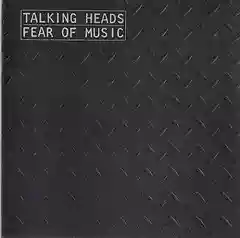
But Fear of Music stands almost as a separate entity in the Talking Heads' career: it already pushed forward the musical and conceptual boundaries of the quartet, with the danceable and intriguing atmosphere of the early days giving way to ambitious rhythmic excursions into daily neurosis. Yes, because this album serves as the soundtrack to the small (and large) obsessions threatening to imprison the common individual in a spiral of indecipherable alienation, as suggested by the album’s cover: a completely black metallic wall signifying total isolation, the loss of freedom which fears not only “music.” David Byrne's agitated presence takes over here, with interpretations on the verge of exhaustion, whether he is talking about minds unreceptive to his ideas, cities with which he wishes to identify, a 1979 imagined during the world war, animals that change his life, electric guitars processed for crimes against the state… without neglecting the instrumental contributions of Weymouth, Harrison, and Frantz, who weave intricate compositions that anxiously revolve around their leader.
The beginning is nothing short of fascinating with the "I Zimbra" tinged with ethnic suggestions ahead of its time, a Dadaist essay of the new course the group had taken: exotic keyboards, pulsing bass, a guitar gracefully played by Robert Fripp, and tribal percussion that reappear in the fake-dance single "Life During Wartime." The hallucinated "Mind" shines with hysterical guitar notes, a bass sliding over itself, and sudden electronic bursts; "Paper" is simply irresistible, vibrant, still capable of influencing new generation bands (for more information, inquire with Franz Ferdinand); "Cities" throws us from one metropolis to another with its frantic rhythm and Byrne's frenzied vocalizations.
In the splendid "Memories Can’t Wait" a frustrated unease slithers through unexpected memories and ghosts returning to make their voices heard, thanks to the thrilling melody and a grand, dark chorus. A brilliant "Air" precedes the most emotional ballad by the Talking Heads, "Heaven"; the dreamy atmosphere of the song truly seems to project us into an unknown paradise, melancholically suspended, emphasized by Byrne’s words, so simple yet so touching:
"Everyone is trying to get to the bar
the name of the bar, the bar is called Heaven
the band in Heaven plays my favorite song
they play it once again, they play it all night long
Heaven is a place where nothing ever happens"
...fantastic.
The final tracks that follow are the most disorienting:
"Animals", with its staggering rhythm and decidedly shouted singing, unfolds into paradoxical tones reflecting the grotesque instability of humans; "Electric Guitar", with the impertinent buzzing of keyboards and a not quite “electric” guitar, maintains oblique visionary ties with the concluding "Drugs", an epilogue as lysergic as its abstract construction, punctuated by sampled effects and stuttering sounds (exemplary is Eno's work in this song, as in the entire album); acidic guitars fading in the distance close the work on a note of mystery.
Fear of Music, aside from being a great testimony of cultured and varied New Wave, is pure modern art.
And the best was yet to come with "Remain In Light"…
Loading comments slowly
Summary by Bot
Fear of Music marks an adventurous leap in Talking Heads' career, blending rhythmic complexity and thematic depth. David Byrne’s vocals convey urban alienation while Eno’s production crafts a futuristic soundscape. From the ethnic vibes of 'I Zimbra' to the emotional ballad 'Heaven,' the album remains a modern art classic and a pivotal New Wave statement.Tracklist Lyrics Videos
Talking Heads
Talking Heads were an American band formed in the mid-1970s, known for combining new wave with funk, art-rock experimentation, and sharply observed themes of modern life.19 Reviews
Other reviews
By Bleak
"Fear Of Music is a true essayistic work, a paranoid and surreal study on everyday life, incommunicability, and artificial hedonism."
"Life, for Byrne, is an endless spiral of neurosis and unease, a cycle in which normality is the only anomalous element."
