
 •
Versione 1
Rating:
•
Versione 1
Rating:
THE REVIEW
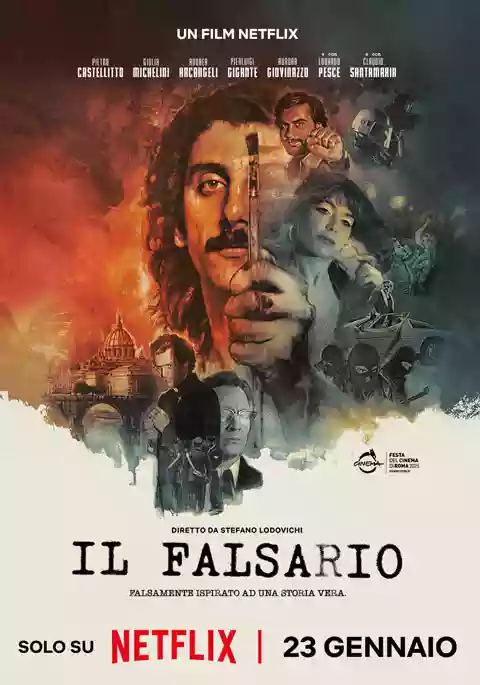
It is undeniable that, for some years now, the Netflix platform has offered a wide range of films and TV series aimed at a broad audience. Unfortunately, such quantity does not always go hand in hand with outstanding quality. As in the case of the film I am reviewing ("Il falsario" directed by Stefano Lodovichi), the viewing experience might leave you somewhat puzzled about the overall result.
Inspired by the book "Il falsario di Stato" written by Nicola Biondo and Massimo Veneziani, the movie follows the story of a real-life character whose name today might mean little or nothing to those who did not live through or have never researched the tumultuous 1970s in Italy: Toni Chicchiarelli. And indeed, one might wonder who he was. Suffice it to say that, among all those who animated the years of lead and the strategy of tension—for better or for worse—Chicchiarelli is certainly one of the most obscure and ambiguous figures. The film's weakness, in my opinion, is that it presents him in a naïve and nonchalant manner, whereas, based on the biographical notes found on Wikipedia, he did not seem at all so innocent.
In the film, we see him leaving his native place near Lake Duchessa (later to become sadly famous) in the 1970s, even though in reality, he had already arrived in Rome in 1970 to seek his fortune. Exceptionally talented at drawing, he officially makes a living as a street portrait artist in Roman squares, but due to the meagre income, he has to supplement by living on expedients, which lead him to spend some time in the jails of the capital. And it is here that he comes into contact with local criminal elements, namely members of the Banda della Magliana (much feared and connected to far-right extremist circles, as well as having ties with secret service informers).
These experiences will mark him in the years to come when, precisely in 1977, he is introduced to an art gallery owner (one Chiara Zossolo), who encourages him to pursue his undeniable artistic talents as an art forger. In fact, Chicchiarelli has a unique gift: he is able to paint with impressive and meticulous precision works by great masters (such as Caravaggio, Cezanne, Modigliani, to name just a few). These faithful copies have a flourishing market, with considerable prices and, consequently, large profits. Thus, Chicchiarelli finds himself blessed with luck and money.
But such success can go to one’s head, and Toni, being a good forger, also practices forging signatures, documents, and whatever else. Those who commission such work may be tied to crime, the mafia, or those murky environments at the extreme ends of the political spectrum (be it right or left), and he doesn’t refuse, earning under the table. In short, a life lived dangerously, especially considering that it is now 1978, the year of the tragic events related to the kidnapping and murder of Aldo Moro, an important DC figure who, as is well known, met a tragic end at the hands of the Red Brigades. This historic event will also impact the forger’s life, as shady secret service agents turn to him to craft the infamous Red Brigades’ communiqué no. 7, which alleged that Aldo Moro’s corpse could be found at Lake Duchessa. The communiqué was entirely false, but useful to mislead the police investigation.
In short, Chicchiarelli is working in high-risk circles and, at least as portrayed in the movie, seems to underestimate certain dangers—dangers that cost others their lives, but not his, at least for the time being. He emerges as a sort of lucky and likeable rogue with a mischievous air. Only, from a certain point on, time will no longer be on his side. As the mastermind, along with some accomplices, of a billion-lira robbery at the vault of the Brink’s Company bank (linked none other than to the swindler banker Michele Sindona) in 1984, he will be killed six months later under mysterious circumstances. And certainly, if one gets too greedy in certain circles, one cannot expect to live long...
Carefully produced and featuring a worthy Pietro Castellito in the role of Chicchiarelli, the film nonetheless has clear limitations. First of all, as with many biopics, the timeline of events is not always accurate, compressing the story’s development and introducing characters that are either marginal or wholly invented (did friends from his hometown really accompany the protagonist to Rome? That’s not for certain). The forger in question also displays such a bewildered expression that he reminded me of a sort of Martian landing in Rome (to quote Ennio Flaiano). To him, everyone he meets is somehow picturesque, and Rome seems like a colourful carousel, full of a certain charm. In short, this Toni is more reminiscent of Voltaire’s Candide, and I can’t help but wonder: is he really like that, or is he just playing the fool?
It is therefore a romanticized version of a man who, in reality—for how his life had been up to that point—had learned quickly to survive the tempests of street-life, perhaps relying a little too much on his artistic talents. In short, not exactly a film worthy of the highest ratings, but a useful memento of a man who, dying violently at age 36, took to the grave many mysteries linked to events that shaped the dark history of Italy between the 1970s and the 1980s.
Loading comments slowly
Summary by Bot
This review takes a candid look at Stefano Lodovichi's film 'Il Falsario.' It offers a balanced critique, noting both strengths and weaknesses. The reviewer assigns the film an average rating, suggesting mixed impressions. Key elements such as direction, storytelling, and cinematic qualities are discussed. Readers will gain an overall sense of whether the film is worth watching.
