
 •
Rating:
•
Rating:
THE REVIEW
Being only 10 years old and having the fortune, along with an enlightened father (for this reason also a great dad), to go to the cinema to see "2001: A Space Odyssey." Leaving the cinema obviously fascinated (also due to that long sequence of lights and psychedelic effects) and keeping such a memory that even today, if I have to mention must-see film titles, I start with the aforementioned film by Kubrick. And since then I have watched and rewatched the masterpiece and confess not remembering exactly how many times.
Put that way, it really has the air of a Proustian madeleine from the search for lost time, but considering that science fiction films are always in good health (the latest being "Dune"), I feel like writing just a few notes on the sidelines of the film without many pretensions. In all these decades since the film's release year (the fateful 1968), many experts and others have practiced, I am content to note some interesting aspects regarding the theme without detailing the overly well-known plot.
Meanwhile, it's not rhetorical to talk about an epochal film, capable of fascinating viewers. At a time when cinema was a calling factor for many, with noteworthy proposals capable of sparking discussions, reflections, and debates, "2001: A Space Odyssey" was highly suitable for attracting interest and also becoming a pop phenomenon. Certainly, in the meantime, there was the so-called space race between the USA and the USSR (with the American landing of man on the Moon in July 1969), but Kubrick's film had all the prerequisites to be a trending event. Just to say, at the London premiere, the Rolling Stones attended in full and later said they were ecstatic about the viewing. In that period, a certain David Bowie, not yet very famous, drew inspiration from the film he had just seen to compose "Space Oddity," one of his best songs. If all this is not a trend that leaves a mark on posterity, I don't know what else could be...
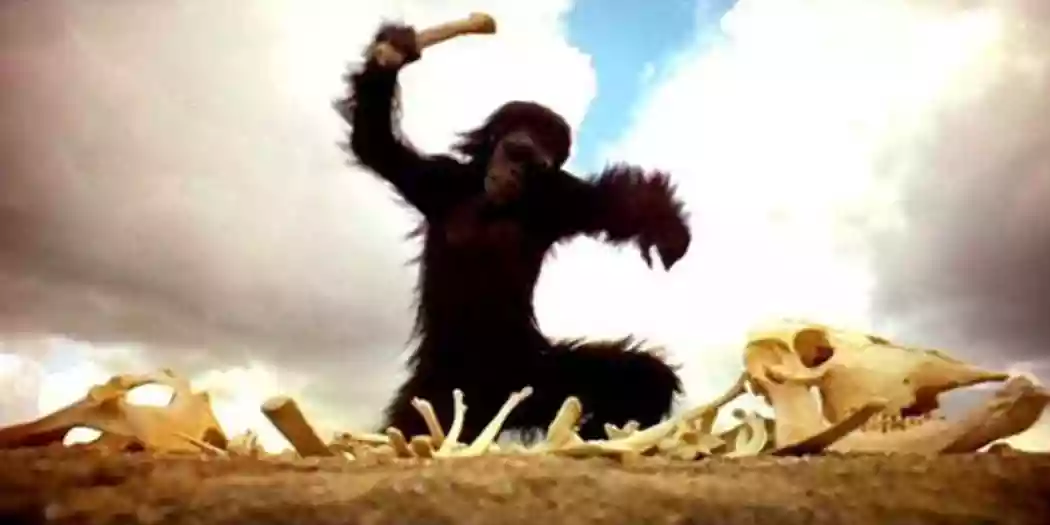
However, it is also true that the film, at first glance, was challenging, almost as if one was facing a purely experimental work. When I saw it for the first time (in April 1969 because films stayed in circulation for a long time then), I couldn't help but notice that outside the cinema, someone had posted an explanatory sign about the themes and significance of the film. I assure you that many people paused to read it carefully, and the expression on their faces was somewhat perplexed. And the second time I watched "2001: A Space Odyssey" (in October 1969 accompanied by my maternal grandmother), I happened to see two young viewers, who had entered the cinema when the screening had already begun and sat near me, very disoriented. So much so that they asked me, while scenes shot in wild Africa were being shown on the screen if what was seen wasn't a documentary about animal species in the Third World. Of course, it wasn't, but this confirmed the enigmatic and innovative nature of the film.
And it would still be worth asking what the message of the work was, given that a filmmaker like Kubrick was not inclined to make vacuous films. It is clear that what is shown is a panorama of the evolution of the human race, starting from our ape ancestors dealing with everyday survival issues up to space exploration with a successful confrontation with the artificial intelligence of a Hal 9000 series supercomputer. From here, the encounter with extraterrestrial civilizations will be an inevitable and fundamental step, with incredible outcomes. Kubrick seems to embrace a vision in line with Nietzsche's theory of the superman (intended as the realization and overcoming of man). But it remains the fact that in the key moments of the plot, we see a dark-colored monolith appear, on which many have puzzled. This thread seems to be an expression of Divine Intelligence, ready to steer the flow of events in the right direction. Perhaps proof of the existence of God?
This eternal theme will never find a definitive answer, with all the scientific criteria. Yet a certain Albert Einstein wrote something enlightening on the subject: "I am absolutely convinced that God does not play dice... Everything is determined, the beginning and the end, by forces over which we have no control. We all dance to a mysterious tune, intoned in the distance by an invisible piper."
And since we find ourselves immersed in this space-time universe, we human beings are so fragile that we cannot know everything, let alone ascertain the existence of God.
Loading comments slowly
Summary by Bot
The review recounts a lifelong admiration for Kubrick's 2001: A Space Odyssey, highlighting its profound cultural impact and challenging narrative. It emphasizes the film's role as a cinematic phenomenon during the space race era and its innovative visual style. Themes of human evolution, artificial intelligence, and divine intelligence are explored. The reviewer also notes the film's enigmatic nature and philosophical depth.
Stanley Kubrick
Stanley Kubrick (1928–1999) was an American film director, screenwriter, producer and photographer, noted for meticulous craftsmanship and influential films across multiple genres including 2001: A Space Odyssey, A Clockwork Orange and The Shining.35 Reviews
