
 •
Rating:
•
Rating: THE REVIEW
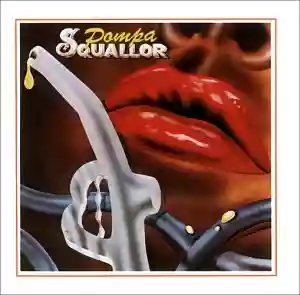
The curious Squallor phenomenon, born in 1973 thanks to Alfredo Cerruti, Totò Savio, Daniele Pace, and Giancarlo Bigazzi, bursts into the vibrant landscape of Italian songs - with which it has little to do - with the third album of their production, contemporary to "Vacca." Following the semi-serious and almost puritanical "Troia" of '73, the year of their debut, and the biting "Palle" a year later, the result is an amiably trashy work, crudely evocative and too noisy (it made its appearances in the charts for weeks without any prior advertisement of the product) to go unnoticed by retrospective critics: "Pompa," curiously enough, is a cult, and it is not a simple policy of valuing too much filth that, by the law of opposites, is too beautiful.
On cover-based, stolen, alluded foundations, the dominator here, as in no other peer album, is the showman Cerruti, who "sings" almost all the tracks, with vocal caricature worthy of an anthology on more than one occasion (Berta, Famiglia Cristiana), while the clean-cut counterpoint of Totò Savio appears only in the witty Sfogo, where the object of ridicule, almost to the extreme of paradox, is the ridicule made of the "system" by post-1968 singer-songwriters like De Gregori and Guccini, and with them their indistinct followers.
"Everyone against everything": this is the extreme slogan of the Squallor; no one is spared from ridicule, and the note of pungent anticlericalism that distinguishes Unisex, whose musical base is that of the well-known "Fiesta" sung and danced by Carrà, only reinforces the argument that no one is spared, and it is certainly not a political or ideological vocation that motivates the group's insults: only verve and horseplay, pure fun and a joy in destruction. Thus, one can even speak of love, of the same love drooled over by contemporary songwriters, with a desecrating, disconcerting, abysmal approach: this happens in the exquisite Saviano ballad La Scarognata, in the Santaniana Nottingam, and especially in the memorable Berta, the seventh track of the album, where to Brahms' notes, Cerruti's showmanship splits into an alternating bickering between Milanese and Neapolitan dialects, an involuntary clash of styles and cultures: the vulgar language, which finds continuity in Unisex without a hiccup, flows undisturbed into Famiglia Cristiana, the penultimate piece, where with simple microphone effects Cerruti invents "Pierpaolo," a monstrous child of the well-mannered bourgeoisie who spends and spreads without any instigation of values: he will also appear, years later, in Arbore's nocturnals. Finally, the spoken style of the march, which will find precedents only in the Squallor, manifests itself in all its bizarre buffoonery in La Marcia Dell'Equo Canone, where Cerruti gathers houses and brothels together before bidding farewell with his unmistakable Buonasera: a courtesy goodbye, since the band hasn't finished scandalizing with their outspoken attitude, and, why not, with a certain musical knowledge that will later lead them to admit they have always nonetheless made music.
Loading comments slowly
Summary by Bot
Squallor's 'Pompa' is a cult 1976 Italian album known for its irreverent, satirical tone and unpolished, noisy sound. The band spares no one in its ridicule, blending vocal caricature and cultural clashes across various tracks. Showman Alfredo Cerruti leads with humorous, sometimes provocative performances, supported by clever musical arrangements. This album remains a unique, spirited entry in Italy's musical landscape, admired for its pure fun and biting social commentary.Tracklist Videos
Squallor
Squallor are an Italian group from Naples formed by Alfredo Cerruti, Daniele Pace, Totò Savio and Giancarlo Bigazzi. Active mainly from the early 1970s to 1994, they became cult icons for obscene, satirical spoken-word pieces over sharp pop/rock backings. They issued numerous albums (including Pompa, Vacca, Arrapaho) and two films (Arrapaho, Uccelli d'Italia).08 Reviews
