
 •
Rating:
•
Rating:
THE REVIEW
“Sehnsucht” is not a pandering film that takes the viewer by the hand. If it does, it’s only to grip a little tighter and drag you into an abyss.
The rain falls relentlessly, dense and insistent, shrinking the space and seeping between the twisted branches of an ever-thickening thicket, where light is all but absent. The sky is low, heavy, oppressive, and it seems to weigh not just on the protagonists but on the entire world around them, squeezing every breath and turning every gesture into something slow, heavy, almost ritualistic.
Within this suspended space move Samuel and Amanda: they seek each other, they brush against one another, they lose each other, within a bond that begins as burning, animalistic, carnal passion and gradually corrodes, changing into dependence, control, and obsession, until it culminates in silent and inevitable annihilation.
Sehnsucht is a German word that is notoriously difficult to translate, often incompletely trivialized as “nostalgia” or “desire”, but in reality, it is much more complex. It is a kind of longing understood as a painful tension toward what is missing or cannot be attained; it is an awareness of emptiness, an attraction to the unknown, a yearning toward a possible outcome that may never actually come true. The whole film lives within this multifaceted emotional state: bound to loss, a memory that merges with suppression, a time that does not move straight ahead but folds in on itself, rendering past and present indistinguishable.
Sid Lucero, with the essential support of Chris Tetrokan in writing, creates a work that refuses any reassuring label. "Sehnsucht" is not a horror film, it is not a thriller, but instead takes on the traits of a conceptual and perceptual experiment, radical and openly anticommercial, that chooses subtraction as its method. The images, often static and unmoving, achieved without the use of a camera, linger beyond what is “necessary”. The editing rejects classical rhythm and forces the spectator to share in the emotional stasis of the characters.
Yes, it is wordy. Yes, it is static. And yes, it can feel exhausting. But this is a precise, coercive choice that either hypnotizes you or risks seriously knocking you out around the thirtieth minute, as happened to a friend of mine who ended up like Abraham Simpson with drool streaming from his mouth.
In this context, language becomes central. The narrative is entrusted to the voices of Samuel and Amanda, who seem to speak from an indefinable elsewhere: from memory, from remorse, perhaps from death itself. The texts are sparse, dry, precisely calibrated. They do not accompany the images: often, they replace them, guiding a narrative that refuses easy explanations and linearity. This is a cinema that demands to be listened to, because every pause, every line, every breath is essential for entering into the minds of the protagonists, whom we only ever glimpse, and only fleetingly, for a few seconds.
The sound design is obsessively crafted, serving an eminently psychological function. The incessant sound of rain does not create atmosphere: it crushes it. It is suffocating, disturbing, devoid of any real breaks; it erases silence and denies any reprieve. Even when nothing seems to be happening, the film offers no rest, reflecting the characters’ inability to halt the flow of their own thoughts.
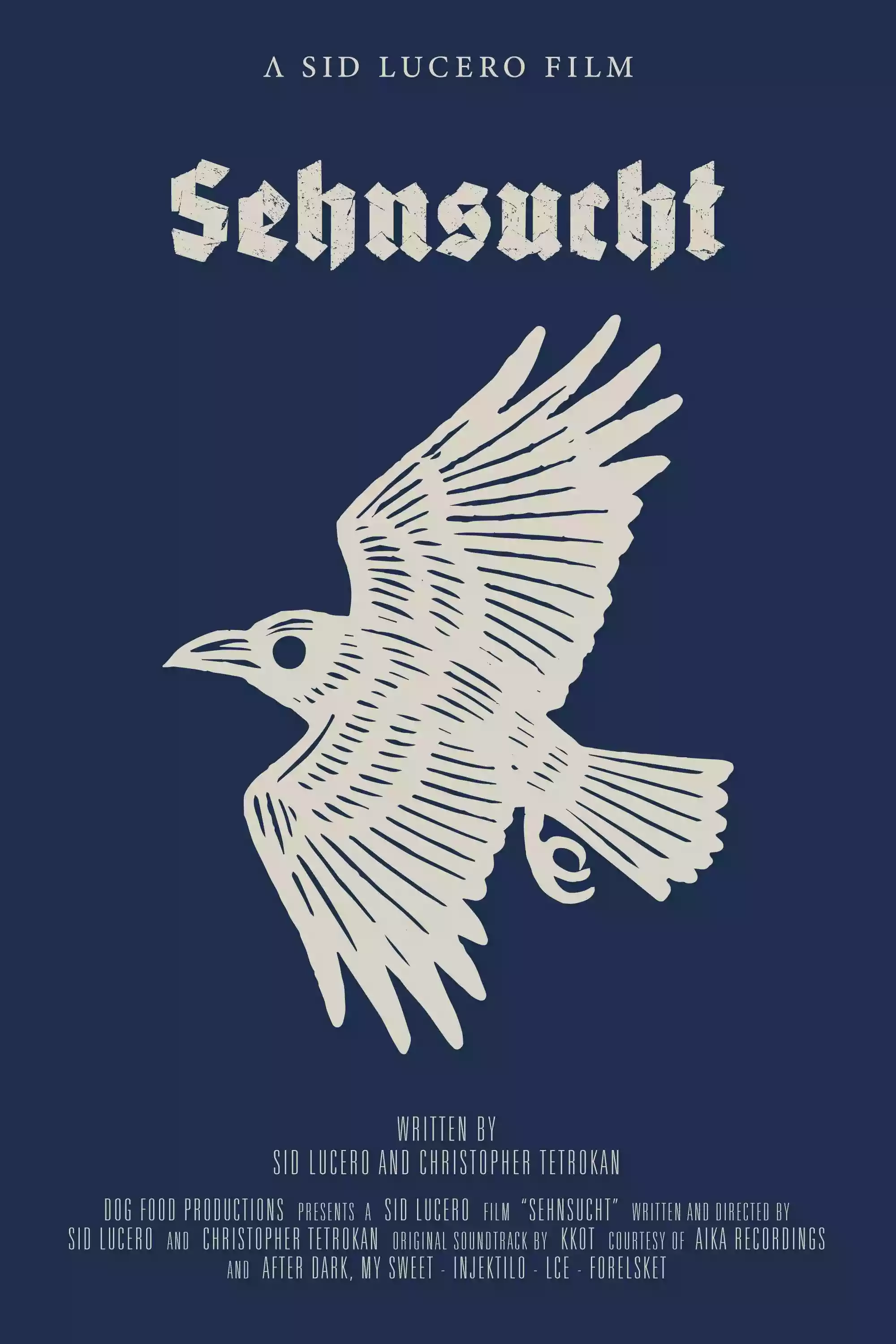
Within this mental landscape appears the figure of the red-haired girl, beautiful and unattainable, a projection of carnal desire and absence, an echo of a life never born. She is eros and mourning entwined, pure obsession, violence already inscribed in shadow without ever needing to be shown. The crow, on the other hand, a recurring and mute presence, observes from above: it does not act, it watches over its prey. Like desire, like the obsessive thought that returns. Like the viewer.
Before writing these lines, I thought it necessary to watch another work by Sid Lucero in order to verify for myself what I had read online. I can confirm that the difference with "Pink for the Masses" is enormous. There, Lucero explored corporeal, extreme, and visceral horror (nostal/vomit gore); here, he chooses a conceptual, cerebral piece, one that does not seek shock but slowly consumes. It is a subtle, psychological violence, which never explodes but sticks to you, clinging on.
"Sehnsucht" is not a film to be “understood”, but rather to be experienced. It asks for time, attention, and a willingness to be unsettled. Its 61-minute runtime might even be excessive, and its stubborn immobility can be off-putting, but these are all part of a coherent project that refuses compromise. There is no catharsis, no redemption: only the weight of unresolved longing that keeps repeating, like the relentless, dense, oppressive rain—impossible to ignore.
This is a divisive and radical work, one that tackles an overused theme in an original and surprisingly deep way. With a ridiculous budget, Sid Lucero and Chris Tetrokan have delivered a work that not everyone will like, and that’s just fine: it’s one of those films that, if it gets under your skin, won’t easily let go. I recommend it.
P.S. For the sake of transparency, I should mention that I personally know one of the people who worked on the film. Nonetheless, the opinion expressed here is that of a viewer and comes solely from the experience of watching it.
Loading comments slowly
Summary by Bot
The review commends Sid Lucero's 'Sehnsucht' for its moody and evocative artistry. Its emotional impact and cinematic qualities are highlighted. The film receives a strong rating of 4 out of 5. The review appeals to fans of artistic and introspective cinema. Overall, 'Sehnsucht' comes recommended for its depth and atmosphere.
Sid Lucero
Sid Lucero is discussed in the provided review as the creator of the film “Sehnsucht,” presented as a radical, anticommercial conceptual/perceptual experiment. The review also mentions another work, “Pink for the Masses,” described as corporeal, extreme, visceral horror.01 Reviews
