
 •
Rating:
•
Rating:
THE REVIEW
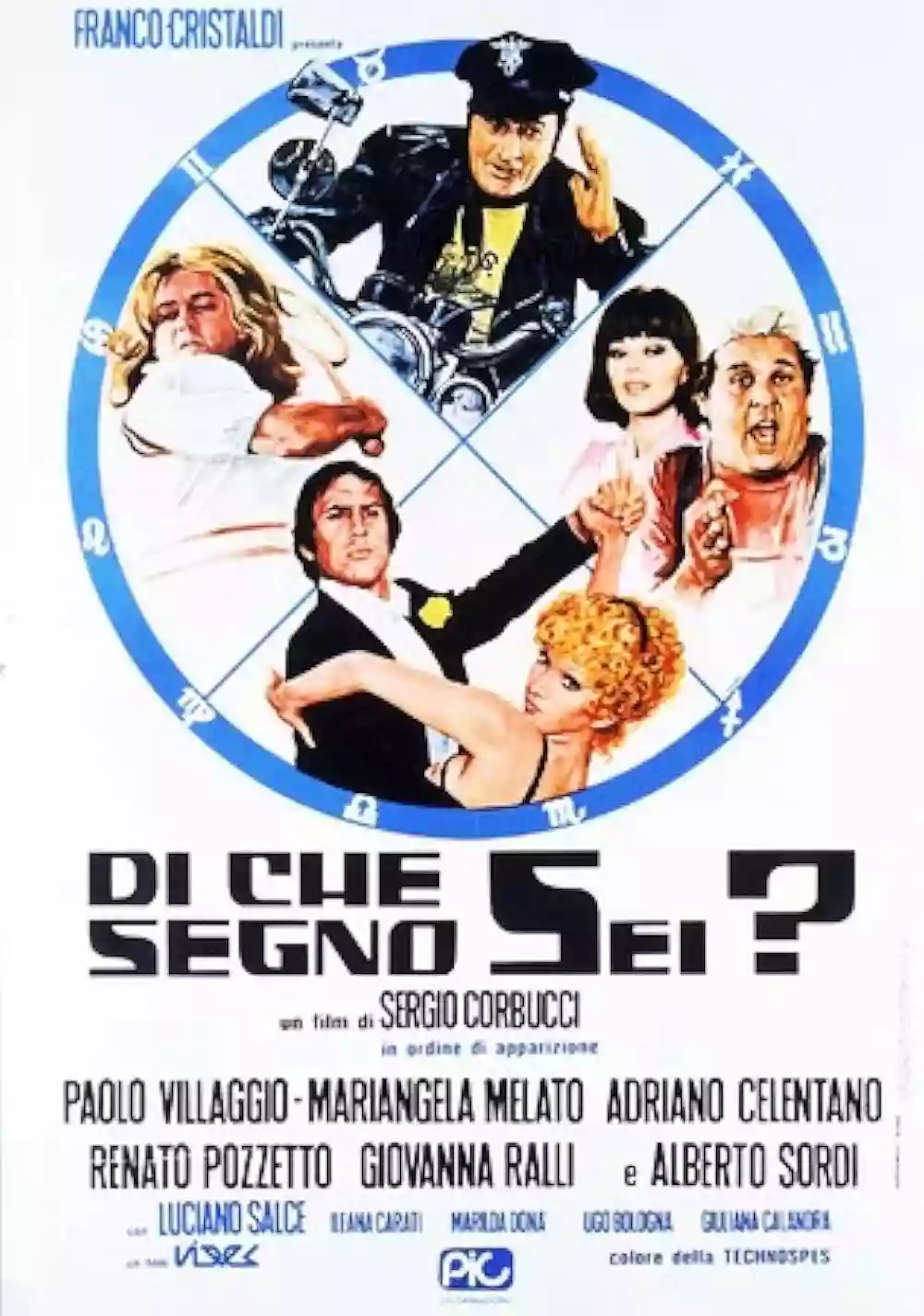
WHAT’S YOUR SIGN? (1975) 4/10
Some rather deleterious things happen in Italian cinema in the 1970s. In primis, the great names of the past either die or grow old and become less and less willing (with only a few exceptions, see Mario Monicelli, but Dino Risi’s post-1974 decline is exemplary); television begins producing top-level comedians who are immediately "captured" by cinema (nothing different from what is done today with Checco Zalone or the like—back then they were called Paolo Villaggio, Renato Pozzetto, Enrico Montesano, and in the early 1980s Roberto Benigni, Carlo Verdone, Massimo Troisi); audience tastes change and anthology films, so delightful (though very sparingly made) in the 1960s (above all masterpieces: “I mostri”, 1963), become in the following decade an extremely tedious habit that sometimes works, but much more often fails. This gives rise to films like: “Dove vai in vacanza?”; “Io tigro tu tigri egli tigra”; “Questo e quello”; “Culo e camicia”, and so on.
In this melting pot (in which, however, there are true gems—though not anthology ones—like “Amici miei” or that absolute masterpiece “Romanzo popolare”) comes, in October 1975, “Di che segno sei?”. It is directed by Sergio Corbucci, 59 years old, a factotum director who moved effortlessly from Totò to “Django”. There are four episodes, and the film goes on forever: 130 minutes. It was a resounding success: in the year of the first Fantozzi, of “Amici miei,” “Jaws” and “One Flew over the Cuckoo’s Nest,” it was the seventh highest-grossing film in Italy (it actually made more money here than The Godfather Part II, which ranked eighth): 4,380,246,090 lire at the box office and almost 7 million tickets sold. Today, such numbers would undoubtedly make it number one.
The episodes are divided into the 4 horoscope macrocosms (Water; Air; Earth; Fire), though in reality that’s the only “link” to the zodiac signs, as they are never mentioned again throughout the film. So be it.
-
“Water.” In Genoa, a port pilot (Paolo Villaggio, dragged in only because of the TV triumph of Fracchia and cinema hit Fantozzi) believes he is about to have to change sex and starts preparing for it (the worst episode, 25 minutes of cosmic nothingness, not a single laugh, and a Villaggio that is clearly disinterested).
-
“Air” (the most famous episode: Adriano Celentano, Mariangela Melato): she is a dancer looking for a partner for a dance competition in Ravenna with a prize of one million old lire; he is a dancer also known as Fred Astaire, and so it’s easily settled (one of the many successes in which simply putting the name of the beloved Adriano on the marquee drew crowds, and this would be the norm until the second half of the 1980s).
-
“Earth” Basilio (Renato Pozzetto) commutes throughout the foggy Bergamo area of Lombardy and attempts to seduce the wife of his boss (an endless episode, it just never ends, and there are never any laughs).
-
“Fire”, technically the best, though it takes quite a bit of imagination to call it that. The protagonist is Alberto Sordi, reprising the character of Nando Moriconi seen many years earlier in “Un americano a Roma” (now that was a great film). We find him 22 years older; he is a security guard for the Security Police and, theoretically, should be protecting a small-time industrialist from the Milan area (the only interesting thing isn’t seeing Sordi in Milan—he’d been there before, see “Il vedovo”—but seeing Nando Moriconi, so thoroughly Roman to the core, racing through Piazza del Duomo and Via Manzoni on a motorbike). He will get into all kinds of trouble. Sordi is Sordi, no question—he’s like Totò, even if the film was appalling their presence alone could lend it some dignity, and in fact, these are the only 30 minutes during which (without great expectations) you actually laugh.
I, who am madly in love with Italian comedies of the 1960s and 1970s, have always thought that it was films like this that killed off a certain kind of cinema—certainly “artisanal”, but totally dignified, like ours (excluding Fellini, Visconti, Leone, etc.). In 2014, that “disgraziato” Neri Parenti made a sort of remake, with Boldi, Salemme, Pintus, Belen, Pio e Amedeo, Paolo Fox.
Loading comments slowly
Summary by Bot
This review is highly critical of Sergio Corbucci's 'Di che segno sei?'. The reviewer gives the movie the lowest possible rating. The film is seen as a significant misstep for the acclaimed director. Major disappointments are highlighted, with little merit found. Lovers of Italian cinema are advised to temper expectations.
Sergio Corbucci
Sergio Corbucci (1926–1990) was an Italian film director and screenwriter from Rome, a key figure of the Spaghetti Western. Known for the darker, mud-and-snow counterpoint to Sergio Leone, he directed Django (1966) and Il grande silenzio (1968), then successful comedies with Bud Spencer and Terence Hill, plus 1980s ensemble hits.04 Reviews
