
 •
Rating:
•
Rating:
THE REVIEW
Samuele Bersani’s fans (I say this from personal experience) are kind, pleasant people, reasonably well-educated, devoted to the most ordinary daily life, sociable, and romantic. In other words, they are the exact human counterpart to the songs of the Romagnolo singer-songwriter. And his songs are just like that: sweet, romantic, light, often elusive, pleasant, already heard a thousand times in a much more effective singer-songwriter past. The honey candies (far too sweet, really) that he’s been offering for thirty years prove this: sometimes, when he leaves the sugar on the shelf, he even manages to be surprising (see "Chicco e Spillo" or "Freak") but it only happens once in a blue moon.
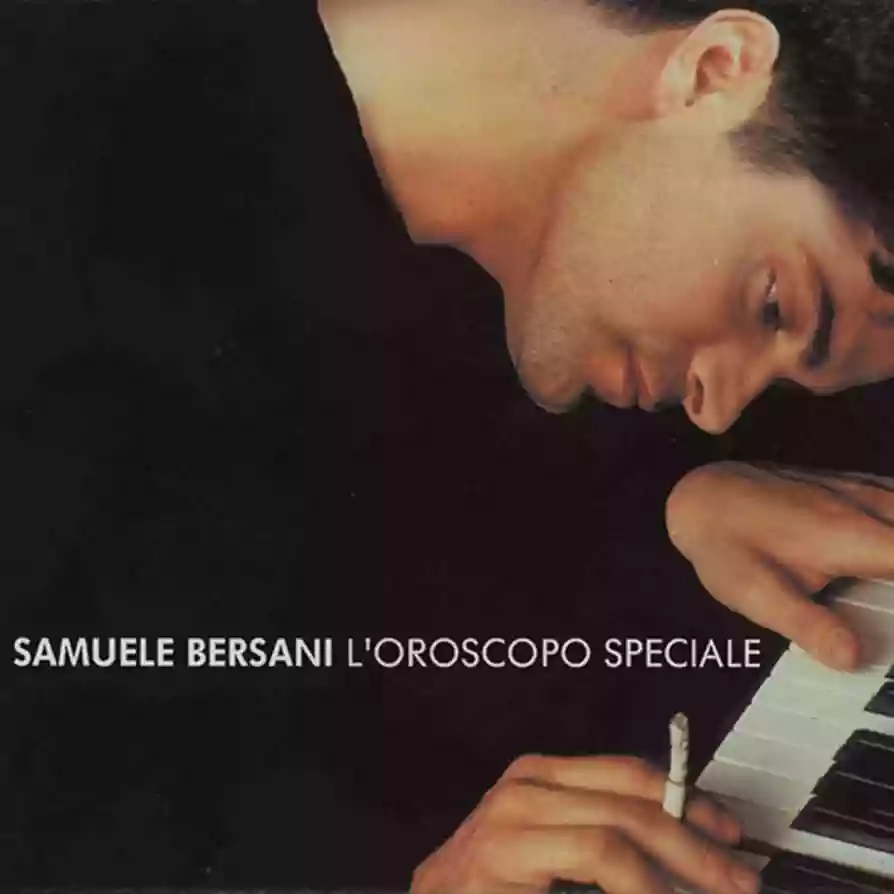
"L'oroscopo speciale," released in 2000, is considered his best album. Of course, a Sanremo appearance with the melodic "Replay" (which, in the author’s intentions, was supposed to wink at the moods and style of Luigi Tenco, oh signùr) and a respectable fifth place—plus a prestigious Targa Tenco (Best Italian Album of the Year)—earned him a spot among the Great Italian Singer-Songwriters (legion d'honor just invented by me). But, with all due respect to the aforementioned horoscope, there’s little special about this album. Actually, it feels like the usual dish, perfectly cooked (yet always missing some ingredient) that he’s been serving us since the early '90s.
Bersani, at the time still part of Dalla’s crew (he'd leave the following year), chose "Il pescatore di asterischi" as the single (the title says it all), and it works: it’s a nice, catchy song, with some beautiful lines ("siamo giocolieri non perdiamo il tempo a cercare/il senso gravitazionale che non c’è"), yet, even by the 16th listen, what sticks in your head is very little—just another Bersani treat that neither disappoints nor fully satisfies, it’s just there, as the main character from "Ovosodo" would say, like an egg that doesn’t go up or down. And the whole album is kind of like that: the satire of the TV commercials that flooded private broadcasters at the time ("Morelli Mirko") doesn’t really work, nor do the stories—told in the title-track—of a guy who kills a woman after taking her to the seaside and gets away with it because summer arrives.
Then, to be honest, some songs are really bad: "Lunedì" (which is also way too long); "Il fossile"; "Isola" (with music by Sakamoto). Obviously, being a talented artist, he does hit the mark every now and then—and does it well: the no-sense of "Senza titoli" is just fun enough to be memorable for a long time; "Slavia" is a beautiful song (never again, I believe, performed live) that elevates him above his usual (pseudo)melancholic standards; the autobiography in "Non portarmi via il nome" is beautiful and, finally, substantive. The album sounds great—which is only to be expected, given the big names playing on it (recalling from memory, Beppe D’Onghia and Paolo Costa, respectively on keyboards and bass).
The 2001 edition adds a song, "Chiedimi se sono felice", featured in the soundtrack of the film of the same name (and a box-office hit) by Aldo, Giovanni and Giacomo (a song that contains a final, definitive, and beautiful line: "Felicità, dichiarata fac-simile dal giudizio che ha rilasciato un orefice/quella vera sarà, senza un graffio di ruggine"). Twenty years later, in 2020, the trio would ask another "cultured" singer-songwriter from the Italian music scene, Brunori Sas, to write the soundtrack for another of their films, "Odio l’estate". Brunori and Bersani: after all these years, a style of songwriting very similar in tone and in its persistent nostalgia.
Loading comments slowly
Summary by Bot
This review criticizes Samuele Bersani's album 'L'oroscopo speciale' for failing to meet expectations. The reviewer expresses disappointment with the album’s direction and overall execution. Despite Bersani’s reputation, this release is seen as a letdown. Fans may be left unsatisfied. The overall rating reflects significant dissatisfaction.Tracklist Lyrics Videos
Samuele Bersani
Italian singer-songwriter from Cattolica (Rimini), active since 1991. Discovered and supported by Lucio Dalla, he’s known for narrative-rich pop songs like Giudizi universali, Chicco e Spillo, Spaccacuore and albums including Freak, L’oroscopo speciale, Caramella smog and Cinema Samuele. At Sanremo 2012 he presented Un pallone, earning the critics’ prize.13 Reviews
Other reviews
By LoveOfMyLife
The sincere and at times "tender" lyrics, complicated just enough, make listening to this album very interesting and hardly ever banal.
The album manages to express Bersani’s shyness and at the same time his sharp irony, which moves while balancing the description of a "light" appearance and a profound discomfort.
