
 •
Rating:
•
Rating:
THE REVIEW
The mid-Seventies Rock turns out to be, on the whole, a great jungle in which multiple genres coexist, such as Classic Rock, Funk/Rock, the Hard Rock of Led Zeppelin, Deep Purple and the like, the Progressive Rock of illustrious names like King Crimson, Genesis, Jethro Tull, Emerson Lake & Palmer, Yes, Gentle Giant and many others, while in the meantime other genres like Pop, Disco, but especially Metal and the British Punk movement are gaining ground, preparing to mature with the advent of the Eighties.
And in all this mix, what place is reserved precisely for Rock/Blues? Well, Rock/Blues tends to "harden" more and more, as happens in the case of our friend Rory Gallagher who, after the glories of the "Irish Tour '74" and "Calling Card" of 1976, changes his lineup once again, ousting drummer Rod de'Ath and keyboardist Lou Martin, and returning once again to the "power trio" of his beginnings with Ted McKenna replacing de'Ath on the drums and the loyal squire Jerry McAvoy on bass.
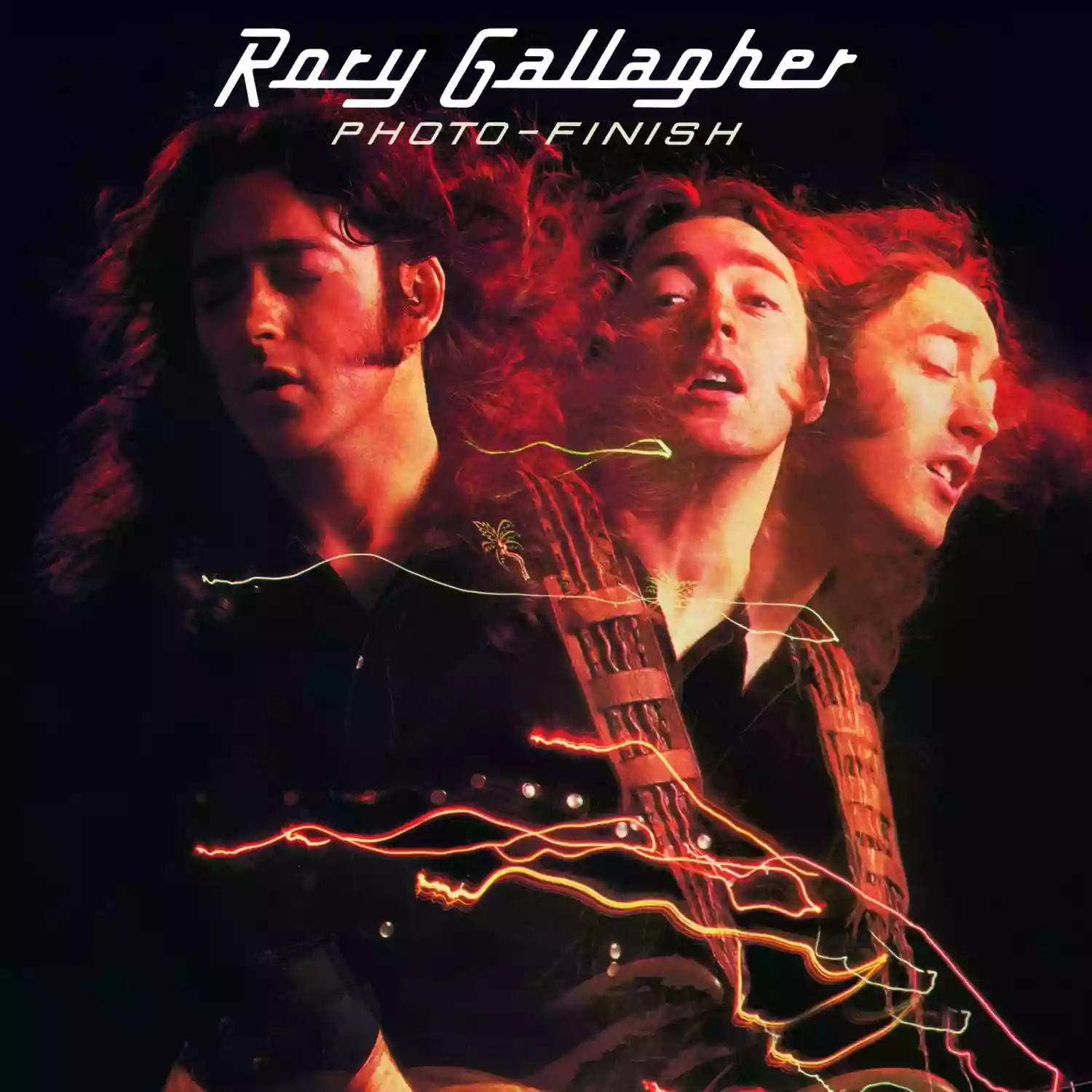
With this ensemble, born after the initial unsuccessful attempts in San Francisco with a subsequent shift of production to Germany, the good Rory records between the end of 1977 and the beginning of 1978 this album unequivocally named "Photo-Finish" due to it being completed literally in "Zona Cesarini" (in just about 11 hours), meaning just in time compared to the "deadline" set by his record company of the time, Chrysalis Records (now under the control of Warner Bros. Records, for the record).
Despite this "tour de force," the result is nonetheless an album that faithfully respects the "musical creed" of the Ballyshannon musician: that is, a sound predominantly based on Blues/Rock, enriched with elements of Rock 'N' Roll and Hard Rock (with a hint even of Southern Rock), intended to make it even more powerful and solid.
The first tangible proof of this is found in the opening "Shin Kicker," an anthem suitable for Bikers of all kinds, in which Rory, as usual, decidedly heats his Stratocaster six-string with a couple of blazing solos.
The following "Brute Force & Ignorance" is instead a massive Rock/Blues piece, whose lyrics were inspired by a Sex Pistols concert that Rory and his band attended in San Francisco, enriched by a mandolin background played by the same versatile musician for the occasion.
With "Cruise On Out," the direction shifts even to Rock 'N' Roll of Elvis Presley and the like, with the only difference being that here the rhythms are quite high, thanks also to the excellent rhythmic section offered by his McAvoy-McKenna, allowing the usual Rory to express himself once again very well.
"Cloak & Dagger," inspired by one of the many "B-movies" about detectives loved by Rory himself, is another robust Rock/Blues piece of excellent level.
In "Overnight Bag," another glimpse of Rory's solitary "on the road" life is provided with a melodic sound, but again very well-suited.
"Shadow Play" is instead one of Rory's live showpieces, where he showcases his "a bit of Jekyll, a bit of Mr. Hyde" identity, as a verse of the song itself states, offering a bright and incisive Hard Rock for about 5 and a half minutes in duration.
In "The Mississippi Sheiks," the flamboyant Irishman decides to pay homage to the eponymous famous Blues duo of Walter Vinson and Lonnie Chatmon, also implanting here a tough Rock/Blues sound with the "slide guitar" as the absolute protagonist, giving it tones tending towards the Southern Rock of ZZTop and company.
"Last Of The Independents" is another Hard Rock piece with quick and incisive Rock 'N' Roll accents, inspired by a crime story dear to the Irishman, but which can easily be referred also to Rory's attitude as "the last of the independents" of his musical generation.
The conclusion is entrusted to the wonderful Rock/Blues ballad "Fuel To The Fire" which in some parts, especially in the spectacular mid-track solo, could resemble any Hendrix with the way his guitar here wails and manages magnificently.
In the re-edited version of 2018, we finally have two more Bonus Tracks such as the fast Hard Rock of "Early Morning" and yet another Rock/Blues episode with Southern accents of "Jukebox Annie" which add nothing nor take anything away from an album that can rightfully be considered one of the best in the Rock domain of that period, without any dispute.
Loading comments slowly
Summary by Bot
Photo-Finish captures Rory Gallagher's intense Rock/Blues style in the late 1970s, blending blues, hard rock, and southern rock influences. Despite a rushed production, the album delivers powerful guitar solos, solid rhythms, and memorable tracks inspired by various cultural elements. The 2018 re-release added bonus tracks without diminishing the original's impact. Overall, it stands as one of the era's finest Rock albums.Tracklist Lyrics Videos
Rory Gallagher
Rory Gallagher (also known as William Rory Gallagher) was an Irish guitarist, singer-songwriter and multi-instrumentalist associated with blues-rock and hard rock. He played in the band Taste before launching a solo career in the early 1970s and became especially celebrated for powerful live performances and a stripped-down, effects-light electric guitar approach.16 Reviews
