
 •
Rating:
•
Rating:
THE REVIEW
Two bumbling criminals find themselves with a car broken down near a beach, one is in bad shape, having been shot in the stomach, a shot gone wrong.
The other leaves him in the car and on foot looks around for food, for a phone... not far away he spots a structure, a medieval castle. He will discover it is inhabited by a solitary couple who have withdrawn to those lands...
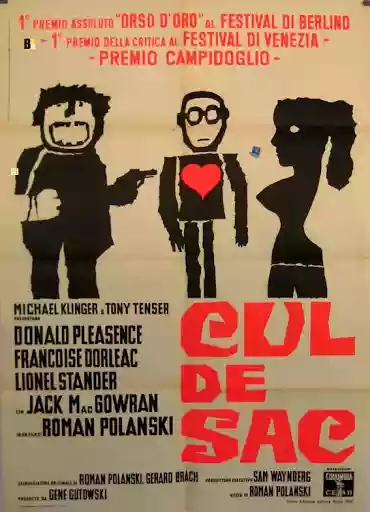
So begins, without a prelude, Cul de Sac. It’s a Polanski from '66, and it is an absolute masterpiece of cinema!
I watched it for the first time yesterday, I’m writing about it now, I'm dazed as I write, both because in the morning I'm not quite sharp, and because when you have to write a few words about such a work it’s never easy, but I’ve already embarked...
The subject is quite interesting but it's the development that leaves one astounded not so much for what happens but for...
It’s a grotesque and surreal film that constantly changes its register. The drama of the situation and the humor alternate, mix, and swap roles in a delirious waltz, where every sequence, every dialogue holds a surprise.
Shot in beautiful black and white and with a very evocative natural setting (the castle, the lagoon, the high tide) enchants, captivates, and fascinates in every frame, beautifully crafted in every single shot and superbly performed especially by Donald Pleasance and Lionel Stander, two giant actors.
Donald Pleasance is George, a timid little man, a doormat, worshiping the beautiful wife Teresa (Francoise Dorléac), exuberant and domineering.
The couple of neurotic bourgeois will have to face Dicky (Lionel Stander), a big and burly third-rate criminal, gruff, bad. A brute, a gorilla, even in appearance. An Alpha male against George the wuss, the lightbulb man.
It’s really useless to delve into the details of the dynamics of the improbable trio, I just know that my mouth dropped open almost immediately and only closed at the end credits.
Of course, it’s also a portrayal of relationships between men and women, chiseled on ancestral, primordial bases: "it's just a joke!" she says: "and these are blows!" says the ogre.
As I write, I glance online for information, details, and discover that there is much to say but it would be reiterating in my own words details and curiosities that are still within reach and then I don’t feel like it.
I haven’t seen all of Roman Polanski’s films but I know for sure that this is undoubtedly my favorite of his, I decided this yesterday while watching it and what do I read today online?
Here’s what:
In an old interview - dated 1969 - Polanski states that Cul de Sac is his best film, from a cinematic perspective. "If I were in search of cinema as Beckett is in search of theater, I would do nothing but make films like Cul de Sac. Unfortunately or perhaps fortunately, I love life and I love to have fun, I love making films."
No, but I don’t understand cinema!
Golden Bear in Berlin
Cul de Sac marks the debut of Blisset (not yet Jacqueline) in a small role.
But what is this nonsense that there are only 5 stars? A thousand stars!
Loading comments slowly
Summary by Bot
Roman Polanski's 1966 film Cul de Sac is hailed as a cinematic masterpiece mixing surrealism, drama, and humor. The black-and-white visuals and evocative setting enhance this unique portrayal of a bizarre trio's dynamics. Outstanding performances by Donald Pleasance and Lionel Stander add depth to this grotesque and captivating film, widely recognized as one of Polanski's best works.
Roman Polański
Roman Polański is a Polish film director and actor, internationally recognized for a body of work spanning psychological thrillers, dark comedies, and dramas, often marked by claustrophobic settings and intense character dynamics.16 Reviews
