
 •
Rating:
•
Rating:
THE REVIEW
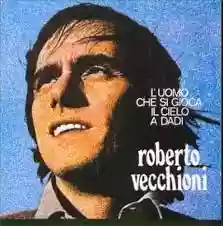
After two albums that marked his debut as a singer-songwriter, Roberto Vecchioni releases a "half anthology" of tracks from "Parabola" and "Saldi di fine stagione" with the addition of four tracks, on which I want to focus my attention. "L'uomo che si gioca il cielo a dadi" is the song that gives the title to the Long Playing, and was presented at the Sanremo Festival in 1973, achieving a good seventh place out of sixteen participants (the victory went to Peppino di Capri with "Un grande amore e niente più"). The track is well arranged between piano and strings and is dedicated to the songwriter's father. One can immediately find a point of contact with Antonello Venditti, who in the same year sang "Mio padre ha un buco in gola". The paternal figure thus serves as an inspiration for both the Roman and Brianzolo songwriters. Vecchioni's father was a gambler, particularly of cards and horses, and this is also recalled in other songs, such as "Per un vecchio bambino" of 1977, specifically dedicated to the parent in the year of his death. And in the 1973 song, reference is made not only to these two games but also to women and rhetorically to heaven, which the father would gamble with dice against God. The song is a declaration of paternal admiration, although they see little of each other, and the chorus says "papà, lasciamo tutto e andiamo via". "Sono solamente stanco da morire" was initially released along with the recently analyzed song as the B-side of the single. It is a song with a classic verse-chorus-verse-chorus structure where Vecchioni sings with a melancholic voice and in a complaining yet pleasant manner about the loss of a love: "perché io sto perdendo lei". So even the two cited tracks are not exactly "new", although published for the first time on LP. The third track is "Il fiume e il salice", also arranged with acoustic guitars and a female voice, where the Author demonstrates his skill with metaphorical writing, comparing the relationship between river and willow to the relationship between music and words. The song is in a broader sense a reflection on the craft of being a songwriter, which will recur in songs like "Vaudeville" from 1977. The last track is "La tua assenza", arranged in both piano and guitar by the excellent Sergio Parisini, who clearly oversaw the entire album. The lyrics seem to speak of the mother, and here too horses, dice, and the river return, representing thematic continuity. Furthermore, after the paternal figure, the maternal figure is also addressed.
The other tracks are, from "Parabola", the mythic "Luci a San Siro", "Io non devo andare in via Ferrante Aporti" and "Povero ragazzo", while from the songwriter's second effort, "Saldi di fine stagione", "Archeologia" and "Fratelli?" have been re-proposed, the first in a shorter version, the only track modified compared to the original.
Essentially we are at an initial Vecchioni, still tied to the traditional song form, with conventional structures and lengths, usually below five minutes and even below three, in two cases. The production is still by Renato Pareti, who appears as a co-writer of the songs, among other things.
In the following years, thanks first to the production of Michelangelo Romano (which lasted 15 years, up to "Milady" in 1989), then to the collaboration with arrangers such as the former Nuovi Angeli Pasquale "Paky" Canzi and especially Mauro Paoluzzi, Vecchioni's sound and voice would become more appealing, and the lengths would reach 8-9 minutes ("Il re non si diverte", "Pesci nelle orecchie", "L'ultimo spettacolo"), with structures that would also foresee three musical themes in one piece and hints, in the endings, of what was happening across the channel (the ending of "Per un vecchio bambino" has a faint Pink Floydian flavor).
We are still in a phase that deserves 3 stars, for a songwriter who is never trivial and never too commercial as R. V. is.
Loading comments slowly
Summary by Bot
This review analyzes Roberto Vecchioni's early album 'L'uomo che si gioca il cielo a dadi,' highlighting key tracks that revolve around family themes and classic songwriting structures. It sketches Vecchioni's beginnings as a traditional singer-songwriter and touches on his evolving production and style in later years. The album blends emotional depth with conventional song forms, earning a fair three-star rating.Tracklist Lyrics Videos
Roberto Vecchioni
Roberto Vecchioni is an Italian singer‑songwriter, lyricist, writer and academic from Carate Brianza. Active since the late 1960s, he’s known for literary, mythic and autobiographical songwriting. He won the Sanremo Music Festival in 2011 with “Chiamami ancora amore.”43 Reviews
