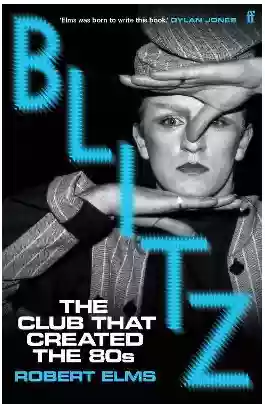

• Rating:
THE REVIEW
If you think you’re about to read an objective chronicle of a small scene that became briefly fashionable, you’ve picked the wrong book. This is an insanely self-aggrandising account written by a London-centric insider who never quite left the dancefloor - at least, not mentally.
Worse still, Robert Elms offers a perfectly sealed echo chamber of what were clearly his “glory days”. The result is that a brief moment in time - young people going out dancing in Soho dressed like peacocks on a budget - is inflated into an earth-shattering, era-defining, culture-shifting movement that apparently reshaped the future.
I could even forgive that kind of historical bloating. After all, the Blitz/New Romantic scene did have some limited, but real influence. What I could not forgive is the writing.
The pedestrian prose. The endless repetition. The laboured attempts at wit. And - capital sin - the holy trinity of lazy adjectives.
A few examples, for the record:
- Pedestrian prose
“Can you imagine the faces of the weary commuters on the Tube, only to see this rowdy gang of magnificent macaronis partying for all they were worth?”
Yes, I can. I can also imagine most of those commuters glancing briefly before returning to their reading or, more likely, their own business, because Londoners always had a high tolerance for people dressed like rejected extras from a futuristic operetta. What Elms offers is not observation but direction: a little film in which he and his friends are the show and the rest of the world obligingly gawks. - The council estate refrain
We are reminded - relentlessly - that Elms and his circle were council estate kids, skint, on the dole, living in squats, without a pot to piss in. And yet, miraculously, always impeccably styled, endlessly inventive, culturally ahead of their time, proto–gender fluid, anti-Thatcher (in retrospect, of course), and - why not - proto-influencers. One begins to suspect that hardship here functions less as context and more as branding. - Cringeworthy grandiosity
“1978 morphed angrily into 1979 – the infamous winter of our discontent” (apologies to Shakespeare).
“A generation of Londoners exhiled from their ancestral homeland” (we’re talking about Romford, not Mesopotamia).
“Extraordinary creatures” (one half expects unicorns).
And the unforgettable: “a weekly winner-takes-all BUNFIGHT of the vanities”—a phrase so overcooked it collapses under its own pretension. - The unholy trinity: ‘effortlessly’, ‘fiercely’, ‘vibrant’
“Effortlessly” is probably the most dishonest word in the English language - code for effort cleverly concealed.
“Fiercely” is added like pepper to rescue otherwise limp adjectives (most often “independent”, usually applied to women).
“Vibrant” means… something positive. Colourful? Energetic? Loud? Fashionable? Vivid? Feisty? Dynamic? All of the above and none in particular. A word that signals approval without committing to meaning.
The endless name-dropping, which inevitably comes with this territory (even if, most of it obscure to anyone not already inside the club) could perhaps be tolerated. But combined with the above, it turns the book into an exhausting exercise in self-mythologising.
Which is a pity. In the hands of a sharper, more detached observer, this could have been a witty, incisive 60-page essay about a scene where thirty people attended, five became famous, twenty-five wrote books about it, and a hundred more later claimed it defined an era.
Instead, we get 284 pages.
David Bowie - the idol of this crowd - once sang: “We live for just these twenty years / Do we have to die for the fifty more?”
Robert Elms’ answer is a resounding: NO - we can simply spend the next fifty years talking about the previous twenty.
At considerable length.
Loading comments slowly
Summary by Bot
The review harshly critiques Robert Elms' 'Blitz: the Club that Created the 80s' for its self-glorifying tone and lackluster writing. It accuses Elms of inflating a small scene into grand cultural importance. The reviewer is especially frustrated by repeated clichés, relentless self-mythologizing, and tedious prose. Missed potential is noted: the same material could have made a concise, witty essay. Instead, readers face 284 exhausting pages.
Robert Elms
Robert Elms is a British writer and broadcaster, longtime BBC Radio London presenter, and author connected to London’s Blitz/New Romantic milieu. His books include The Way We Wore and London Made Us.01 Reviews
