
 •
Versione 2
Rating:
•
Versione 2
Rating:
THE REVIEW
Robbie Basho lived with a ghost that wandered through his rooms almost every night. Like in a dark Japanese story with strong shades, you know?
We are at the end of the 17th century. 1694, to be precise. — I’m taking a bit of a detour, forgive me. North of Kyoto, along the bends of the ancient Lake Biwa, the greatest poet of the Tokugawa era, Matsuo Bashō, dies. Struck by sudden fevers, at the decline of a perpetual, restless wandering, he would have wanted to stain his last papers. Before dying, he dictated to one of the many disciples who now accompanied him, his final composition:
旅に病んで夢は枯野をかけ廻る
Sick on the journey / my dreams wander the desolate fields.
In Japan, at that time, the art of brevity had gradually been refined. Initially, the opening verses of longer compositions, renga, now poets mostly wrote compositions in the form of hokku, or haiku: seventeen, only seventeen, phonetic units. Translated into a European language, about ten words.
In that scarcity, entire endocosms. This same longing, but in music, can be found in Robbie Basho's primitivist fingerpicking.
But this is a story, above all, of nom de plume and symbols. In the same years of the 17th century when Matsuo Munefusa, the son of a landowner and minor samurai, was born, the then baron of Baltimore, in the county of Newfoundland, Lord Cecilius Calvert, founded what would later take the name of Baltimore, independent city of Maryland. Shortly thereafter, Matsuo Munefusa would take the name "Japanese banana" (芭蕉, bashō) due to a banana tree that grew next to his wooden hut. He wrote, in his hermitage:
芭蕉 野分 して盥に雨を聞く夜哉.
A banana tree in the storm / the dripping of water in the basin / marks my night.
1940, Baltimore, Maryland. One Bashō dies, another is made. Even in this case, Bashō was not a first name. He was called Daniel Robinson, and he was a rather peculiar character. The guy was out of his mind, I warn you. When, just eighteen, he retired to a mountain hermitage to take peyote, a lot of peyote, he convinced himself he was a reincarnation of Matsuo Bashō. He probably didn't even know what "bashō" meant. But this, little matters. For an American of that era, the Orient must have been something indistinct, only imagined, heard about, and invented. A New Age pot for the very first hippies. But Robbie Basho always remained on the fringes of this trend, a shy and symbolist musician. His music is the child of this modest approach to life. His imagination is made of A Thousand and One Nights, of angry falconer princes, of Hindu deities, of thanatologists, of zodiacs, of Chinese emperors, of American primitivism, of gold seekers, of poets high functionaries of the Great Khan, of mystic beggars, of dowsers, of more or less oriental music.
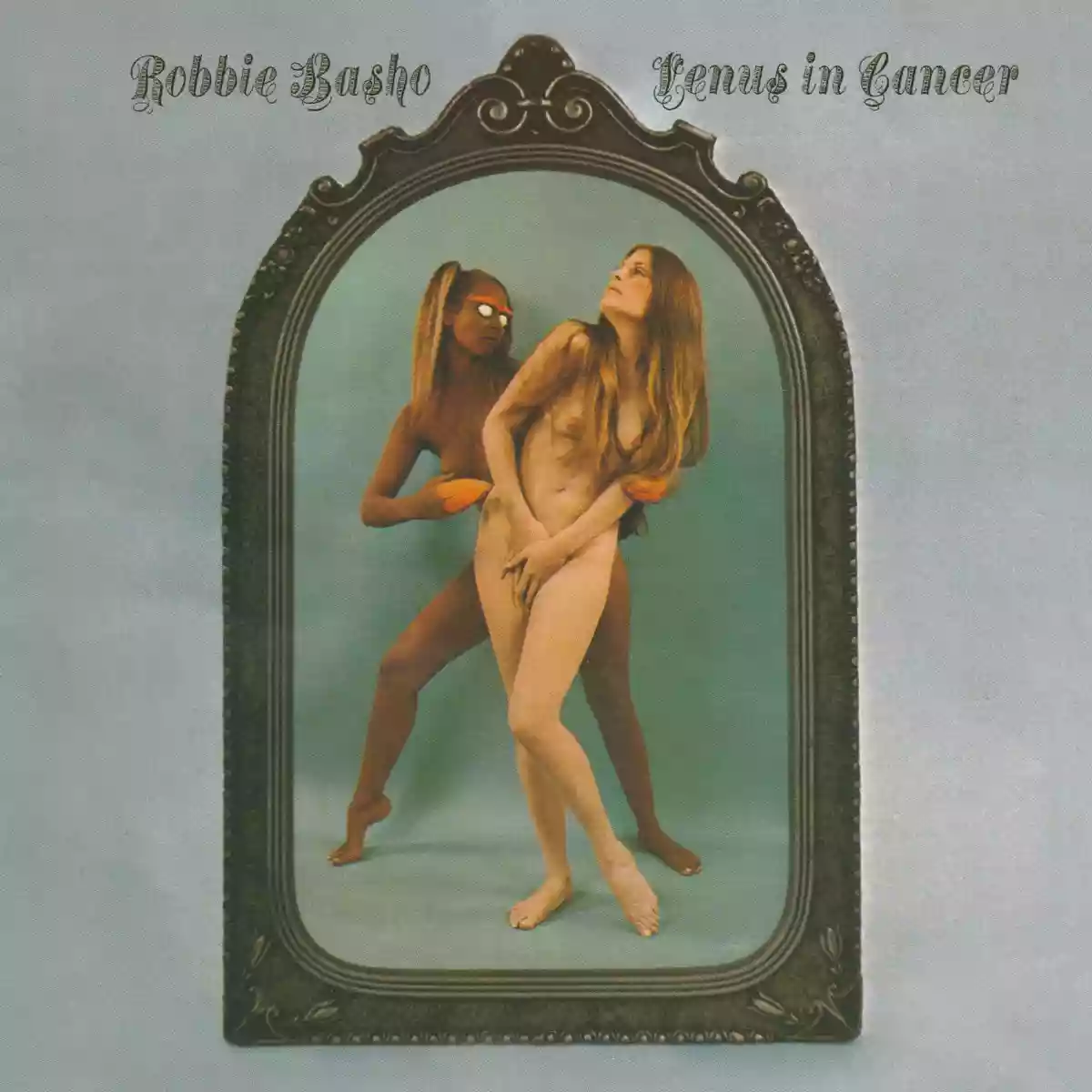
1969. On the cover of Venus in Cancer, a Botticellian Venus and an anthropomorphic crab dance still. Sarcasm and symbolism go hand in hand. Up to this moment, Basho has released a handful of records for Takoma, record label of John Fahey. But that is another story. Especially the last album of two years earlier, Falconer's Arm, is the accomplished expression of his peculiar Weltanschauung.
After such a short time, however, we find him changed, matured, reconciled. When Venus is in Cancer, sensitivity sharpens, sweetens, and takes on a certain air of depth. What the devil does that mean, then? For the eccentric hippie Robbie Basho, with a twelve-string guitar in one hand and a head full of clouds and fire, it must mean something.
In this album, his youthful ardor for primitivist minimalism, for the fancied echo of old blind bluesmen, for dusty 78s, for this remixing of horizons between Indian raga and finger-picked acoustic guitars, finds a cove where it flows less impetuously. It matures into suites so tempered, where the stasis of an intangible raga is poured out, sharpened in bursts of dissonance. And then there's his voice, his disorienting voice. Warbling and primitive.
Among cathedrals and cornflowers, stretched and faded love songs that are not of love and weaves and warps of symbols, in Venus in Cancer Basho has found the squaring of his circle. Between melody and dissonance, in precarious balance. A strange way, certainly, of doing minimalism with a colorful and so burdened imaginary on his shoulders, of Native Americans and Orients full of trinkets and fantastical worlds.
Loading comments slowly
Summary by Bot
The review delves into Robbie Basho’s album Venus in Cancer, framing it as a mature expression of his unique blend of primitivist acoustic guitar and mystical symbolism. Drawing parallels between Basho and the Japanese poet Matsuo Bashō, it highlights the album’s balance of melody and dissonance, its evocative imagery, and Basho’s distinctive voice. The review acknowledges the album’s depth while noting the artist’s eccentric approach and complex inspirations.Tracklist Videos
Robbie Basho
Robbie Basho (1940–1986) was an American guitarist and composer associated with primitivist fingerpicking and Takoma Records. He is known for blending country/folk elements with raga-influenced, experimental acoustic work and a distinctive baritone voice.02 Reviews
