
 •
Rating:
•
Rating:
THE REVIEW
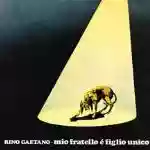
Two years after his first album, "Ingresso Libero," which went unnoticed, and just a year after his first success, "Ma il Cielo è Sempre Più Blu", one of his most famous songs, in 1976, the then twenty-six-year-old Rino Gaetano returns with one of his best albums, "Mio Fratello è Figlio Unico".
Rino Gaetano stands apart from the typical '70s singer-songwriters due to his particular style of writing simple and amusing lyrics (almost like nursery rhymes), yet at the same time biting and satirical, siding with the exploited and describing the many contradictions present in late '70s Italy, which unfortunately still exist (and may have even increased). For this reason, his songs remain very relevant, even after all these years.
The title track, a ballad with prominent piano and chorus, is one of the most beautiful songs Rino ever wrote. We will never know who this Mario is (also because Rino had no brothers), but he will become a symbol of social protest and Gaetano’s political soul ("mio fratello è figlio unico perché è convinto che esistono ancora gli sfruttati malpagati e frustrati"). Personally, I have a strong connection to this song because it was the one through which I discovered Rino Gaetano (more precisely, the beautiful cover by Afterhours). "Sviorivano le Viole" can be divided into two parts: the first delicate and romantic, and a more rhythmic one where the love described in the first part traverses history, among Marquis de Lafayette, Otto von Bismarck, Michele Novaro, and Mameli. Following it is a very cryptic song, verging on nonsensical, yet very entertaining: "Glu Glu". If anyone knows what the lyrics mean (a random part: "C'è un attimo però l'aereo per Francoforte/ non ho più preso il treno da quattro anni almeno"), please explain it to me.
Another romantic ballad is "Cogli la Mia Rosa d'Amore", which invites one to appreciate the happy moments in life, such as village festivals or summer, and to love one another. Another famous and ironic song is "Berta Filava", which talks about this girl, who spun the garment of the saint who was to be burned at the stake, but at the same time "filava con Mario/e filava con Gino/e nasceva il bambino che non era di Mario/che non era di Gino". Next is "Rosita", a sadder song where the Rosita Rino meets, to best understand the lyrics, is meant to be understood as "drugs" ("ieri ho incontrato Rosita perciò questa vita valore non ha"). An apparently cheerful song like "Al Compleanno della Zia Rosina" becomes an almost prophetic song, where Rino imagines his own death, "vedo già la mia salma portata a spalle da gente che bestemmia, che ce l'ha con me", which would happen five years later. It closes with a not-so-famous song "La zappa … il tridente il rastrello la forca l'aratro il falcetto il crivello la vanga" in which the ironic contrast between farm tools and wealthy bourgeois is sarcastically described "giovane e bello divo e poeta con un principio d'intossicazione aziendale". The album closes with a curious horoscope and the reprise of the chorus from "Rosita".
Who knows what else Gaetano could have contributed to Italian music if it hadn't been for that terrible accident. We miss you, Rino!
RATING = 8
Loading comments slowly
Summary by Bot
Rino Gaetano's 1976 album Mio Fratello È Figlio Unico stands out for its witty, satirical lyrics and social commentary. The reviewer highlights the enduring relevance of Gaetano’s work and praises key tracks such as the title song and 'Berta Filava.' The album mixes romantic ballads with biting social critiques, reflecting contradictions in 1970s Italy. This release remains a significant and beloved part of Italian musical heritage.Tracklist Lyrics Videos
Rino Gaetano
Rino Gaetano (Salvatore Antonio Gaetano) was an Italian singer-songwriter known for ironic, provocative songwriting that mixed catchy melodies with sharp social and political commentary. He rose to national popularity around the late 1970s, including a breakthrough at the Sanremo Festival with “Gianna,” and died in Rome in a road accident on June 2, 1981.14 Reviews
Other reviews
By maxgit
All the characters in this album somehow go 'against' the set tracks, against what one must or should do.
At the center of the album, in Cogli la Mia Rosa, all the love for this life is found, the necessity to live it and tell it.
