
 •
Rating:
•
Rating:
THE REVIEW
If it is true that one must say what one has to say, then they must say it quickly. So, just like in the previous "free entry," it was already mentioned in the first song - about the irreversible uselessness of time, and maybe not essentially you (but in the end, definitely you) - even here, everything is already present in the first song: not recognizing oneself in fashionable behaviors and meanings, prefabricated for the 'consumption' of an unknowing society - and having no choice but to laugh at it, to destroy them all with a hearty laugh (even though it's a somewhat melancholic irony). All the characters in this album somehow go 'against' the set tracks, against what one must or should do, or what should be liked.
The unexpected alternative to the career-money-lover standard is the beautiful Rosita dressed in white, waiting for an adventure with her while revolutions are happening in the world; the protagonist of "Sfiorivano le Viole," Berta spins asbestos to save the saint from the stake, and she runs away with Mario and Gino (and keeps the child), the pitchfork mocks the vanity fair of human conceits, and in "Bella al Compleanno della Zia Rosina," Rino cannot decide to take the train and mix with others in the madness of an incomprehensible world, yet time passes, and Rita got married (how long did she have to wait, poor thing?) - in "Glu Glu Ri" he even laughs about suicide, oh yes.
The alternative of a real, authentic life could be love - but... this can also be a trap, an illusion. Perhaps this is the meaning of the mockery in mazurka form of the theme of the beautiful Rosina at the end, and what meaning should be given to the seductive bossa nova of "Sfiorivano le Viole"? Here too, as in the first album, returns the ambiguity of "let's admit a love, once only, that I don't want, that you want" which in the end more than seeking it, one surrenders to it.
But, right at the center of the album, in Cogli la Mia Rosa, all the love for this life is found, the necessity to live it and tell it, to discover its poetry and soul (ah, seeking the sooooul...) in authentic things and in simple people, which it seems to me, for Rino, is certainly not those who live in the city....
Loading comments slowly
Summary by Bot
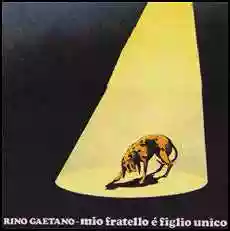
Rino Gaetano's album 'Mio Fratello E' Figlio Unico' uses irony and melancholic humor to critique social conventions and fashionable behaviors. The songs explore characters living authentically against societal expectations. Love is portrayed as both a potential escape and a trap. At its core, the album celebrates the poetry and soul found in simple, authentic life beyond the city. The work continues themes from his earlier album with thoughtful ambiguity and sharp social observation.Tracklist Lyrics Videos
Rino Gaetano
Rino Gaetano (Salvatore Antonio Gaetano) was an Italian singer-songwriter known for ironic, provocative songwriting that mixed catchy melodies with sharp social and political commentary. He rose to national popularity around the late 1970s, including a breakthrough at the Sanremo Festival with “Gianna,” and died in Rome in a road accident on June 2, 1981.14 Reviews
Other reviews
By stargazer
Rino Gaetano stands apart from the typical '70s singer-songwriters due to his particular style of writing simple and amusing lyrics, yet biting and satirical.
Who knows what else Gaetano could have contributed to Italian music if it hadn’t been for that terrible accident. We miss you, Rino!
