
 •
Rating:
•
Rating:
THE REVIEW
It's a rainy day in Budapest. I walk among the passersby with my music in my ears, as always, and a voice inside the headphones sings about the end of their love and certain nights and adventures on the road that will never return.
I know a lot of reviews about this album have already been written. What I wanted to leave was just my own idea. What you are about to listen to is nothing more than what has already filled my entire day. It's nothing but rain.
Rickie Lee Jones, nowadays (unfortunately) an unknown folk and jazz singer-songwriter from across the ocean, made her debut as a very young woman at the end of the Seventies with a multicolored and prematurely mature self-titled album, full of exotic nuances, blues, and pop capable of evoking the greatest American tradition of rock artists and more, beat poets, storytellers, hipster authors, and the so-called street artists. Besides being seductive with a unique voice, not particularly virtuosic but as soothing as few others in the light musical scene of the time, she is also the life partner of Tom Waits, a then less known bluesman with drunk bohemian traits and an inclination towards cabaret that would become a model in the late Eighties and achieve enormous critical and public success in the Nineties up to the present day. The fact is that their story serves as an artistic and worldly framework to portray an entire scene of post-everything artists, a nostalgic American imagery of bebop jazz and black blues, made of kerouac and bukowski, whiskey, and melancholy. Suddenly, their story ends, and with it seems to turn the page on this entire universe. From all this, it can be said that her second troubled work, jokingly called "Pirates," is born. Perhaps that’s how Waits and Jones liked to define themselves together.
For those who know our artist, "Pirates" confirms itself as the dark summa of all her work, her most obscure album and somehow also sweetly unbearable. But it's not a contradictory album as this confused description of the sensations arising from this work might suggest, but rather: except for some isolated, schizophrenic episodes, it's a monochromatic and anemic album, based on resigned blue notes, drawn-out and almost endless jazz melodies, the perfect nemesis of the sunny debut, an album for lost souls and girls in search of an identity. A deeply feminine album, based on feelings of love and oblivion, perhaps one of the most romantic works ever conceived, in the broadest sense of the word.
We Belong Together opens epically and desperately; it’s the first ode to Waits, and Rickie sobs almost drunkenly, rambles, does anything but sing. Her voice is annoying to the edge of hysterical whispering, mentioning places, metropolitan scenarios, raving and confessing her lost love, her renunciation of happiness, and that piano stabs and doesn’t seem to want to stop. Until the epic finale made of a jubilation of instruments that seem joyful and aware because now resigned to that end foreseen from the beginning.
Living it Up stands out as the gem of the album, sweet like a Joni Mitchell ballad from Court and Sparks, but colder and harrowing. Never had a chorus by Rickie been so melodic and enchanting at the same time (Oh Wild and the Only ones, Tell him where you are, Oh Wild and the Only ones, Tell him where you are, Tell him where you are) before turning into a slow distressing march and then winding back on itself, just as the best jazz-rock tradition knows how to do.
Only Pirates seems (apparently) like an enthusiastic and lively song with its fanfares hanging on to the memories of those nights losing oneself along the streets of a dirty, hipsters- and vagabonds-addicted America. While Lucky Guy drowns in exquisite arrangements, with a versatile voice capable of cajoling and declaring its discreet envy for a certain "luckier guy" of any "lonely girl" like her.
But the true climax of Pirates seems to be that Traces of Western Slopes approaching the end of this short, bizarre, and inconsistent rock opera. A waltz on the verge of psychic delirium, a continuous call and response between a man and a woman (besides Rickie, there is also a male voice surprisingly opening the piece), enveloped by the martial beats of a razor-sharp bass and the usual fatal piano by Jones, which also seem to wage war in this incredible melody too cumbersome to be constrained in just eight perfect minutes.
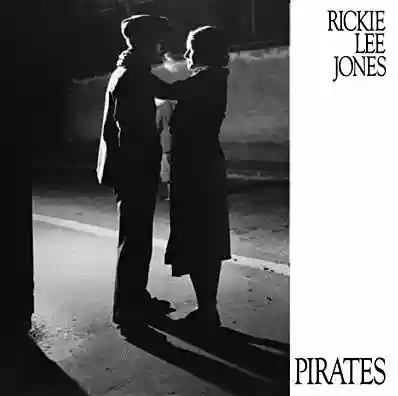
Only after listening to this album several times did I discover that the beautiful cover depicting a nighttime scene of an encounter between a man and a woman who don’t kiss but just touch each other’s face in a deserted street is the work of a famous Hungarian photographer dear to Henry Miller and the entire beat visual arts tradition and beyond, did I realize this album was exactly for me, for that moment of my life I was living in a year away from home, dangerously spent in Budapest. An album also made of contradictions, many layers, and furious or confused choruses, of joy and anger sung together with overflowing passion.
It is somehow still an album made of rain.
Loading comments slowly
Summary by Bot
Rickie Lee Jones’ album Pirates is a melancholic and deeply emotional jazz-folk work that contrasts with her debut. The album explores themes of love, loss, and identity through rich blue notes and jazzy melodies. Known for its introspective mood, Pirates reflects a bittersweet artistic collaboration with Tom Waits. The reviewer connects personally to the album, especially in moments of solitude and reflection. Despite some inconsistent moments, the album remains a poignant, romantic journey for devoted listeners.Tracklist Lyrics Videos
Rickie Lee Jones
American singer-songwriter born November 8, 1954 in Chicago. Broke through with her 1979 self-titled debut and the hit “Chuck E.’s in Love,” followed by the acclaimed Pirates (1981). Her work spans jazz, folk, rock and pop over a decades-long career.06 Reviews
Other reviews
By Socrates
"Pirates" is precisely about this: bohemian, wandering, Bukowskian life, or better yet, Waitsian.
Rickie Lee Jones is a class act artist, a model for a generation of singer-songwriters.
