
 •
Rating:
•
Rating:
THE REVIEW
Raised in the slums of Brooklyn (New York), Richard P. Havens began to make a name for himself on the street corners of the Big Apple singing doo-wop hit singles. At the beginning of the sixties, he was a regular visitor to that authentic talent factory that was Greenwich Village (Bob Dylan and Joan Baez... they might suffice), the driving force of American counter-culture, which would spark the demands for change from all young people around the world (rich and Western...).
The young African American managed to record two works between '64 and '66, thanks to which he was noticed and signed by MGM Records, which had just created Verve Forecast, a label dedicated exclusively to folk recordings.
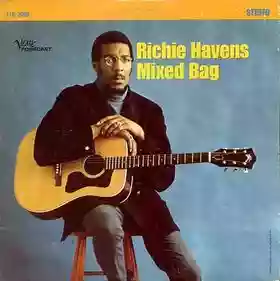
From this union, in 1967, "Mixed Bag" was released, still considered by many to be his best studio work, an incredibly intense and passionate album; where Havens surrounds his three original songs (a creative parsimony that he would carry throughout his career) with a series of very personal and heartfelt reinterpretations of songs (some famous, others a little less so), almost as if he wanted to internalize them, making them his own and returning them to us clothed in a new soul. In this sense, the concluding "Eleanor Rigby" is perfect, where the mood of the song remains almost identical, but the austere intransigence of the original Beatles version is softened by the faint piano threads that, together with a martial "jazzed" drum and a decisive bass, support Havens' deep and suffering voice, where the vigorous strum of his guitar fits perfectly. An alchemy that sublimates perfectly in the opener "High Flyin' Bird" by country singer Billy Ed Wheeler, where Havens' melancholically rocky voice proudly traverses four hundred years of African American slavery, overshadowing in pathos even the robust and austere atmosphere of the song. Tension, unease, and anger, but also joy and hope, enter and exit the voice of the "folk-crooner", wonderfully tailored according to the main themes of the songs, being strong and reassuring in the easy-listening interpretation of " I Can't Make It Anymore" by Gordon Lightfoot or warm and soft in "Morning, Morning" by the Fugs' Tuli Kupfenberg; while a smoky club tension emerges in songs like "Sandy" and "San Francisco Bay Blues".
But the best is yet to come. The fusion of psychedelia and folk implemented by Californian bands like Kaleidoscope and Country Joe & The Fish, in "Adam", lives with the same soul with Richie Havens trying to follow the same path but with the slightly irked pride of a New Yorker, who has the sky in slices between skyscrapers instead of the azure that sinks into the blue of the ocean with the green and orange of the orange hill backdrop as a soft home for West Coast lysergic experiments. "Follow" is a 100% Dylanian ballad, crafted for him by composition artisan Jerry Merrick, a sort of homage to Robert Zimmerman, which becomes a true tribute in the rigorous cover of "Just Like A Woman". "Three Day Eternity" by Jesse Fuller is the weakest track on the record, a sort of folk version of billionaire crooners from Las Vegas, only good for further showcasing Havens' versatile vocal adaptability while "Handsome Johnny" deserves a separate discussion. The pacifist ballad is the track that would kick off Woodstock Festival and propel Richie into a long and fruitful career, a song completely embedded in the era it was born, which fully expresses the peace and change demands that were yet to be shipwrecked and gives us that vibrant tension that flowed through the streets and veins of that lost paradise... and that I like to set exactly halfway between the prophetic seed of "The Times They Are A-Changin'" and the apocalyptic fruit of "Ohio".
Loading comments slowly
Summary by Bot
Richie Havens' 1967 album Mixed Bag is widely regarded as his best studio work. It showcases his ability to reinterpret folk and well-known songs with soulful passion and depth. The album blends folk, soul, and psychedelic elements, reflecting 1960s counter-culture themes. Notable tracks include his unique covers of "Eleanor Rigby" and the iconic peace anthem "Handsome Johnny." Mixed Bag captures the tension, hope, and social change spirit of its era.Tracklist Lyrics Videos
Richie Havens
Richie Havens (January 21, 1941 – April 22, 2013) was an American singer-guitarist from Brooklyn who emerged from the Greenwich Village folk scene. He opened Woodstock in 1969 with an extended set culminating in “Freedom,” became known for percussive open-tuned guitar and a warm, smoky voice, and recorded key albums for Verve Forecast.03 Reviews
