
 •
Rating:
•
Rating:
THE REVIEW
"Art should not be a pastime, but rather a calling."
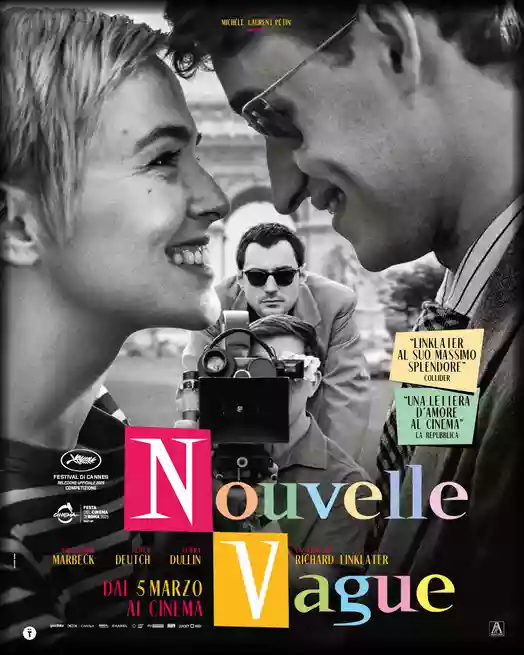
These words, spoken by Jean Cocteau congratulating Francois Truffaut after the screening of the film "Les Quatre Cents Coups" at the Cannes festival in 1959, serve as the best reminder offered by "Nouvelle vague," a film directed by American filmmaker Richard Linklater, an authentic devotee of innovative cinema-making in France at the turn of the 1950s and '60s. A historical moment long gone, but one that marked an indelible turning point in the art of cinema. In my opinion, however, Linklater’s film, which came out just a few days ago in Italy, bears a rather misleading title. Indeed, while masterfully recreating that period in which the journal "Cahiers du cinéma" expressed the need to revitalize the so-called "cinéma du papa" of the time, beginning with the reappraisal of American B-movies (especially noir), it then shifts focus to the determined efforts of Jean-Luc Godard to embark on a feature film. Already an attentive and caustic critic at the Cahiers, Godard feels compelled to follow his colleagues (Truffaut, Chabrol, Rohmer, Rivette, etc.), stepping behind the camera to perhaps create an even more experimental film. At this point, perhaps Linklater could have opted for a more targeted title like "Portrait of the Artist as a Beginner," but this is a minor quibble.
Godard’s fortune is to find a producer like Georges de Beauregard, somewhat reckless, who grants him confidence and a budget just enough to allow his debut: "A bout de souffle," a landmark work in cinema of the late twentieth century. Here, "Nouvelle vague" picks up a relentless rhythm, as Godard emerges as an unpredictable experimenter armed with a camera. Aware of the creative importance of a feature film (he had only a few shorts to his credit), Jean-Luc leads actors and actresses into an unprecedented adventure. Starting from a barebones script inspired by a recent crime involving a swindler, Godard turns everything upside down and favors street shooting. Drawing from the naturalist lesson of a master like Rossellini, he films life in real-time: the everyday chatter in Parisian bistros, existential and philosophical dialogues between the characters.
There is a great deal of improvisation in Godard’s method, and the personnel involved on set are left somewhat bewildered. But if Jean Paul Belmondo (here portrayed brilliantly by Aubry Dullin) adapts and has quite a lot of fun, the same cannot be said for the female lead, Jean Seberg (played by Zoey Deutch). Accustomed to the meticulous and obsessive work of a director like Otto Preminger, the American actress is often tempted to abandon the set, faced with someone like Godard who works only when inspiration strikes and where improvisation reigns supreme. Not to mention the producer de Beauregard’s concerns when, upon learning of Jean-Luc’s morning malaise, finds him as usual at the local bistro embroiled in an intense pinball match—an episode which is the basis of one of "Nouvelle vague’s" most entertaining sequences. But how? He claims to feel ill but apparently has enough energy to play instead of work?
In short, there is real danger that "A bout de souffle" might not be finished, but despite everything, after just 20 days the enterprise succeeds, and the film, after a frantic and nervous editing, hits theaters in 1960, marking a clear before and after in the art of cinema.
Needless to say, "Nouvelle vague," by recreating a distant chapter in film history, is solely a heartfelt celebration of those events. But it must be acknowledged for its meticulous and calligraphic work. Shot in black and white similar in technique to the period, acted with great care by actors and actresses closely resembling the originals (Guillame Marbeck is a sublime newcomer as Godard, though in reality Godard could be rather abrasive and irritating), Linklater’s film is a sincere homage to the golden era of so-called auteur cinema. The very same kind faithfully followed by an educated, discerning audience, regulars of art house cinemas where spirited debates inevitably followed the screening. Truly another era, and one has to wonder whether today that line about art spoken by Cocteau and recalled at the start of this review still holds any meaning for contemporary cinema.
What is certain is the uncanny effect that watching "Nouvelle vague" has had on me. A work that tells us of all that was lived and accomplished by people of culture, all now long gone. And perhaps, as I like to imagine, at this very moment up there Godard is still passionately arguing with Truffaut about the necessity of making films as experimental and as little commercial as possible...
Loading comments slowly
Summary by Bot
This review examines Richard Linklater's film 'Nouvelle vague', highlighting its artistic merit and cinematic qualities. The reviewer gives it a strong 4 out of 5 rating, commending its thoughtful execution. The review addresses the film's style and impact, situating it within Linklater's filmography. Overall, it's recommended for fans of artful cinema.
Richard Linklater
Richard Linklater is an American film director and screenwriter from Texas, known for conversational, time-spanning storytelling and formally inventive projects across drama, comedy, romance and animation.08 Reviews
