
 •
Versione 1
Rating:
•
Versione 1
Rating:
THE REVIEW
"A Bertonce', what are you writing?"
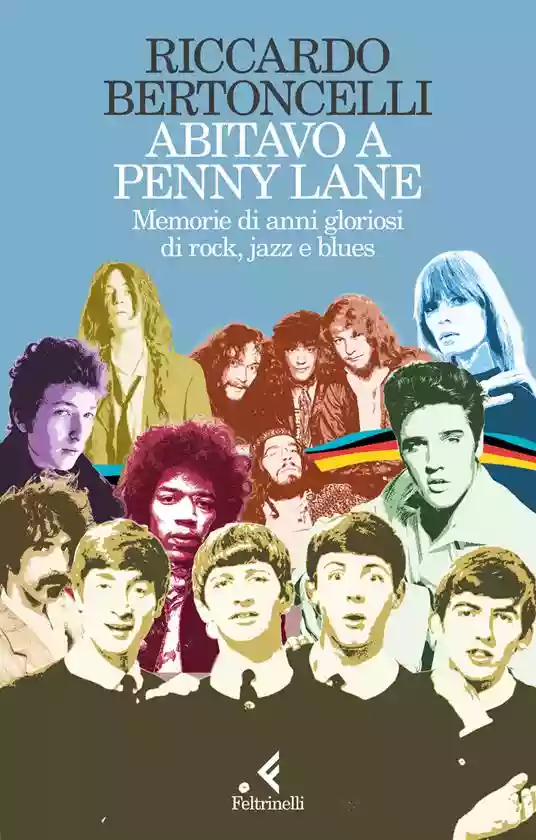
Perhaps Riccardo Bertoncelli has jokingly been asked this question more than once over his long career. But the fact remains that, even in the face of possible disagreements, what he wrote (together with other figures) on so-called "rock and its surroundings" was fundamental to bringing the Italian music criticism scene out of its provincialism. The book "Abitavo a Penny Lane" offers a collection of delightful episodes that pepper Bertoncelli’s professional growth up to 1980.
Born in Novara on March 21, 1952 (the very day a rock and roll concert was held in Cleveland presented by disc jockey Alan Freed), Bertoncelli grew up in a small provincial Italian town where musical stimuli were limited. And, indeed, it was not much different throughout Italy, where new musical languages like rock and roll arrived in a tamed version, à la Celentano, so to speak. Moving into the '60s, just introducing new authors from the Ligurian school (De André, Paoli, Tenco, Bindi, etc.), considered nonconformist compared to the mainstream, was already a big deal. In short, these were times when the question of the day could be, "Do you prefer Claudio Villa or Gianni Morandi?" while elsewhere in the West, names like the Beatles, Rolling Stones, Bob Dylan were already on the scene. Adding to that, in Italy the height of exoticism was to listen to beat groups performing Anglo-American songs poorly translated into Italian, giving a rather stale picture of the situation.
Tough times for many youths of those distant days, and young Bertoncelli too had to hustle to find copies of Anglo-American 45s and LPs, only available sporadically, especially in provincial cities like Novara (things might have been a bit better in big cities like Milan and Rome, though even there the Italian record market was nowhere near as well-stocked as in other European countries). In essence, the kind of music most suited for a young audience was surrounded by an almost “evil” aura, suitable only for those subversive long-haired youths. Adults (or, to use a word then in vogue, the so-called "matusa") had a very serious idea of music: the more pompous, the better. These aged adults would never have dreamed of attending concerts by strange groups with incredible names like Beatles, Rolling Stones, Who, Pink Floyd, etc., if only to avoid getting caught up in turbulent situations like the ill-fated Led Zeppelin concert in Milan in July 1971, marred by incidents and well described by Bertoncelli, who was present.
But, as a minstrel of those times would have sung, the times were changing, and even Riccardo Bertoncelli's tireless search for explosive vinyl would take him far. While certain TV shows (like "Bandiera gialla" and "Per voi giovani") were just starting to break through, Bertoncelli began writing about new music in what were then called "fanzines" mimeographed and distributed by eager friends (truly a different era!). The gospel was spreading also because youth pressure and hunger for "good vibrations" was now unstoppable and impetuous. Then came, in the '70s, real music magazines like "Muzak", "Gong", "Musica 80", founded and run by Bertoncelli and a group of peers, as well as the birth of a publishing house like "Arcana" with a vast catalogue of hefty essays on the rock phenomenon and other innovative sound languages.
Through all this, good old Bertoncelli stood out as a sharp analyst of youth music, endowed with a sparkling prose that sometimes led him into the occasional slip-up. And it wasn’t so much about his reservations regarding certain new trends like prog rock and glam rock, but rather his hard-hitting critiques of albums by otherwise respected authors and groups. He himself mentions this in "Abitavo a Penny Lane", citing his quarrel with Guccini, whose album "Stanze di vita quotidiana", filled with somewhat intimate and less engaged lyrics, he criticized. Guccini, in turn, replied in kind with the song "L'avvelenata", which became the basis for a strong friendship between the two (when two people, even in different roles, respect each other, anything is possible..). There was also a quarrel with the band Area, who in 1975 released an LP called "Crac" that Bertoncelli considered weaker than their earlier works. Of course, Demetrio Stratos and friends clarified their take in defense of the album, but without resentment. These were times, you might say, when music was made and listened to with the utmost attention.
But it is precisely in the final part of "Abitavo a Penny Lane" that the author recalls a notable blunder. At the end of 1980 he reviewed John Lennon’s last album, that "Double Fantasy" which he judged too flat, commercial, lacking creative spark. What did Lennon need to redeem himself from such creative torpor? Maybe a sudden cataclysm, a grave misfortune? This was the gist of Bertoncelli’s review, published just days before the fateful December 8, 1980, the day Lennon was killed by a madman. In the next issue of "Musica 80", Bertoncelli wrote a remembrance of the former Beatle, describing him as a kind of older brother who used to bring him something musically new in his youth. Later, their paths had drifted apart; Riccardo’s search for new musical vibes had taken him elsewhere. Yet, the unexpected news of John’s death should not be seen as a tombstone on the precious musical legacy of the English musician. The memory remains.
And for me, reading this book was like a journey back in time, to those years when, as a baby boomer, my approach to and listening to so much music (then called "alternative") was a means of emancipation and discovering new worlds. I can truly say those were unrepeatable years.
Loading comments slowly
Summary by Bot
This review praises Riccardo Bertoncelli's 'Abitavo a Penny Lane' as an essential read for music lovers. The book delves into music history and personal reflections, offering rich pop culture insights. The reviewer highlights Bertoncelli’s engaging storytelling. A top-rated recommendation.
Riccardo Bertoncelli
Riccardo Bertoncelli (born March 21, 1952, Novara) is an Italian music critic and author, among the key figures in bringing Italian rock journalism to maturity from the late 1960s onward. He wrote and edited for magazines such as Gong and Muzak and authored books including Abitavo a Penny Lane and Belin, Sei Sicuro? Storia e Canzoni di Fabrizio De André.02 Reviews
