
 •
Rating:
•
Rating:
THE REVIEW
A.D. 1991 The Slint delivered an epochal truth to rock: to create those expansive, shifting, almost impressionistic atmospheres, those in which eternity and even more so the non-time are sought, that music in which the illusory and fleeting thrill of the moment is banned in favor of the emotional impact evoked by a set of fluid images, by a musical flow that now returns to itself and now lives on subtle changes and not on the frenetic spasms of hard rock dynamism, in short, all that idea of music that we encompass in that ridiculous yet essential term called post-rock, it adopted as its distinctive feature, well, to create all this only a bass, a drum, and a guitar were enough.
Good job Talk Talk, eh, good job. You are among my favorite groups and I'm not going back on my word, but to bring to life that mystical, spiritual, jazzy asceticism of Laughing Stock, you employed seven violas, two cellos, two double basses, and a fair squad of winds. Well done Dirty Three, Ocean Songs is an album where I've lost neurons, but hell, you can't talk about Dirty Three without the first comment being "the violin! That damn violin!". Good too, the Goodspeed You! Black Emperor (whom I already like less but still, I like them), however, damn, there are eight of you and yet at times you do not avoid slipping into minutes of almost deadly boredom. And then oh, nothing to say about Sigur Ros, nothing to say about Radiohead.
They all look towards the same goal, in my opinion. To demonstrate that "rock" music can produce that music that doesn't seek the moment, but the continuum, and that paradoxically manages to live with more intensity when the piece has turned to its end because just a little while ago some images began to emerge in the listener, a bit disordered, some that are not understood. But how much effort you put into it. How exasperate your tracks... damn, Radiohead has created a monster with Kid A. A broad, boundless album, different from rock, certainly ethereal and impressionistic as I said above. But really it's not clear where Kid A wants to go, it's not clear if there's life behind those electronic oceans, behind those distant and distorted voices. Those on the Radiohead album seem like sketches of unfinished music; it's impossible that the songs were fine as they were. Music of great class and immense emotional depth, but Radiohead is missing. In the attempt to remove boundaries, they removed themselves. (In my mind this is very clear, I don't know how much I've made my thought accessible with these phrases)
Rock is a discipline that requires grace and sprezzatura. I can almost see Thom Yorke, presenting himself before the indisputable judgment of Music, all puffed up and conceited, offering her the first copy of Kid A...
And Music listens impassibly and rules: "A damn rock album! A damn rock album, and melodic to boot! With this face, you show up to me with this album? And where did Mozart, Ligeti, Stravinsky go? Light music! They make light music and act all high and mighty!". And the same goes for GY!BE, how they give it to themselves, the GY!BE.
Then oh, far be it from me to downsize a group I respect a lot like Radiohead. However, Mark Kozelek wouldn't do that.
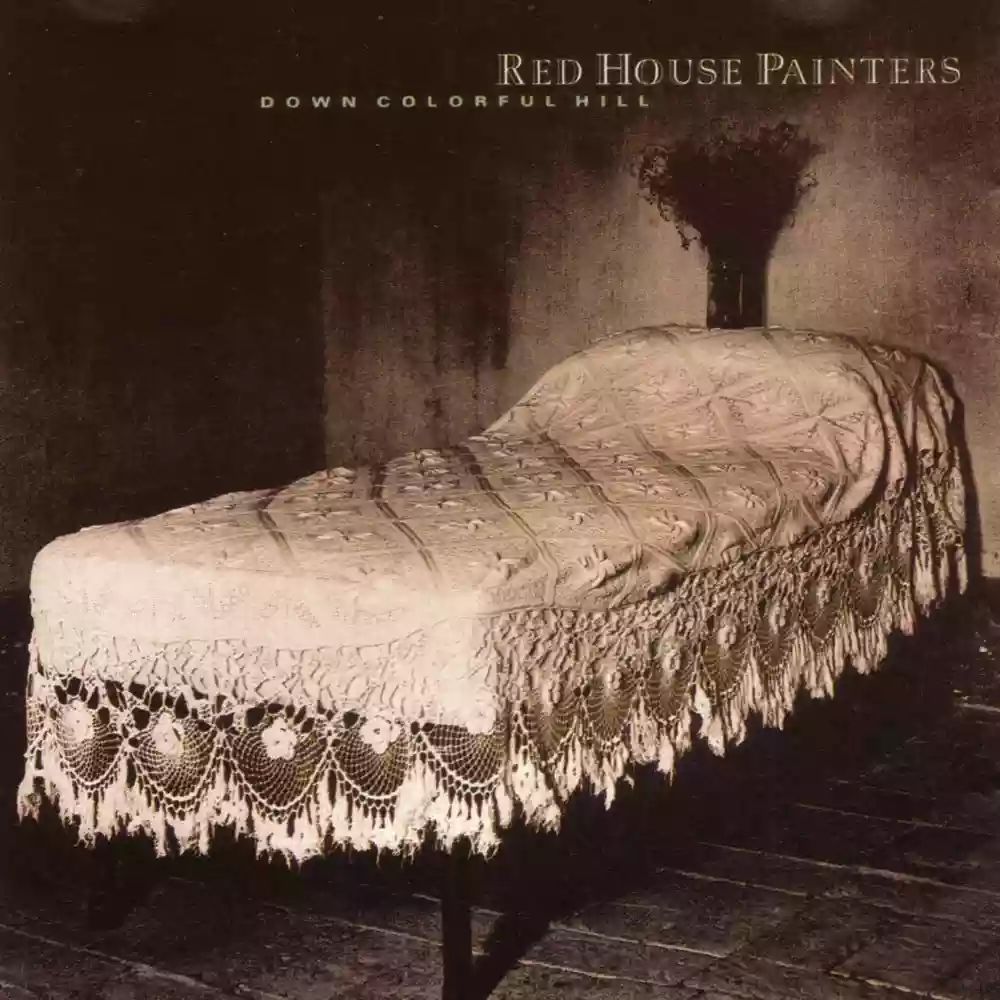
"I would have done this..." and he offers Music a copy of "Down Colorful Hill". As a Roman rapper would say (not the best, but MY Roman rapper) "it takes humility my friends. It takes humility and well-done music..." Down Colorful Hill represents this. And the album speaks for itself.
The debut of Red House Painters sacrifices nothing to be what it is. "24" lives so much that it daydreams of an old age that disrupts the plans of a youth that dreams of suicide and then flees astride an almost sly guitar during the last minute. Kozelek (we've heard it in every way) is present throughout this album, not hiding behind heaps of electronics: he's present as Nick Drake was, putting all his drama into theme.
Mark, however, makes it clear, I don't want to die without you. In "Medicine Bottle", it takes him five minutes to say it, after his stories about his romantic relationship with a certain Japanese woman found in the textures of Anthony Koutsos and Jerry Vessel, essential and yet so full (even in the silences, as in the best Slint and Codeine) one of the most unforgettable dresses of the '90s: one cannot avoid talking about the rhythm section of Medicine Bottle, how much it suffers and yet still believes in it, almost trying for redemption after those verses, helped by a guitar that distorts and tries to emerge, yet ultimately it is forced to succumb again and be reabsorbed into the "flow", which in fact, after the scarce ten minutes of the track, takes everything away.
In the eleven minutes of "Down Colorful Hill", this unity unravels. The drums develop an unwavering march, of an enthusiasm (?) that the downtrodden guitar and voice cannot follow. One of the most fluid tracks of the album, as it constantly returns to itself, like a stream of consciousness. "Japanese to English" opens a part of the album with slightly more articulated compositions, without for this fading the naked, heartbreaking essentiality. The second redemption of the album is here, still around 3/5 of the track, with a sudden ignition of guitar and bass rather melodic and almost pop, which is unforgettable. The penultimate song is "Lord Kill The Pain", a brilliant folk pursuit conceived deliberately in antithesis to the general mood of the album (to which, however, it returns in some passages, especially at the end, perhaps the most interesting moments of the album). The only track of the album that I find partially out of place, undoubtedly the one I find least interesting, even in its absolute dignity in terms of absolute value. "Michael" still speaks the language of folk, but dives into a very delicate, heartfelt epitaph to the lost friend, in the power of the innocence of those questions that even a child could ask: Michael, where are you?
After "Michael", the first album of Red House Painters ends, but it lives within the listener, still well beyond the last note.
Loading comments slowly
Summary by Bot
This review praises Red House Painters’ debut album Down Colorful Hill as a humble yet deeply emotional and timeless work. It contrasts the album’s minimalism and sincerity with other more elaborate post-rock efforts, highlighting Mark Kozelek’s presence and storytelling. The album's fluid musical flow and melancholic folk undertones resonate with authenticity. Despite some minor critiques, it is celebrated as an essential and impactful record that lives on beyond its runtime.Tracklist Lyrics Videos
Red House Painters
Red House Painters are an American slowcore band formed in San Francisco in 1988, led by singer-songwriter Mark Kozelek. They released acclaimed records on 4AD in the early 1990s, followed by the rock-leaning Songs for a Blue Guitar and the long-delayed Old Ramon (issued by Sub Pop in 2001). The group ceased activity by the early 2000s, after which Kozelek formed Sun Kil Moon.09 Reviews
Other reviews
By egebamyasi
Kozelek pours all his existential pain into his chords and lyrics.
One realizes what a masterpiece it is once its taste is fully savored.
By my bloody syndicate1
This album tells the story of a man irreparably scarred by drugs, loneliness, and depression—a man who cannot even scream, spit, or get angry.
Down Colorful Hill marks the stride of a new artistic dimension forgotten since the days of Nick Drake.
