
 •
Rating:
•
Rating: THE REVIEW
He’s back!
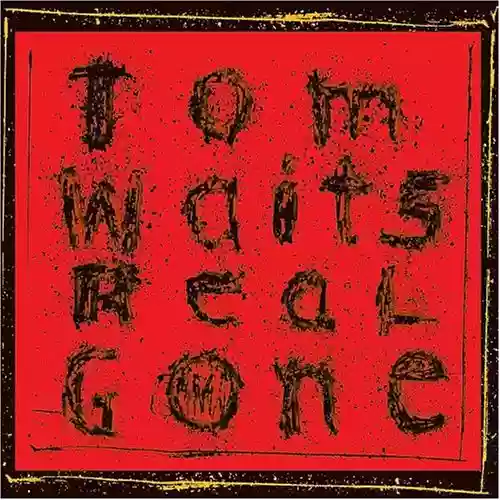
He’s back to tell us his lopsided and disoriented stories, which speak, as he himself said, of “mom, liquors, trains and death, politics, mice, war, hangings, dances, pirates, farms, sins.” He’s back with his and our fears translated into music. He’s back and he’s changed, even though he has the same spirit. He’s back and he has brought along some old and new friends to keep us company. He’s back, but he never really left, because his music has been with us every day of this damn life.
How much time has passed since the last time? Six years? It’s already been six years since “Mule Variations” and in this span of time, Tom Waits has released “only” two albums at once, which he had tucked away in some drawer for years: “Alice” and “Blood and Money.” So, yes, six years have passed and it has been a sweet wait, yet always filled with curiosity for this “Real Gone.” The rumors added to the impatience. It had been known for some time that Waits would be working, along with the faithful Marc Ribot, with Brian Mantia and Les Claypool of Primus; furthermore, the decisive and constant presence of his wife Kathleen Brennan was certain, and joined by that of his son, X Casey Waits.
The wait is over and here’s the trial by fire: the listening. A few notes were enough to convince me that it was worth the wait because Real Gone is a masterpiece. However, explaining briefly why is not easy, as there are countless points one could dwell on. First of all, there’s the noticeable absence of the piano, which Waits decided to omit in order to explore new paths. This fact is not all that surprising, given that throughout his long career (25 records since 1973), Waits has reinvented himself several times. The shift to Anti six years ago could have been another step in the evolutionary stage of Tom’s art, but, as beautiful as it was, “Mule Variations” was not an unusual and innovative album. But waiting pays off as I mentioned earlier, because “Real Gone” is a new beginning for the bard of Pomona. From the outset (“Top of the hill”) you realize the change.
His voice is still rough and grating, but the “cubist funk” rhythm is devastating, exhilarating, pulsing through the veins. It’s immediately clear that he wants to emphasize the rhythmic power of his voice. So, while listening, you get the impression of taking a journey in the boiler of a racing locomotive, of walking wearily in a moonless night, pitch-black along filthy and desolate streets, of swimming in an ocean of poison, being in a long, narrow corridor, full of curves and niches, from which occasionally pops out the sound of a music box, a banjo, or a noise like a gunshot that becomes rhythm, entering your blood, not leaving you for a moment. “Don’t go into the barn,” for example, is an unsettling voodoo dance, so captivating that you can’t think of not taking part in the ceremony. But there are also ballads tinged with that dirty and bitter melancholy that only he can deliver, “How’s it gonna end” for instance, and a little surprise like the ghost track "Chicka Boom". Marc Ribot’s guitar then, never before like in this case, seems to exist only for Waits’ voice.
I already know I will cradle it for years. I know I will listen to it until I make myself sick, until I reach exasperation. I will suck every note, every tiny fragment and detail, tearing myself apart, destroying myself as if savoring a sweet poison slowly. Because beauty must be lived to the spasm.
Yes, he’s back!
Loading comments slowly
Summary by Bot
Tom Waits returns with Real Gone, delivering a captivating and raw album that explores new sonic territories without his signature piano. The album blends dark, gritty storytelling with powerful rhythms, showcasing his unmistakable voice and collaborations with longtime allies like Marc Ribot. Praised as a masterpiece, it offers listeners an intense, immersive journey filled with melancholy, funk, and experimental sounds.Tracklist Lyrics Videos
Tom Waits
Thomas Alan Waits (born 1949) is an American singer-songwriter, composer and actor known for his gravelly voice and eclectic blending of blues, jazz, rock and experimental music.51 Reviews
Other reviews
By NickGhostDrake
"The fucking grooves man was the bard of the desperate, the clown of crowded streets, the theatrical poet."
"Real Gone is… the second album from which I suck the marrow without delay. And I devour it, in the usual frenzy of loves feared to end soon."
By vonhesse
Old Tom rolled up his sleeves and created from mud, sweat, and tears a record that will leave many followers behind.
"Real Gone" is a desperately 'blues' record in the most raw sense of the term and profoundly 'soul' in the true sense of the (black) soul.
By Testaverde
REAL GONE represents, however, yet another proof that Waits, when he wants to, knows how to make music.
Everything that the art of the note, since the time of the monks of the Middle Ages, has created and developed is found in that track.
