
 •
Rating:
•
Rating: THE REVIEW
1995: The Ramones release an album titled "Adios Amigos," the declared end of their musical journey, and for their subsequent farewell tour, they choose as a support band an emerging group that has as much to do with punk as a polar bear with the Sahara: it's Rammstein, who had just released their debut album, "Herzeleid," that year, the first step toward eternal glory for a band capable of surpassing all clichés, writing downright ingenious lyrics, and inventing a true genre (the Tanz Metall) only to disown it in their mature years. A passing of the baton that may seem at least bizarre but still symbolizes the succession of two equally indispensable musical realities, each for its own genre and era.
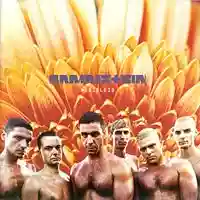
So, what is this object that afforded the newborn Steamroller such a great honor? "Herzeleid" is a very fluid, very cohesive, and very homogeneous album, a sort of rough diamond, the firstborn of a band not yet at the height of their potential. The key element of these primordial Rammstein is the groove, the unmistakable groove of Tanz Metall created by a continuous, meticulous guitar-keyboard work repeated in almost all the songs on the album. The result is a sound of great appeal and originality, where metal fits perfectly with almost '80s synth elements, thanks to Christian "Doktor Flake" Lorenz's keyboards. Just the first notes of the opener "Wollt Ihr Das Bett In Flammen Sehen," with its riff accompanied by an incessant bass line that repeats throughout the track, are enough to completely immerse oneself in these somewhat over-the-top atmospheres, which also return in songs like the beautiful "Der Meister," where the band adds a vaguely oriental melody to the cocktail, adding further charm to an already magical composition, or the pair "Weisses Fleisch"-"Asche Zu Asche," boisterous and defiant, yet with great class. The backbone, the mainstay of the album, is completed by three other great tracks: the single "Du Riechst So Gut," whose almost obsessive melody and catchy, somewhat perverse chorus can certainly not leave you indifferent, "Leichzeit," another textbook Tanz-Metall, and the ironic "Heirate Mich" (remarkable choirs on the chorus, which will be echoed ten years later in "Te Quiero Puta".)
The young Rammstein also experiment with variations on the theme, and this is where they show their limitations as a debut band, not always hitting the mark: for example, "Das Alte Lied," the slowest and most paced song on the album, a kind of grandmother to various "Dalai Lama" and "Spring," compared to which it shows less grit and taste for melody, thus resulting a bit flat and monotonous, as well as the title track "Herzeleid" which, except for the chorus and the use of the piano, turns out to be a rather poor and unconvincing performance, perhaps due to the stop-and-go nature of the riff and Till's vocals, which on this occasion do not fully show his extraordinary vocal expressiveness, a quality he instead demonstrates in one of the most beautiful and successful experiments on the album, Rammstein's first ballad, "Seemann," made extraordinary and unique in its genre precisely thanks to Till's melancholic singing, which becomes one with the delicate arpeggio that wanders uncertainly on itself before giving way to a powerful and irresistibly melodic riff in the chorus. "Seemann" represents the sweetest and, in a way, the most romantic facet of Rammstein, while the song that closes the album, "Rammstein," indeed showcases their darker, grim, and shocking side: a dark and insistent electronic beat that merges with an airplane propeller, then a slow, lingering, and threatening riff that stretches infinitely, with a somber Till chanting a macabre poem that fades without ever exploding, closing the album unexpectedly.
An album that finds its strength and weakness in its homogeneity. The creative vein is still to be perfected, but the class, creativity, and talent of this extraordinary band are already ready to explode and venture into new horizons.
"Rammstein, a dead child, Rammstein, smell of burnt flesh, Rammstein, the sun has gone out, Rammstein, a sea of flames, Rammstein, a bloodbath, Rammstein, drops of blood on the asphalt, Rammstein, no bird sang anymore... Rammstein, RAMMSTEIN."
Loading comments slowly
Summary by Bot
Rammstein's debut album Herzeleid introduces their innovative Tanz Metall sound, combining heavy metal with '80s synth. While some tracks show early-stage limitations, the album is cohesive and original. Key songs like 'Du Riechst So Gut' and 'Seemann' highlight the band's creativity and Till's expressive vocals. Herzeleid sets the foundation for Rammstein's future success.Tracklist Lyrics Videos
Rammstein
German music group formed in Berlin (1994), known for German-language industrial/Neue Deutsche Härte music and theatrical, pyrotechnic live shows.37 Reviews
Other reviews
By natopostumo
What this album unleashes goes beyond all these considerations. What these eleven tracks evoke is power, pure power.
The first three tracks immediately make it clear that you are facing a steamroller; monolithic riffs and the singing in German, which is more suited than ever for the music offered by Rammstein.
By DrMorte
'Herzeleid' is undoubtedly one of the best albums, just like 'Mutter'.
Without this link, the chain cannot be completed.
By MiseryMachine
Herzeleid sounds like an unstoppable machine, with guitars featuring deliberately repetitive and aseptic riffs.
Rammstein likes to showcase how far human depravity can go, a bit like Throbbing Gristle did, without any filter or beating around the bush.
