
 •
Rating:
•
Rating:
THE REVIEW
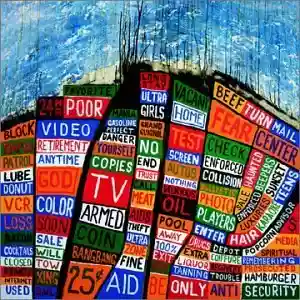
After the electronic experiments, the Dadaist texts, an album released with virtually no promotional effort ("Kid A"), and another considered by most to be little more than a collection of leftovers, Radiohead return home somewhat with "Hail To The Thief", their sixth studio album and, if I'm allowed to take a risk, their best.
Essentially, the album blends the psychedelic and expansive atmospheres of "OK Computer" with the less linear and more electronic ones of "Kid A", complete with loops, samples, and digital glitches, offering an elegant and decidedly evocative fusion of moods and sounds: we can thus admire tracks full of pathos like the opening "2+2=5", with a nervous guitar emphasizing the anguished emphasis of Thom Yorke's voice, submerged in the most surreal pathos until it explodes into a captivating hard rock ride that reminded me (and I say this at the risk of being lynched once again) of the wildest White Stripes.
This track could almost serve as a manifesto for the entire album, of its successful fusion of rock and electronics, while "Sit Down Stand Up" shuffles the deck, offering a tense and hallucinatory piano trip-hop, with lyrics painting disturbing scenes of power abuse (walk into the jaws of hell... we can wipe you out anytime
) as Thom Yorke's voice becomes increasingly delirious and the song reaches boiling point in a frantic finale with jungle overtones, with the voice repeating in a trance-like mannerthe raindrops, the raindrops
.
The rest of the album, after all, merely repeats this blueprint in various combinations, from the Pink Floydian ballad "Sail To The Moon", another high point of the album, to the menacing (and vaguely oriental) electronics of "The Gloaming", passing through the moving U2-like pathos (with a hint of The Cure and Talking Heads) of "Where I End And You Begin", one of the most beautiful songs on the album, with the curious electronic funk of "A Punchup At A Wedding" and the nervous burst of grunge anger of "Myxomatosis" complementing the rest.
The only episode in my opinion that is less convincing is "Scatterbrain", perhaps a bit bland and infused with deja vu, and the bizarre conclusion of "A Wolf At The Door", a sort of surreal rap-blues all in one breath (which may vaguely remind of R.E.M.'s "It's The End Of The World As We Know It (And I Feel Fine)").
The lyrics, then, deserve a chapter of their own, rich in allusions and allegories, surreal and poetic images, often with political and social implications (the album's title itself could be a nod to the protest slogan of anti-Bush activists after the alleged fraud that led to his victory in the 2000 elections) and never trivial, as is Yorke's well-established tradition.
After listening to this album over and over, I realize I'm faced with a complete work, rich in emotions, ideas, implications, and capable of provoking thoughts and reflections, thus entering the ranks of music that cannot be defined as "pop" because its primary purpose is not to entertain. Food for thought, and that's precisely what we all ask for from music, isn't it?
Loading comments slowly
Summary by Bot
Radiohead's sixth studio album, 'Hail To The Thief', combines the experimental electronics of 'Kid A' with the expansive rock of 'OK Computer'. The album features emotionally charged tracks with political and surreal lyrics. While most songs successfully blend genres, a few tracks feel less impactful. Overall, it's a complete and thought-provoking work that transcends simple pop entertainment.Tracklist Lyrics
02 Sit Down. Stand Up. (Snakes & Ladders.) (04:20)
03 Sail to the Moon. (Brush the Cobwebs Out of the Sky.) (04:18)
04 Backdrifts. (Honeymoon Is Over.) (05:22)
05 Go to Sleep. (Little Man Being Erased.) (03:21)
06 Where I End and You Begin. (The Sky Is Falling In.) (04:29)
07 We Suck Young Blood. (Your Time Is Up.) (04:56)
08 The Gloaming. (Softly Open Our Mouths in the Cold.) (03:32)
11 A Punchup at a Wedding. (No No No No No No No No.) (04:57)
12 Myxomatosis. (Judge, Jury & Executioner.) (03:52)
13 Scatterbrain. (As Dead as Leaves.) (03:21)
14 A Wolf at the Door. (It Girl. Rag Doll.) (03:21)
Radiohead
Radiohead are an English rock band formed in Abingdon, Oxfordshire. The members are Thom Yorke, Jonny Greenwood, Colin Greenwood, Ed O'Brien and Philip Selway. They evolved from guitar-based alternative rock into work that incorporates electronics and orchestration.120 Reviews
Other reviews
By 2+2=5
Have you ever woken up with the absolute conviction that you had a beautiful dream?
This is Music. ...don’t come to talk to me about intellectualism for its own sake or excessive experimentation, because the dream is mine.
By massimo1
The album seems simply FANTASTIC to me (perhaps because of the anticipation?)
To close, I would just like to emphasize how I liked this CD on the first listen, unlike the previous ones
By josi_
When I listen to 2+2=5 (The Lukewarm) I feel Radiohead’s hysteria rewritten in a way I couldn’t have imagined.
A Wolf At The Door ... the most beautiful song of the album, if not of their history, in my humble opinion.
By dado
"It's incredible how in a three-and-a-half-minute track like 2+2=5, the band manages to incorporate three radical tempo changes without clashing."
"The lyrics, even if incomprehensible in parts, show Thom’s talent as a writer, depicting a world that seems a symbiosis of our own and Orwellian dystopia."
By Blackdog
A meeting point between the anguished melody of 'Ok Computer' and the 'cryptic' experimentalism of 'Kid A'.
A resolute and utopian rebellion against the current state of affairs, against the mystification of reality operated by politicians and mass media.
