
 •
Rating:
•
Rating:
THE REVIEW
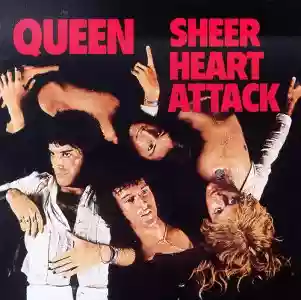
I loved Queen so much when I was 13-14 years old. And I loved this album so much, perhaps even more than the celebrated "A Night At The Opera" which made me dream and learn so much in my early adolescence. Then came the discovery of hip hop, great English pop, alternative rock, metal, psychedelia, and the great classics of post-war music, but that's another story. My first approach to music was at 8 years old with the Beatles: then, shortly after, came Queen.
"Sheer Heart Attack" was the last of the CDs I bought from their catalog in the years (1993/1994) when I listened EXCLUSIVELY to them, but for unknown reasons, it is also one of the few that has stayed in my heart, despite the discovery of "Monster" by R.E.M. completely redefined my musical growth and my way of understanding rock.
"Sheer Heart Attack" takes me back to my 14 years, entering high school, my first awkward attempts with girls, the first youthful identity crises. The November rain. It's an album I would only listen to now if it were raining, although I already know I'd have to turn off the stereo halfway. Too many memories of that kid I was and of whom I still have a certain nostalgia. And then I can't even listen to Queen now, I find them ridiculous and gaudy, despite Mercury. But the riff of "Brighton Rock" is always in my head when I improvise with the guitar, "Killer Queen" will always be a classic in my compilations to listen to in the car stereo, the arpeggio of "Tenement Funster" will almost always be the first thing I play as soon as I pick up the acoustic guitar, "Lily Of The Valley" is the piano ballad I wish I had written.
And then "Flick Of The Wrist" is one of those songs that seems to be familiar even if you've never heard it before: because if there's an example to best describe what rock'n'roll was in 1974 and what was happening in London in those years, nothing works better than "Sheer Heart Attack". The album is pervaded by a wrenching sense of decadence, bitter sarcasm, genius madness, and bursts of heat that lead to a heated erotic tension ("Now I'm Here", the ironic "Misfire").
The lyrics, for the first time in Queen's career, are "life-sized": beyond the exotic mercurial visions of never-ending wars, lilies of the valley, and the seven seas of Rhye, there are glimpses of suburban solitude (Roger Taylor's ghosts of the past), of whores and pimps (the latter most likely representing the Trident executives), of fragility and inner submission (Brian May's lament in the troubled "She Makes Me").
And then, so much glam: almost as if wanting to take up the baton from Bowie, who in the meantime had discovered America and white soul. Schizophrenic as only the '70s albums could be, the album ranges from the lyrical tragedy of "In The Lap Of The Gods" to the heavy metal rattling of "Stone Cold Crazy" (a true cornerstone of the genre) to culminate in the 1920s farce of "Bring Back That Leroy Brown".
The stunning, and venomous, ballad "In The Lap Of The Gods...Reprise" is abruptly interrupted by a thunderous bolt of lightning cast by Zeus, incinerating any sound to leave only silence and a sense of emptiness.
With that thunder, the humble and genuine Queen come to an end, who would become something else after the success of "Bohemian Rhapsody", an album rightfully considered the best of the royal quartet's vast discography ends, and I... stop listening to them and start growing up.
Loading comments slowly
Summary by Bot
The review fondly recalls the author’s teenage years with Queen's Sheer Heart Attack, highlighting its mix of glam rock, intense lyrics, and memorable riffs. Despite later musical explorations and changing tastes, the album remains cherished for its emotional resonance and raw energy. It reflects the spirit of 1970s London rock and marks a pivotal moment before Queen’s transformation with Bohemian Rhapsody.Tracklist Lyrics Videos
Queen
British rock band formed in London in 1970. Core classic lineup: Freddie Mercury (lead vocals), Brian May (guitar), Roger Taylor (drums) and John Deacon (bass). Known for genre-crossing albums and stadium anthems such as "Bohemian Rhapsody", and for legendary live performances (notably Live Aid 1985). Freddie Mercury died in 1991.143 Reviews
Other reviews
By Tony Montana
Queen decisively change direction with 'Sheer Heart Attack', laying the foundations of rock and the Queen style that would make the group famous worldwide!
Brian May’s solo prowess— in this case superb—offering a thrilling performance, where the Red Special seems to converse with itself.
By frank1979
This remains, in my opinion, the album marking the first real turning point for Queen towards the rock that would truly make them famous.
Sheer Heart Attack is characterized by very powerful and melodic Hard Rock tracks at the same time, allowing them to be classified as precursors of future Heavy Metal.
By Walterstarman1
"Sheer Heart Attack remains nevertheless a beautiful album that... relies on its 'team player,' that is 'Killer Queen' and its assist-man 'Now I'm Here.'"
"It's a somewhat controversial album... made of high peaks but hallucinating style slides."
By Workhorse
Live at the Rainbow ’74 is a powerful double album that collects two concerts by the early Queen at London’s Rainbow Theatre.
Fans of early Queen or seventies hard rock in general will find a treat for their ears.
