
 •
Rating:
•
Rating:
THE REVIEW
It is 1975, the Queen has been alive for five years, and it's time to record their fourth album. Their production, which began in 1973, has seen a worldwide successful single: "Killer Queen," and the pattern of their sound could be found mainly in the first two albums. It's worth noting that the first record ("Queen") is a tribute to the late "Led Zeppelin" with glam shades where the vocal power is expressed at the top, and Brian May's sharp riffs intertwine perfectly with Mr. Freddie Mercury's voice. It gets even better with "Queen II", where these characteristics emerged exponentially over the first album. As said before, the single "Killer Queen" led the album "Sheer Heart Attack" to worldwide success. With this album, Queen became known all over the world.
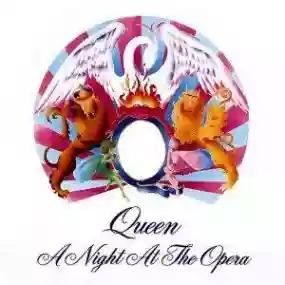
Soon, however, it was realized that the sound wasn't what was sought. Armed with this meditation, the production of their fourth album: "A Night At The Opera" was very long and highly sophisticated. In an interview, Roger Taylor (drummer) openly declares inspiration from past albums, such as those by the Beatles: "Rubber Soul," "Abbey Road," and from the desire to try to give a tone of a concept album to the work in progress. After all, the album is named in honor of a great Groucho film: it serves as the soundtrack for an evening of pure entertainment.
The album is colorful of many genres, ranging from Scott Joplin's Rag-Time style ("Seaside Rendezvous") to the most sophisticated jazz, from powerful hard rock to psychedelic oriental melodies, not to forget the first example of Rock Opera, which is the poignant "Bohemian Rhapsody".
Let's move to the Tracklist:
The album opens with "Death on Two Legs (Dedicated to....") written by Freddie Mercury. The story of this song is quite particular. I'll just say that after the worldwide success of "Killer Queen," the Queen were broke due to the poor management by their Manager. Immediately following his dismissal, Freddie composed this track between glam and hard rock and it's incredible how it is both very raw and ironic at the same time. The guitar riff was always thought to be by Brian May, but it was actually by Freddie, born on the piano and perfectly rendered with Brian May's Red Special. The delay effect on his guitar gives the piece an angry tone and classifies it as a hard-rock piece.
The second track, "Lazing on a Sunday Afternoon", is a very short composition of just a minute by Freddie Mercury. It tells how easy it is to do nothing on a Sunday afternoon. The summary of a stressful week ends with lazing on a Sunday afternoon. The style is pure '30s jazz, and the recording technique tried to bring it back to those "golden" years. If you listen closely to the voice, it sounds like it comes through a megaphone: two tin cans were used and placed in the headphone where the sound was "aged". Another tin can was placed in front of the studio microphone, and the singing went in step with the headphone sound. Both results ended in the console where they were mixed. When it came time to record the solo, due to the various vocal overlays of the piece, the tracks ran out, and the Great Brian thought of inserting his few seconds of solo into a vocal track, giving the impression of a voice that imitates the sound of the guitar. Brilliant!!!!!
The third track, "I'm in Love With My Car", written by Roger Taylor and sung by him, expresses his love for fast cars in a very rock way. The curious thing about this piece is that it is in 6/8 rhythmic time, which can approximately be seen as waltz time. The funny paradox is that such a soft and delicate style is paired with a very aggressive style.... If we also add Roger's voice, it all becomes even more paradoxical.... :)
In every Queen album, there's always a track that tries to break out from the sound's canons: I'm talking about "You're my Best Friend", written by John Deacon and released as a single. Still today, it is one of the most played Queen songs on American radios. I said it breaks out of the schemes, but partly... John Deacon (the shyest part of the group) is a fan of funk, and his tastes are not very rock, and his compositions reflect this, but this is precisely one of the many characteristics of Queen's sound. Writing with four different techniques that come together in a single Queen's sound. The peculiarity of this piece is the vocalizations that accompany Mercury's melody. Exercises in singing and pure technique overlays dominate this love song.
"'39" sung and written by Brian May, is a sort of sci-fi folk ballad. It tells of a space journey at the speed of light where the travelers return after a year and discover that 100 years have passed on Earth. The piece can be considered one of the most relaxing on the album, with unplugged tones, and a chorus where all three give a good demonstration of excellent singing. The most interesting part of the piece is a progressive high falsetto by Roger Taylor. It's a tour de force for him, producing notes above the average from his vocal cords... It's curious that this performance was reproduced for many years on tour without missing a beat or skipping a note. Listen to the song in "Live Killers".
In "Sweet Lady", written by Brian May, it presents as the only heavy metal piece on the album. Brian May confesses it talks about his difficult relationship with his woman at that time. Like the third track of the album, it is a 3/4 (waltz time), but this time it is in a heavy metal tone. It closely recalls Strauss waltzes, especially in the piece's characteristic riff and its solo, always in 3/4.
"Seaside Rendezvous", written by Freddie Mercury, is a brief Rag-time style piece in the manner of Scott Joplin. It is sharply cheerful, and the piano's difficulty is very high, signaling that Mercury was also a skilful pianist. The lyrics, only someone like Mercury could think of. It talks about his walks on the Rendezvous along the seafront. As always, the most interesting point in the piece's interlude is Freddie's vocal duet with Roger, where they imitate the trumpets and trombones of a jazz orchestra and do tap dancing with thimbles. It gives the impression that this band didn't take themselves too seriously.... :)
Returning from a trip to Japan to promote the album, Brian May was struck by the customs and musical culture of that country and wrote "The Prophet's Song." A special guest of the piece is a "toy" instrument originating from Japan called Toy Koto, which is a string instrument with a typical oriental sound and is tuned on Japanese scales. This particular instrument dominates the beginning and end of the piece. For a good eighty percent, the piece is of a psychedelic hard rock style, reminiscent of Pink Floyd's "Wish You Were Here". It's no coincidence the year is the same. The theme of the piece is an obsessive dream of Brian May; he himself remembers: - I was obsessed with this Prophet who spoke to the masses of hopes and better Worlds-. The most interesting part of the piece, besides the guitar solo, is the intermediate vocalizations that make the piece of long duration. Freddie Mercury was an expert in delayed singing. On a phrase he sang with echo, he was able to build another melody. It's thrilling when all three sing over Freddie Mercury's delays. After this explosive form of art, comes the solo that with great pomp dominates the piece, returning to the point of departure with the beautiful chorus and closes with the beautiful duet of guitar and Toy Koto by Brian. The duet concludes to give space to Freddie's piano, which opens the following poignant love aria.
Of all Queen's love ballads, the one that is certainly the best is "Love of My Life", written by Freddie Mercury and dedicated to his great love: Mary Austin, his life partner. The piece is very acoustic and opens with a piano and guitar duet to give three seconds to a harp played by Brian. This latter opens the love verse accompanied by vocalizations that seem like blooming flowers. The drums or more precisely the timpani erupt for a few seconds for the end of a progression that begins with piano first, guitar, bass, and finally Roger's good timpani. The nostalgic guitar of a lost love opens the final vocal call (...back, hurry back...) before the piano and harp finally close the piece.
It is said that Brian May learned the guitar starting with a Ukulele Banjo: George Formby, to move to the guitar at the age of seven. And it is precisely with this instrument that Brian writes "Good Company" in a jazz style. Brian has always been an admirer of a '20s jazz dixieland orchestra and it is from these musicians that he was inspired for the arrangements of the piece. The track talks about his childhood and how his father advised him to always find good company. The piece is sung by him, and returning to the arrangements, Brian performed a precise and very accurate work because to make the solo seem like a pure wind orchestra (trumpets, trombones, saxophones, clarinets...) every single note was detached and recorded to obtain a detached effect. This can be noticed better at the end on the "bell" effect. Even the final trill sounds like a real trumpet. It's hard to believe this was done by a guitarist, and Brian was certainly the first to create these effects.
Finally, we arrive at the true work of art of rock: the monumental "Bohemian Rhapsody" entirely written by Freddie and released as a single. It broke Paul Anka's record with his famous "Diana". As for the theme of the piece, it talks about a life consumed in murder and a boy saying goodbye to his mother before ending his days. Subsequently, in the text, old loves of Freddie from opera and Italian come into play; see: Mama Mia, Mama mia... and of a final hard rock explosion on the desire to react against the imposed system. Freddie's rebellion references to the criticisms of his homosexuality are clear. The piece closes with a reaction of indifference to everything surrounding the protagonist of the piece. The piece musically, is one of the most complex in the history of rock and, as mentioned earlier, represents the first example of rock opera. It begins with a doubled vocal quartet opening the piano riff of the piece to leave room immediately after to: Mama, just killed a man... For two verses, this theme holds sway, progressively exploding into a very nostalgic and poignant guitar solo. Orchestrally, the piece amazes when after a downbeat bang, the hardest part to describe and comment on begins. The fact is that the doubled quartet with sudden bursts of orchestra almost to frighten the listener leaves one speechless. Technically, it was sung on different tracks where Mercury's ghost track revealed very little of the piece's structure, the final result being that many variations of the piece were thought of and recorded just days before publication. The solo that concludes this operatic and lyrical part and gives strength and aggression to the piece gives a sense of retaliation and rebellion to everything previously said in the text. But indifference and the force of destiny bring the atmosphere to that piece that closes as it began with a famous phrase: Anyway the wind blows...
The album closes with a reinterpretation of the English Anthem "God Save The Queen", rearranged by Brian May and played with the delay effect of his Red Special accompanied by Roger Taylor's timpani. It wants to be a kind of farewell and a see you soon, as well as a blessing to the Queen of Music. They are the Queen.
The album is considered by many world charts as one of the greatest albums in rock history, and "Bohemian Rhapsody" as one of the most important and beautiful pieces in rock history. It represents the true masterpiece and turning point in Queen's career.
Loading comments slowly
Summary by Bot
This review covers Queen’s 1975 album A Night At The Opera, highlighting its sophisticated production and genre diversity. It details individual tracks and their unique styles, especially praising Bohemian Rhapsody as a groundbreaking rock opera. The album is celebrated as a major turning point in Queen's career and a masterpiece in rock history.Tracklist Lyrics Videos
Queen
British rock band formed in London in 1970. Core classic lineup: Freddie Mercury (lead vocals), Brian May (guitar), Roger Taylor (drums) and John Deacon (bass). Known for genre-crossing albums and stadium anthems such as "Bohemian Rhapsody", and for legendary live performances (notably Live Aid 1985). Freddie Mercury died in 1991.143 Reviews
Other reviews
By 2Torri
Upon the first listen, you will be completely captivated by the genius of these 4 people.
This album contains the most beautiful song a human being has ever created, I am referring to Bohemian Rhapsody.
By Torre Ste
There are no adjectives to describe the ultimate rock opera!
Bohemian Rhapsody? I can’t find other words to describe it, as to understand what is being talked about one must simply listen to it.
By PIXELID
Bohemian Rhapsody disrupts all known musical standards in no time and quickly reaches the top of almost every global chart.
When someone else makes a song that approaches the spectacularity of Bohemian Rhapsody, we can talk.
By Walterstarman1
"'A Night at the Opera' with 'Bohemian Rhapsody' is the explicit manifesto of how music escapes classifications."
"I thank God for appointing Freddie Mercury to give us the most beautiful song ever… Bohemian Rhapsody."
By piccolojedi1991
"'A Night at the Opera,' absolute masterpiece, an international monument to Glam Rock."
"We have listened to one of the best songs the human mind has ever written, perfect in every way... a unique and simply unforgettable experience."
