 •
Rating:
•
Rating:
THE REVIEW
The Fraternal Twin of “A Night at the Opera”? Just because it might once again take its title from a Marx Brothers' opera? Yes and no. It is indeed the fraternal twin, the one that turned out a bit less attractive, a bit shorter but still deriving from the same mother/source: the underlying idea of the previous album. However, the outcomes will be different.
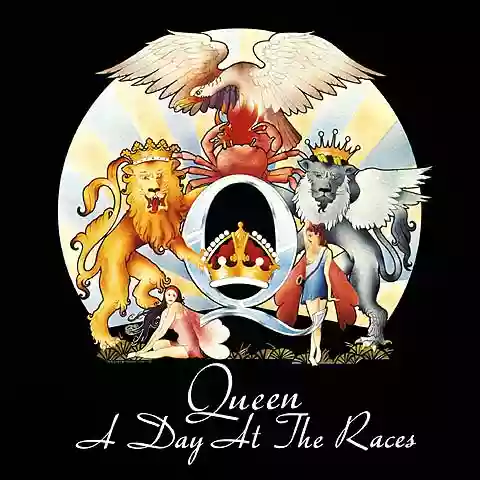
“A Day at the Races” (1976), a black cover this time to testify to the day/night and black/white dichotomy that so characterized Mercury/May in those years, opens in classic style of Her Majesty the Queen still in full grandeur.
1) “Tie Your Mother Down”, after a crash to Taylor's gong, kicks off a rock track deemed too hard for the Queen of the time, in Rolling Stones style. The approach with the audience was so great that it would be reproduced for all concerts to come. “Tie your mother, your father is obtuse, your brother a bother, let's run away together and give me all your love” writes May. Irony, rock, drive = winning formula.
2) “You Take My Breath Away.” A gorgeous all-voice and piano piece by Mercury that at first glance gives the impression of a sad text but is actually a romantic love song. The effect is very strange, the lyrics rather simple and direct but it is one of those “love at first listen” pieces.
3) “Long Away.” Again, a May who tackles, as in every album, the role of singer but perhaps finds his rightful vocal texture in this track where he doesn’t overdo it. The result is more than appreciable. The complexities, the baroque elements, and the mega-chorus that characterized the previous production seem to have ended, but instrumental and thematic simplicity prevails. Reflective and nostalgic.
4) “The Millionaire Waltz.” Here emerges the tradition that seemed put aside until now. Mercury blends waltz with rock with much dandy irony, yes, of a scion enjoying life earning loads and spending equally. You had to be really out of mind to propose a waltz in rock at the time. Mercury was this. No obstacles. This is Queen. Evergreen piece.
5) “You and I.” One of the more limited moments of “A Night at the Races.” Written by Deacon, it offers a fairly engaging rhythm but very lacking in inventiveness, technical, lyrical, and arrangement aspects. Clearly a cute but trivial piece that lowers the quality average of the album.
6) “Somebody to Love.” That Opera from the year before still lingers in the air, so not only the resumption of traditional music genres can be felt, it's breathed. A Freddie Mercury who almost matches, as a composer, the one of a year before with “Bohemian Rhapsody.” A voice without uncertainties, perfect from the lows to the highs to the falsettos. A work also of anthology, highly melodic slow rock built on a parade of choirs crafted with maximum care and imagination, capable of momentarily detaching from the principal melody and taking a solely vocal direction before closing in regal style. The symbolic piece of the album and one of the band’s flagship songs. It’s already History.
7) “White Man”. Anything but white! Brian May appears rather dark both in the strictly musical choices, which are quite anomalous in the melodic profile (considered the album's melodic standard), and lyrically. Indeed, the lyrics talk about the exploitation of Native Americans. Was it one of those moments when you read a book or an article, are impressed, and want to write a piece? It's unknown. Certainly, "White Man" is indefinable, it escapes but surely once again affirms the Queen voice that most reflects social and historical events.
8) “Good Old-Fashioned Lover Boy.” The melodic peak of the disk. A great Freddie Mercury, who, although presenting us a 50s style song far from those theatrical splendors of “A Night at the Opera,” proves to be very catchy, dreamy, and carefree. One of those tracks that puts you in a good mood especially in the sentimental realm. Nice arrangement, text valid for both grown-ups and the young where once again a dandy in Walter Pater or Oscar Wilde style “dines at the Ritz, offers wine, full of gallantry conquers his beloved.” It appears in almost all versions of the Greatest Hits. Bijou.
9) “Drowse.” Queen fans hate it. I was one of them too. Slow, lazy, and sleepy as the title, it puts an incredible lethargy on, but, it must be admitted, it also reflects a social snapshot in which we can identify: “I spent more hours in billiard halls than in school... those were the olden days... now it’s easier to sit in an armchair and dream.” Roger is less lively and artistic compared to Freddie but very nostalgic and metropolitan. It remains a barely sufficient track but certainly not to be trashed. It too is one of the weaker points of the album anyway.
10) “Teo Torriatte (Let Us Cling Together).” Ask in Japan about this piece. It is almost as famous as “Imagine.” Dedicated expressly to the oriental people who will go crazy for the English band, it beautifully closes the record. One of those pieces where you embrace and rediscover the sense of group or couple. A typical Queen text, certainly not innovative but dense with emotion. The gem of singing the refrain in Japanese is incredible, not to lose sight of considering Mercury's blatant idiosyncrasy for learning foreign languages. The closing reprises the initial motif of the album, thus cyclical.
“A Day at the Races” is a beautiful album, without a doubt, where the predominant element is the melody, capable of entering the heart of the musical populace with the same euphoria of the baroque elements of “A Night at the Opera.” Less multifaceted, less refined, less innovative than the previous one but surely an album that shines with its own light and not as a reflection of the preceding album, a melodically amber yellow light compared to that rainbow of “A Night at The Opera.”
Loading comments slowly
Summary by Bot
This review examines Queen's 1976 album A Day at the Races as a melodic and heartfelt follow-up to A Night at the Opera. The album is praised for its memorable songs like Somebody to Love and Good Old-Fashioned Lover Boy despite some weaker moments. It highlights the band’s blend of rock, irony, and emotional depth, showcasing Freddie Mercury's vocal range and Brian May's unique contributions. Overall, it's regarded as a beautiful, though less intricate, classic that holds its own light.
Queen
British rock band formed in London in 1970. Core classic lineup: Freddie Mercury (lead vocals), Brian May (guitar), Roger Taylor (drums) and John Deacon (bass). Known for genre-crossing albums and stadium anthems such as "Bohemian Rhapsody", and for legendary live performances (notably Live Aid 1985). Freddie Mercury died in 1991.143 Reviews
Other reviews
By poeta73
The music it contains is unassailable in terms of quality.
'Somebody to Love' needs no introduction...just one adjective: brilliant.
By dany87
The first track, Tie Your Mother Down, is the best hard rock track ever made by Queen.
Somebody to Love is Freddie’s latest vision, setting everything up as a game between his melodic line and the complex choral score.
By Silvaplana
"Without Queen, rock would not have known the best of itself."
"'Somebody To Love' represents a uniqueness never repeated in the world of rock and perhaps in the entire light music as well."
