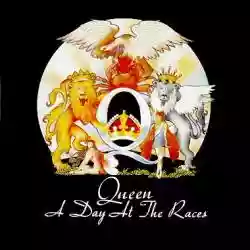

 •
Rating:
•
Rating:
THE REVIEW
I have never been a fan of light music and rock in particular. Its bare melodies, lacking flesh and blood (what's there to bite?!); with the drums doing the dirty work, like a street sweeper, to give sense to a melody that would have none on its own; that electric guitar that wouldn’t function without power plants because it lacks what gives meaning to an instrument, the soundbox! This guitar… that wouldn’t turn on without the electrical socket (basically an appliance! Hendrix is for me a housewife with a broom compared to Angel Romero playing on the acoustic the Largo from Bach’s “Concerto for Harpsichord in F minor BWV 1056”… but let’s be clear, the credit doesn’t go to Romero, but to that man from the 18th century who composed this Largo, which, adapted for guitar, is worth more than the sum of the riffs of rock music masterpieces!).
The Queen fall into these parvenus! They’re worth nothing, like all light music musicians. However, without comparisons to Classical music, the Queen have given us one or two ideas on where rock music could go. “Somebody To Love” and “Bohemian Rhapsody” are by far the most unexplored territories of light music. Let’s be clear! Without Queen, rock would not have known the best of itself. The works of so-called songwriters, progressive rock, and many others don't reach the melodic, harmonic, vocal, and arrangement level of those two Queen songs. Intelligence, delicacy, and curiosity are the ingredients to achieve this. And only Queen could dare so much: the way they balanced the drums and guitar didn’t set a trend, but it should have! It is rare to find such disciplined instruments in rock. Intelligent for sure as long as there was inspiration. But listen to me well: from the Queen, I save only the two aforementioned songs and also “My Melancholy Blues”, “Love Of My Life", “Killer Queen” and a few others. All of Mercury's songs. The rest I don’t even consider. But this is subjective. Anyway, reviewing “A Day At The Races” I will focus only on the song worth dealing with, leaving the others that fall into the norm to themselves, to bring some order to the way of seeing Queen and, by contrast, all the rest of modern music.
“Somebody To Love” represents a uniqueness never repeated in the world of rock and perhaps in the entire light music as well. This is also true for “Bohemian Rhapsody". This shows the uniqueness of the Queen, in the face of those who say they weren’t original. Their sound is unique, among the most unmistakable, both for the individual instruments (the drum is tuned to make it very recognizable - it has a smooth sound, the bass almost always classical, the guitar with a unique tone, the unique choirs), and for the arrangements. In this sense, “Somebody To Love” shows its novelty. Compared, a rock masterpiece like “Stairway To Heaven” is typical, making the Led Zeppelin traditionalists and certainly not different from the blues in vogue at the time. “Stairway To Heaven” has the typical guitar you would expect and the typical arrangements. But it is undoubtedly an incomparable classic; but what I mean is that “Stairway To Heaven” is traditionally “’70s rock”. This is not true for the Queen's masterpiece. Already the fact that it is a gospel in a rock version (with guitar and drums) is unimaginable for a Jimmy Page (perhaps only Brian Wilson could do as much). Now, we have the content of the shortcrust pastry pie obtained by mixing a jazz piano in a gospel way, a typical Deaconian bass that winks at Strauss (the Viennese!). Then the whipped cream is placed on top and here are the vocal harmonies of the three, which, given the tonal differences, mixed together, offer all three nuances that a good choral blend can have: May's warm and low voice, the warm, passionate, loving, and furthermore, the opposite, that is Mercury’s bright voice and Taylor's high falsetto.
In short, from the low (May) to the lowest possible (Taylor), with a warm and persuasive interlude (Mercury), which reconciles the extremes. Perfect! Never were such choirs so perfect in the world of rock (the Beach Boys could only perform a choir in multi-voiced falsetto, but always in falsetto with typical and monotonal lows… the Sardinians teach!). But the interesting point is not this. The fact is simple: how do they manage now to insert electric guitar and drums in this Viennese cake? Won't the rudeness of an appliance and a drum with cymbals ruin it all? No, if you’re the homosexual Freddie Mercury, instead of a Syd Barrett or a Bob Dylan (sorry, but I have to make fun of you… you fans of poets and “progressives”!). Obviously, a Mercury with the support of engineer Mike Stone (never forget the approach given by a sound technician, especially when talking about arrangements). But what a well-measured drum! Such délicatesse! Its tribal Africanism does not spoil at all this Viennese party that wriggles to rock (poor Mozart! Poor Classicism!). It is a vital, alert, fateful, wicked, and graceful drum that dances to a waltz. If I were sentimental, I’d call it “Sissi”. It's a banal drum, very banal!, typical, but for this reason perfectly right: it sacrifices, sacrifices its virtuosic presumption (we have an example of senseless hominid virtuosity in “Moby Dick” again by Led, the background of the Led!), to give all the stage space to the melody and its harmonics. Such a gentle drum, so benevolent, so shy (rare things in the noisy world of rock), that bends in front of such melodiousness, had never been seen. It, itself, accustomed to being mistreated, to being beaten even in a “Help!”-style Beatles, not to mention the thrash metal manner. It took that melancholic man, who sought inspiration from the past, whether it was the Vienna of other times or Jack's London, because on that island where he was born there was no room for the present (there the newspapers arrived with months of delay).
Let’s move to the guitar. It is absent until the verse “he works hard” and appears with four simple rhythmic notes reminiscent of a “I Want It All” fragment. Good! Very shy, it doesn’t show much… like its colleague. Drums and guitar are balanced with French refinement and the essentiality of Nouvelle Cuisine. And then? Here comes the solo! Does it really seem clownish Scaruffi? You're right! Indeed! But in a certain sense, it seems almost like an act of gratitude to rock, almost a desire not to exclude it at all costs, so that even the fans can not be too upset and say “ah, but this is rock!”. And since they are, the Queen offer, unknowingly, material for detractors who are fans of poets and progressive-scientist-experimenters (Robert Fripp composed in a white coat at CERN; and also the NEU!). After the solo, the guitar disappears backstage. Champagne and caviar for the after-show. And so the Queen emerge from this review truer, more for what they are than for what others think of them (I never expressed my personal taste in this writing). And justice is done (I am a proud guy and I defend my youth with teeth and nails!). But there is always to say that beyond tastes, beyond subjectivity, the war between Queen fans and lovers of poet-experimenters, like the famous challenge between classicists and avant-gardists, rock music in its multiplicity of genres shows so much lack, too much! If Dodecaphony at the beginning of the 20th century is the signal of a decline in music begun already with the Romanticism of the mid-19th century (Tchaikovsky and Verdi above all), Jazz and light music are their funeral march.
And yes unfortunately… “A Day At The Races” is nothing but the commendable gesture towards a past that, precisely because it disappeared leaving us its trail of fragrance, can only be contemplated with the nose, recalled with mannerism. The Queen, in their breathless manner, are just breathless, in the midst of a breathless mass. And let's not forget the most important thing: these Queen, these Bob Dylan, these De André, these Pink Floyd, these Zappa, these Vasco, are nothing but common men, who only make rock. Just rock! Is it worth intellectualizing light music? You figure it out! Anyway, this review gives a clear idea of what I think of you, zappians and dylanists and the like!
Loading comments slowly
Summary by Bot
This review offers a serious and nuanced critique of Queen's A Day At The Races album, emphasizing the band's unique contributions to rock through intelligent arrangements and exceptional vocal harmonies. While skeptical about the broader genre of light music and rock, the reviewer praises specific Mercury-led tracks as true masterpieces. The review contrasts Queen’s originality against other rock classics and highlights the delicate balance of instruments and production that make these songs stand out.
Queen
British rock band formed in London in 1970. Core classic lineup: Freddie Mercury (lead vocals), Brian May (guitar), Roger Taylor (drums) and John Deacon (bass). Known for genre-crossing albums and stadium anthems such as "Bohemian Rhapsody", and for legendary live performances (notably Live Aid 1985). Freddie Mercury died in 1991.143 Reviews
Other reviews
By poeta73
The music it contains is unassailable in terms of quality.
'Somebody to Love' needs no introduction...just one adjective: brilliant.
By Walterstarman1
"A Day at the Races is a beautiful album, without a doubt, where the predominant element is the melody."
"‘Somebody to Love’ is the symbolic piece of the album and one of the band’s flagship songs. It’s already History."
By dany87
The first track, Tie Your Mother Down, is the best hard rock track ever made by Queen.
Somebody to Love is Freddie’s latest vision, setting everything up as a game between his melodic line and the complex choral score.
