
 •
Rating:
•
Rating:
THE REVIEW
Florian Fricke (1944-2001) was a great artist demonstrating to “have the vision of things”: the German musician always had a great interest in religions and their healing and therapeutic power. Fricke studied sacred books, searching for the esoteric truths of all doctrines, reaching a sort of cultural syncretism. This philosophical and spiritual background translates into a mystical music conception: he wanted to create a state of catharsis with music, making inward what was outward.
This philosophy in the early albums of Popol Vuh materialized in long and monotonous electronic tracks aimed at infusing catharsis in the listener, connecting them with their own self. Surely there was a deep and non-superficial approach in the music, a thing not so common today.
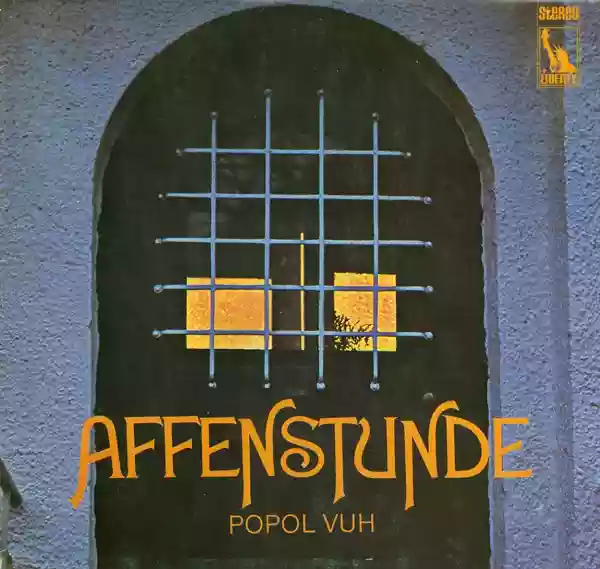
“Affenstunde” (“The Monkey’s Hour”) – released in 1970 by Liberty – is a “historic” record in the evolution of electronic music. It was the first album where the Moog synthesizer (specifically the Mood III Modular Synth) was used artistically and creatively (two years earlier, in 1968, Wendy Carlos used it in the famous “Switched On Bach” where she adapted the synthesizer to make some of J.S. Bach’s most famous arias "popular" for the general public).
With “Affenstunde”, Popol Vuh placed themselves among the prominent figures of the European avant-garde and the emerging German Kosmische Musik alongside various artists like Klaus Schulze, Tangerine Dream (a group with whom Fricke collaborated on the milestone “Zeit” playing the Moog in “Birth Of Liquid Plejades”), Ash Ra Tempel, Mythos, and Limbus. However, the originality of the project and its spiritual inclination compared to their colleagues is evident. The album is structured in two long electronic compositions: “Ich Mache Einen Spiegel” and “Affenstunde”.
The first track is divided into three sections, probably extracts from a long improvisation session. In “Dream Part 4” we hear experimental electronic effects and drone music, while the following “Dream Part 5” is characterized by the effective use of percussion by Holger Trulzsch, with Frank Fiedler (on synth) one of the other members of Popol Vuh. “Dream Part 49” is instead quiet and Cosmic, transporting the mind to remote Tibetan monasteries. The title track “Affenstunde” begins again with tribal percussion and electronic effects until otherworldly voices make way for Florian Fricke’s Moog: at this point, the Veil of Maya unfolds before the listener, showing reality in its essence, liberating your personal demons and putting you in relation with your personal God.
We are in the realms of pure electronic mysticism that surpasses all subsequent new age and anticipates influential ambient musicians like Steve Roach. The intensity and transcendence of this music have probably not been reached by anyone since. The subsequent “In Den Garten Pharaos” (1971) will be another great mystical and esoteric classic that will confirm Florian Fricke's genius. However, the timeless charm of “Affenstunde” – unjustly considered by some an immature album – remains unchanged. It is a raw diamond that continues to emit its transcendent light even today. An album for visionaries and Cosmic travellers.
After “In Den Garten Pharaos”, Florian Fricke underwent a deep spiritual crisis that led him to literally hate electronic music. He thus sold his Moog to Klaus Schulze and shifted his interest toward the pristine purity of acoustic instruments. This new phase culminated in the epoch-making masterpiece of “Hosianna Mantra” (1972). The career of the mystical caravan of Popol Vuh continued to produce masterpieces until “Einsjager und Siebenjager” (1974). Then there was a slight decline, but the quality of their music remained in any case (as in “Nosferatu” – 1979 – and “Die Nacht Der Seele” – 1979 –) always at excellent levels.
Loading comments slowly
Summary by Bot
Popol Vuh's 1970 album Affenstunde is a groundbreaking work in electronic and mystical music, notable for its pioneering use of the Moog synthesizer. Florian Fricke's spiritual and philosophical vision is deeply embedded in its hypnotic and cathartic compositions. The album secured Popol Vuh's place among the key figures of the German Kosmische Musik scene and influenced ambient musicians that followed. Though sometimes viewed as immature, Affenstunde remains a transcendent work for open-minded listeners. Fricke later shifted from electronic music to acoustic instruments, further evolving Popol Vuh's mystical sound.Tracklist
Popol Vuh
Popol Vuh was a German music group led by Florian Fricke, formed around 1969. The group is known for early electronic work and later acoustic, spiritual compositions and several acclaimed film soundtracks for Werner Herzog. Florian Fricke died in 2001.31 Reviews
