
 •
Rating:
•
Rating:
THE REVIEW
The Simpsons have always been a great source of inspiration for me...
Recently, I've pleasantly discovered that Otto's favorite band (the metalhead school bus driver) is the now forgotten Poison, who were called to play at his wedding and caused the tragic end of the marriage itself with the groom escaping on the party-decorated bus, alongside his beloved band, while the notes of "Nothin’ But A Good Time" played.
Well... That episode was a revelation.
Why not share the memory of the legendary Poison with the DeUsers?
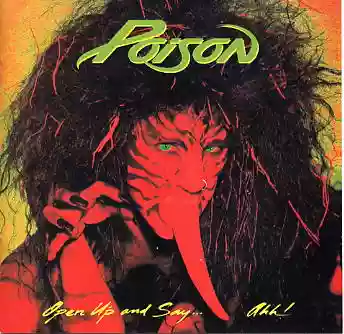
Why not annoy the DeUsers with the review of "Open Up And Say... Ahh!" (which was also missing from the DeArchive)???
Why not make all those who think "if you can't understand an album only by the three hundred and fortieth listen, it's not good music" cringe?????
Why, you may ask (even though most of you have probably already told me to bugger off and have changed the review)?
Well... Simply because I used to really like Poison, quite a lot actually. With sadistic pleasure and a smirk under my mustache, I got busy looking for my old and dusty cassette, and here I am.
Well... Poison belongs to that successful trend of the eighties known as Glam Metal-Rock (but also Glam Hard Rock, Pop Metal, Party Metal, and "We Do Naughty Stuff with Our Drunk Girlfriends Metal"), and more precisely to the second wave (1986-90) of Glam Metal, the more melodic and "mainstream" one that stood out from the first, more aggressive and "horrifying" one (Twisted Sister, W. A. S. P. etc...), for its romantic and often tear-jerking atmospheres and for the fun-loving and amused attitude of most of the tracks.
In short... music for partying (and to appeal to the young girls)!
At that time... Poison can undoubtedly be considered the most popular representatives of Glam from those years. Hair styles that would make Platinette envious and wax museum makeup were paired with pants so tight they compromised anyone's fertility. These were Poison. As excessive and ridiculous aesthetically as they were charming and simple musically.
Born in 1983 in Harrisburg, Pennsylvania, they quickly understood that for sexual satisfaction and commercial success, the promised land at that time was California. They packed their bags and set off for the land "of the sun" and, mindful of the teachings of various Kiss, David Bowie, Motley Crue, AC/DC, Aerosmith, Led Zeppelin, Alice Cooper, Van Halen, and so on (in short, practically everyone), they began composing and performing. If anything could be said about eighties Glam Metal, it is that it sold like hotcakes, or even more. Bands like the aforementioned Motley Crue, along with Cinderella, Bon Jovi, and many others had an appeal on the youth (especially young Americans) that influenced the entire American music market. Whether it was the allure of the typically eighties forbidden and excess, or a continuous and obsessive search for the best combination between Sex (a lot), Drugs (and sex) and Rock'n'Roll (and sex), the record companies were enjoying the substantial profits young people (and especially young women) were pouring into their coffers, deliberately ignoring those who tried to make music a bit more "serious" (even in the Metal field, see Thrash, Death, etc.).
During that period, Poison did nothing but make "the right album at the right time". Brazen and glossy, excessive and hyper-melodic, fun and party-like with that touch of polite "romanticism" that would bring out the usual tear from the young and excited fan ("Every Rose Has Its Thorn"). After making a name with the previous rocking "Look What The Cat Dragged In" (1986), they exploded definitively in the hearts of American teenagers (and beyond) with this "Open Up And Say... Ahh!" unanimously recognized as their best work.
Associated with other bands of the genre for their manifest carefree spirit, light musical joy, and exaggerated aesthetic extremism, they stood out from other Glamsters (neologism?) for two fundamental aspects:
1) They were one of the very few bands not to take themselves too seriously and to adopt a blatant parody attitude towards the imposed style elements of the genre (hair, costumes, etc.), as could be noted from their hilarious videos (unlike, for example, Motley Crue and Bon Jovi who sincerely believed themselves to be the God-symbols of universal music and sole bearers of the "sonic Word").
2) Musically, they were much more elaborate and "derived" than others, managing to create songs where the elaborated was not synonymous with variety but with sonic dynamism never stale or immobile on certain aspects; rather, spontaneously "multicolored" or "multiform" while always maintaining an immediacy and accessibility envied by much Pop of those years.
It is no coincidence I used the adjective "derived"... Personally, I consider Poison as a band that, anchoring to their own musical tastes and idols, managed to propose deliberately referential pieces that walked a fine line between the original elaboration of numerous influences (on the verge of Crossover, but perhaps I'm too high) and the sly copying. Nevertheless, tracks like the "party-oriented" "Love On The Rocks", "Nothin’ But A Good Time", and "Back To The Rocking Horse" (true Party Rock songs with a slight AC/DC-ish flavor) manage to be engaging and enthralling just right. Also noteworthy is the Aerosmith-like "Good Love" with its playful and lively rhythm; the solid and "heavy" "Tearin' Down The Walls" and "Bad To Be Good" adorned by Bret Michaels' tense voice (a real sex symbol of the time); the naughty and manic "Look But You Can't Touch" (the title says it all); the beautiful "Fallen Angel" (typical expression of glossy Rock) and the famous yet sappy "Every Rose Has Its Thorn". There's also room for a cover of the Loggins/Messina duo ("Your Mama Don't Dance", 1972) which highlights how Poison was influenced, and you can hear it at times, by the Rock'n'Roll of the 60s (a rare thing in those years).
A special shout-out goes to C.C. Deville, a guitarist who, although not possessing virtuosic musical skill, managed to give every piece and every solo truly incisive feeling and punch.
After this work, the band could no longer maintain stable formation (C.C. Deville left) and the right motivations... With the subsequent "Flesh and Blood," they attempted to harden their sound to adapt to the new dominant model coming from Seattle, but the results were poor, and that melodic and image balance that made this album great broke forever as Grunge devoured everything it found in its path.
Loading comments slowly
Summary by Bot
This review nostalgically revisits Poison's 1988 album 'Open Up And Say... Ahh!', highlighting its role as a defining glam metal classic. The album is praised for its fun, melodic party rock vibe, witty theatricality, and memorable tracks like 'Every Rose Has Its Thorn.' The review also reflects on Poison’s unique parody approach to glam aesthetics and the band’s evolution during the changing music scene of the early '90s.Tracklist Lyrics Videos
Poison
American glam metal band formed in 1983 in Pennsylvania. Rose to multi-platinum fame in the late ’80s with Bret Michaels, C.C. DeVille, Bobby Dall and Rikki Rockett, landing hits like Every Rose Has Its Thorn and Nothin’ but a Good Time.06 Reviews
