
 •
Rating:
•
Rating:
THE REVIEW
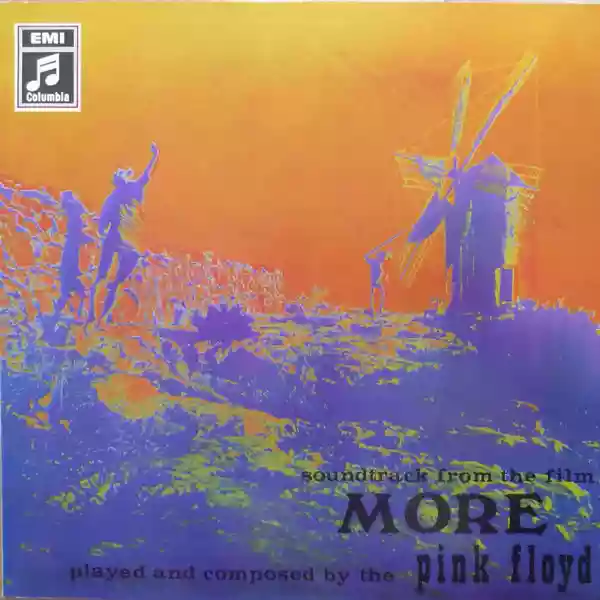
Third studio album for the legendary band, the first without the "physical presence" of Syd Barrett. No one could predict what might happen next, and no one saw a bright future for the band. 1969. The band began to take an interest in cinema, writing music for certain films, particularly those films that in a certain sense "fully reflected" the "acid" period of the late sixties. The Floyd started working on a film directed by Barbet Schroeder entitled "More," which is officially their first experience with soundtracks. Over the years, this album has nonetheless become a classic, and now the public doesn't even "identify" it as a soundtrack but simply as the band's third album.
It is an album that also contains the only two truly Rock tracks of their entire production, I'm talking about "The Nile Song" and "Ibiza Bar," two tracks that are not exceptional and that, in my opinion, clash with the sublime atmospheres created with the other tracks on the album.
It opens with "Cirrus Minor," a wonderful track, nature anticipates a sweet and melancholic acoustic guitar arpeggio, Gilmour's voice is almost spectral, Wright's organ becomes increasingly powerful, and the finale is completely entrusted to him in a chord progression that vaguely reminds one of the wonderful ending of "A Saucerful Of Secrets." "Cirrus Minor" is a wonderful track, in my opinion, very underrated by both the public and the Floyd, a track that, in my view, has all the characteristics (except for the length) of early Floyd music. Listening to it is sublime. "The Nile Song," the second track, breaks the spectral atmospheres of the previous piece and focuses on something that almost pushes towards hard rock. In my opinion, this is not a "typically Floydian" piece and has little to do with their music, but on the other hand, I understand that they were working for a movie, so it's very likely that some choices didn't come from them. In any case, "The Nile Song" is a track that I find very forgettable. We immediately return to the atmospheres of "Cirrus Minor," and we do so with the third track on the album "Crying Song," the song of crying...a very slow piece that manages very well to leave the listener with that sense of sadness that the track wants to convey. After this "little cry," we finally move on to the instrumental part, a true trademark of early Floyd, "Up the Khyber" is not an exceptional track, but it is certainly a clear testament to the still alive and thriving desire for experimentation. We are immediately catapulted into a beautiful green meadow, a meadow created for dreaming, Gilmour's relaxed and sweet voice sings to us "Green is the colour," which will become a classic in their live performances. A "simple" song, a round of simple chords with good work (as always) by the "painter" Rick Wright, definitely pleasant to listen to. The next track is particularly noteworthy, "Cymbaline," which in my opinion will work much better in live performances, there it will be much longer, much more complex, much more "psychedelic," a wonderful track! The following tracks, apart from "Ibiza Bar," are all instrumental, among them is a small masterpiece, and in my opinion, together with "Cirrus Minor" and "Cymbaline," it completes the circle that makes this album exceptional. The track in question is "Quicksilver," seven minutes of pure madness. A track that takes you into the darkest recesses of sound, the Gong gradually enters until it explodes, moments of silence that turn into small sound vibrations caused by Gilmour's guitar and Rick Wright's Farfisa, a piece that with a good dose of acid inside transports you to any point in the cosmos. The real Pink Floyd, the ones I like.
Free sex, parties, alcohol, and drugs, ingredients that united the Floyd of that era with Schroeder's project, which involved a plot that dealt precisely with these themes. I think the director understood very well that the Floyd were perfect for creating the right music for scenes that involved free sex and drugs. "More" is an album that should be listened to like any other Pink Floyd album, you can "travel" as much as you want, the ingredients for a good trip are not lacking...but it's always good to remember that we are talking about a soundtrack, therefore the "fluctuating" pace between one track and another (example Cirrus Minor - The Nile Song) should not be considered a defect or a poor choice but a well-thought-out logic for a project intended to be an integral part of a film. This is work for a film! After "More," the Floyd will continue to experiment greatly, with "Ummagumma," "Atom Heart Mother," and company...new adventures with cinema, unforgettable and tragic from a certain point of view the experience with Michelangelo Antonioni (anyway, a wonderful instrumental piece by Rick Wright and an incredible version of "Careful with that axe Eugene" will come out of it). "More" is important because it also marks the debut of the four boys without their genius, the genius who started it all...Syd Barrett. For these reasons, I consider "More" a fundamental album, to be listened to and understood fully. With "More," the Floyd "give" us another "journey"...and in the end, we might scream the phrase that Gilmour utters in "Cymbaline"... "....please wake me!"
VinnySparrow
Loading comments slowly
Summary by Bot
Pink Floyd's third studio album and first official soundtrack, 'More,' marks an important phase without Syd Barrett. The album blends atmospheric psychedelia with rare hard rock moments. Highlights include the haunting 'Cirrus Minor' and the cosmic 'Quicksilver.' Despite some unevenness due to its soundtrack nature, the album remains essential for understanding Pink Floyd's evolving sound and experimental spirit.Tracklist Lyrics
Pink Floyd
Pink Floyd formed in London in 1965 and became a defining force in psychedelic and progressive rock. The classic lineage spans Syd Barrett’s founding vision, Roger Waters’ conceptual leadership, Richard Wright’s harmonic textures, Nick Mason’s pulse, and David Gilmour’s arrival in 1968, shaping their signature sound.237 Reviews
