
 •
Versione 4
Rating:
•
Versione 4
Rating:
THE REVIEW
In the labyrinth of forms that seek each other out but never quite manage to meet fully, the expression emerges imperfect and lacking the surefooted step, and sometimes even banal, of what is believed to be given forever.
Oh, friends, I believe that sometimes hobbling and going crooked are worth more than going straighter, and I am almost sure that, in these cases, the certain gladly yields to the uncertain, perhaps even with a bow.
That not always is the flowing simply a flowing, not always is the measure truly measure. Oh sure, when it happens it's a miracle, it's the aesthetic soul that has found home or refuge.
But I do not choose between these two paths, for I love extravagance and measure equally.
Then sometimes it happens that the roads intersect. It happens that expressive power, completely disregarding rules and regulations, flows, indeed it does flow (and since we're on Debaser, we can say that certain rock is the most perfect example of this).
But today I want to talk to you about the first path. The one of expression perhaps clumsy or perhaps all wrong.
And I do so by pointing out the name of Pietro Ghizzardi, the great naive painter. An uneducated man and almost illiterate, but not for this reason lacking his very personal tangle of dreams.
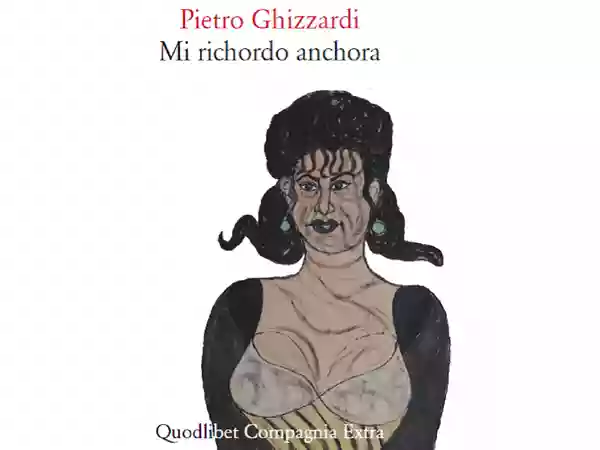
Pietro Ghizzardi used to paint his chimeric women (extremely sensual brunettes with enormous breasts and a ruddy face) on the farm walls and on yellow paper.
The bold charcoal stroke, the powerful mark that emerges from the painting and overwhelms with life. And the tumult, the tumult of blood. Not the Venus of Botticelli, but to my eyes even something more.
Well, this man whose works I happened to admire in an exhibition a few years ago in Ravenna, this man who repeated the first grade like three times and the second grade twice, this man has written a book...
Until this morning I didn’t know, I learned from a newspaper article.
Behold, this book titled "Mi richordo anchora, memorie di una vita dolorosa e meraviglioza, this book I have not read.
Sure, you might say, a bit strange to review a book you haven’t read...yes, maybe it is. But, in some cases, the title is enough and having the certainty that you will surely read it is enough.
The two h's and that "meraviglioza" with a zeta instead of an esse are enough.
And they are enough because sometimes hobbling and going crooked are worth going straight, and when this happens, the certain gladly yields to the uncertain, perhaps even with a bow.
Then maybe it makes you want to read it too...
Trallallà…
Loading comments slowly
Summary by Bot
The review reflects on the value of imperfect and raw artistic expression, highlighting Pietro Ghizzardi as a great naive painter whose personal dreams shine through his bold, passionate style. The author admires the clumsy but authentic path of Ghizzardi's art and life. Although the reviewer has not read the memoir 'Mi richordo anchora,' the title and artist’s story evoke curiosity and respect. The review values honesty and extravagance over polished perfection.Tracklist
Pietro Ghizzardi
Described in the review as a great naive painter: an uneducated, almost illiterate man who painted chimeric women (often on farm walls and yellow paper) with a bold charcoal stroke; his work was exhibited in Ravenna and a book titled "Mi richordo anchora" is associated with him.01 Reviews
