 •
Rating:
•
Rating:
THE REVIEW
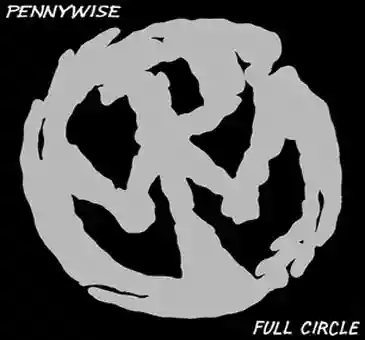
The circle closes. It's time to turn a page, to lower the shutters on the past. A story has ended, another one begins, new spirit, new energy, new interpreters. Even if the old ones are dearly missed. In 1997, Pennywise reappears on the music scene after the most difficult and mournful moment: the death of bassist Jason Thirsk, another rock martyr killed by excesses and indulgences. Replacing him is Randy Bradbury, the unofficial fifth member of the group, friend, and mentor to Jason, one of the family, although it certainly does not ease the pain.
In that 1997, Pennywise gives birth to their personal "Black Album," while Metallica is in their full Reload phase, and the pop punk boom is already beginning to shape as a temporary phenomenon well-manipulated by the media. Yes, you read that right, "Full Circle" is to Pennywise what the Black Album is to Metallica: a new beginning, something has changed. Although, unlike the case of the Four Horsemen, here the pace does not slow down, wedding ballads are not composed, nor do they cut their hair: the Hermosa quartet does not drastically shift in style (which is their true, absolute strength), rather in the atmospheres, the sensations that permeate the entire album. "Full Circle" is dominated by an indefinable feeling, a sinister presence that inexorably thickens in the usual thundering guitars and lightning-fast drum rolls. An intense reworking of anger and fear, frustration and pessimism, torment and uncertainty, which, if possible, gives even more power to the tracks on the album. And the result is nothing short of spectacular. No drop in tone, no slowing, no filler. Just classy skate punk, quality and passion.
It opens with the hallucinatory "Fight Till You Die," one of the best tracks in their entire repertoire, incredibly fast, exhilarating, adrenaline-pumping but also suitably angry: it chases you, grabs you, shakes you and doesn't let go until you've shed the last drop of vital sap. Not recommended for the hard of hearing or faint-hearted! Following are "Date With Destiny" and "Get A Life," and the formula does not change: speed and melody, aggression and harmony are the tools with which the four musicians try to face their pain and find strength in the face of the relentless deadlines encountered in life's long journey. "Society" distinctly deviates from these themes, to address socio-political topics (which will dominate subsequent albums): it's more sober than the previous tracks but hits its target harmonically, also promising great live engagement. The main bass riff, then, is already part of the fundamental dictionary of Californian punk rock. "Final Day" and "Running Out Of Time" continue the discourse on the transience of time and life, representing a wonderful (and sad) synthesis of melody and unease. In between, the splendid "Broken", opened by a terrifying riff (try playing it, it will capture you!) completes a first half of the album that's absolutely anthology-worthy. Not that the second is any less, mind you. We challenge anyone to remain indifferent to episodes of sonic power such as "You’ll Never Make It" (a rhythm section to die for), "Every Time", "Nowhere Fast" (with an interesting tempo change), or the magical "What If I" (Jim's superb vocal performance). Two other insane songs for rhythm and intensity, both musical and emotional, are "Go Away" and "Did You Really?", which accompany us towards the conclusion of an exceptional album in every aspect.
But as is known, an exceptional album sometimes becomes a classic, an indispensable "must". For this evolution to happen, however, there must be something that makes it so, something unforgettable, unrepeatable, that not only enhances the album but the entire career of the band. That "something" mentioned above is a splendid bass riff by Jason, on which the band’s debut highlight track "Bro Hymn," from their 1991 self-titled debut, was constructed. And on "Full Circle," that piece is re-recorded, expanded, redefined, glorified, becoming what it is today: the punk rock anthem, at least comparable to "God Save the Queen," "Blitzkrieg Bop," "Nervous Breakdown," or any other genre classic that comes to mind. In "Bro Hymn Tribute" is the entire essence of punk: simplicity, adrenaline, enthusiasm, friendship, freedom, youth (certainly not just in terms of age). It is a party translated into music, paying tribute to a friend who is no longer here. And they do it with his best track, sung, played, and lived by all punk rockers around the world at any concert, in any place.
And as if that wasn't enough, the CD closes with a poignant hidden piano instrumental, built on the introduction of "Unknown Road", the title track from the eponymous album. Just under a quarter of an hour of emotions, of incredible melodies for all their simplicity ... One could talk about it forever, but it wouldn’t be enough: punk is not theory, not pen and paper, not a review. "Full Circle" must be listened to, played, interpreted, discussed, assimilated; everyone must live it with their own tools, with their own sensitivity, with their own approach. With this album, Pennywise left us a great message: punk is simple, wonderfully genuine, it does not impose classifications, technical requirements, or anything else. It represents a solid base where everyone can find their own characteristics, add their own ingredients, rediscover old emotions, or discover new ones. They did all this: they paid tribute to Jason while remaining true to themselves, but also giving in to what they felt.
"All of us are bonded forever
If you die, I die that’s the way it is"
R.I.P. JMT (1967-1996)
Loading comments slowly
Summary by Bot
Full Circle by Pennywise is a passionate and intense punk rock album marking a critical new chapter after bassist Jason Thirsk’s passing. The album combines speed, melody, and raw emotion without losing their signature sound. It features standout tracks like 'Fight Till You Die' and a powerful tribute 'Bro Hymn Tribute.' The review highlights the album’s raw honesty, musical quality, and lasting impact in punk rock.Tracklist Lyrics Videos
Pennywise
Pennywise is an American punk rock band formed in 1988 in Hermosa Beach, California. Known for fast, melodic hardcore and socially conscious lyrics, they helped define 90s skate punk on Epitaph Records. Founding bassist Jason Thirsk died in 1996; Randy Bradbury joined thereafter. Their anthem “Bro Hymn” is a staple of punk singalongs.09 Reviews
