
 •
Versione 1
Rating:
•
Versione 1
Rating:
THE REVIEW
The enveloping sound design and the low camera skimming ever faster over the asphalt suck you right into the scene. The undulations of the road turn into real waves, and the film lets you surf that sea of tarmac with a crescendo of shots, transforming the landscape into a living, pulsating body. That almost tactile sensation also comes from the decision to shoot many sequences in VistaVision, with horizontal frames wider than the traditional ones: cinematography that gives back vibrations, dust, and asphalt crests as if you were actually touching them, damn it! You have no idea how it’s possible, but suddenly you’re there, inside those gigantic waves of asphalt; you’re riding them, and even though you’re sitting in a movie theater seat, you feel the wind, the bass throbbing in your chest, and the urge to open your arms and shout. An aesthetically perfect scene—one of those that reminds you why cinema exists and why it’s worth savoring on the big screen. And makes you say it’s so beautiful that, yes, I’ll even spend 10 minutes writing an extra-long review that no one will read.
But beyond all this visual splendor, beneath the surface runs a fractured nation. America is torn apart from within. I don’t think you have to be a top-tier analyst to notice how American society—and, by extension, Western society as a whole—has become polarized, incapable even of debating in academic circles. Incapable of listening, it hates itself; incapable of understanding, it despises itself. And when things go well—let alone great—it simply ignores itself.
Anderson’s film is exactly about this chaos. The result is inevitably confusing, and not just as an artistic choice, but sometimes also due to structural limitations. The ambition is massive: satire, drama, grotesque, action, politics, melodrama, parody, and tragedy all inhabit a single body stretching 162 minutes. But when you try to embrace everything, something often ends up out of focus. Portraying chaos shouldn’t mean building a chaotic film. Or should it? I need to think about that.
Anderson throws you into the social, psychological, and political jungle of a nation imploding, using time jumps, abrupt ellipses, shifts in tone and rhythm that mimic a collective mind in a state of shock. It’s a powerful choice, but a risky one too: because when everything breaks, the viewer may lose not just their bearings, but their emotional involvement as well. To counterbalance this, though, there are the characters. Outstanding to watch, irresistible, performed masterfully but also flattened by their own caricatural nature, which is so strong.
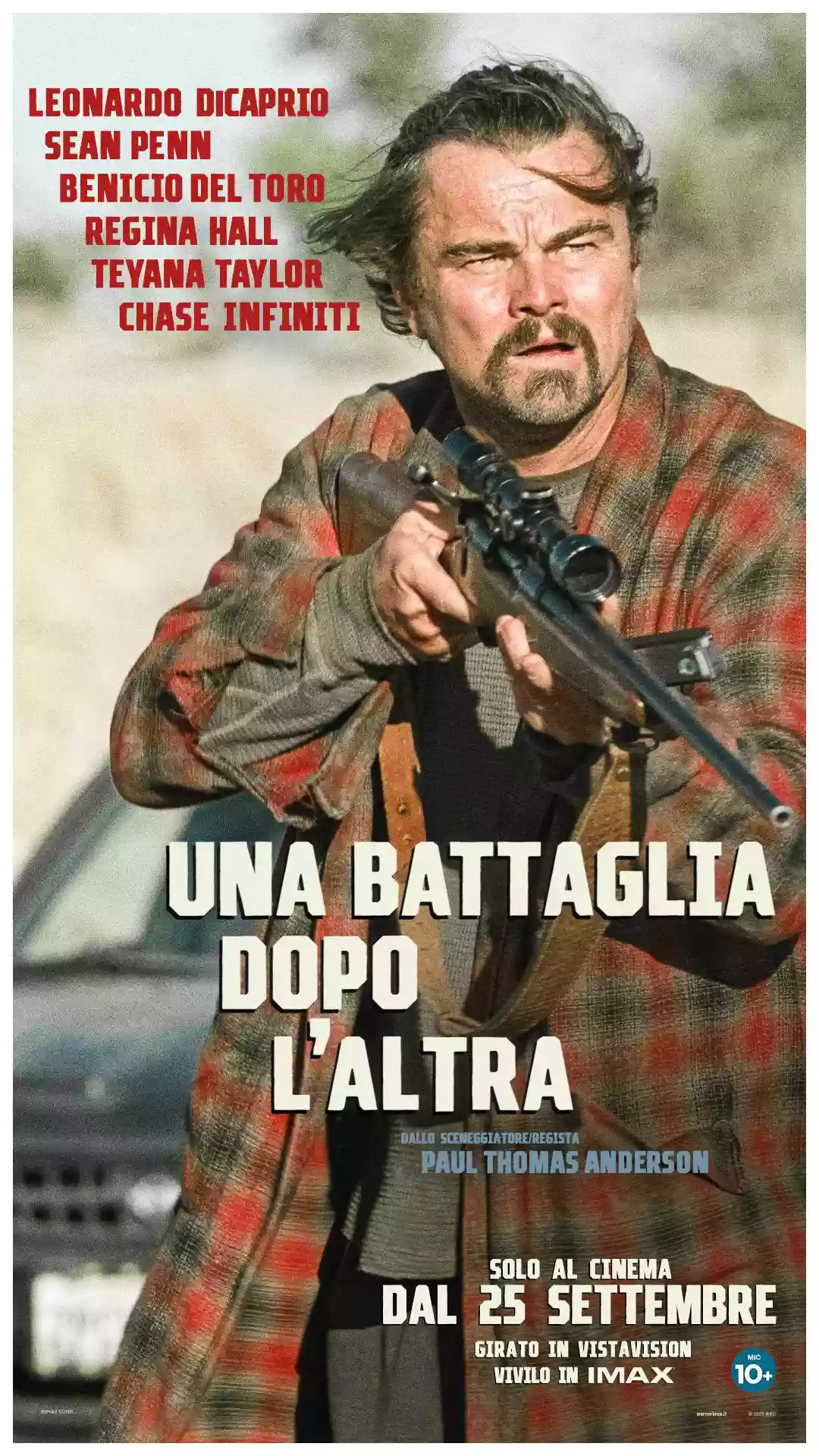
Bob, played by DiCaprio, is a hallucinating revolutionary who seems like a mix between The Dude and Belfort: a “total” character, but often more a symbol than a man—a living representation of the rampant madness that lives in our minds. His partner is pure fire, passion and craziness wrapped up in a magnificent body and name (Perfidia Beverly Hills), never at peace; and precisely because of this, she risks becoming a figure more decided by the screenplay than by life itself. Sean Penn is magnificent as the rigid soldier, obsessed, guided by a distorted moral code that he expresses more with his body language and vocal tone than with words. Benicio Del Toro, a karateka-guru, is almost a graphic novel figure, a mélange of Splinter and Mr. Wolf, who works as a spectacle but constantly reminds you you’re watching a living metaphor more than a human being.
The film overflows with brilliant ideas: nuns growing cannabis, secret white supremacist societies, deserts and metropolises alternating with no apparent logic, but this constant shift of tones can fragment the emotional arc. Sometimes it feels like Anderson falls so in love with his digressions that he forgets the central emotional trajectory.
In the end, you’re left with the sensation of a gigantic stew: full of flavors, some delicious, others less harmonized, all convinced they should coexist in the same bowl. The film wants to say everything, but risks not letting anything sink in deeply. And yet, it’s precisely in this chaos that our times are reflected. The America in the film could be today’s, tomorrow’s, or the near future’s. What Anderson captures—sometimes with genius, sometimes with too much emphasis—is the confusion we’re soaked in. A reality where every day we lose a point of reference, a foothold, a certainty from the past.
And so, yes: non ci stiamo capendo un cazzo.
I just hope I don’t end up like that relentless pursuer, flooring it, convinced he’ll reach his goal, so blinded he doesn’t realize he’s lost the road—and himself—a long time ago.
Viva la Revolution! I liked it. I’d say a solid 3 stars, but then I think back to that asphalt wave scene.
Loading comments slowly
Summary by Bot
The review covers ‘Una battaglia dopo l'altra’, directed by Paul Thomas Anderson. It highlights the film’s notable direction, storytelling, and artistic merits. The reviewer praises the movie’s strengths and considers it a solid work within Anderson’s filmography. By awarding it 4/5 stars, the review indicates a strong, positive reception. The film is depicted as impactful and worth watching.
Paul Thomas Anderson
Paul Thomas Anderson is an American filmmaker (director and screenwriter) known for character-driven dramas and stylistically distinctive storytelling.13 Reviews
