
 •
Rating:
•
Rating:
THE REVIEW
After buying it and listening to it a couple of times, you get the feeling of having a small, great jewel in your hands.
Paul McCartney is the greatest living songwriter. His "sense of song" is incredible, perhaps only comparable to the great American songwriters of the twentieth century.
Is this album full of compositional masterpieces? Probably not: this album is full of beautiful songs, excellently written both harmonically/musically and lyrically (let's never forget Macca's stature as a lyricist, often close to pure poetry and almost always underrated due to the greatness of the musician and performer).
At this point, one might ask what distinguishes this album by the ex-Beatle from the rest of his recent solo production. Many things. First of all, it had been many years since Paul wrote and played everything himself, as in the very first solo album after the breakup of the most famous band in the so-called light music history.
Then, and in my opinion, this is an absolute novelty, Nigel Godrich's impeccable production gives the whole album a melancholic/autumnal atmosphere that is perfect not only with the approaching season but with the concept of "mature song." Indeed, McCartney is no longer a kid. You can hear it in his voice, in the overall tone of the compositions, and in the array of sensations that, broadly speaking, the album conveys.
An album that might risk being perceived as sad if the definition weren't simplistic and fundamentally stupid.
Certain additional elements are definitely interesting and mark its distance from the (though excellent) products of the recent past: these are almost always compositions performed, and probably written, entirely on the piano (with the exception of a couple of tracks), where guitars, drums, and the inevitable bass serve as a backdrop to a picture that would already be nearly perfect for piano and voice alone.
Examining the individual tracks is certainly an activity to leave to those who will buy and listen to the album. Personally, I can point out "How Kind Of You" and "Riding To Vanity Fair," but we are in the realm of pure subjectivity, as the compositions are all equivalent, and all can undoubtedly be classified as the finest craftsmanship in modern songwriting.
Exciting, then, is the very Beatles-like start of "Fine Line." But it's the only track that could come out of an unreleased session by the Fab Four. The prevailing - misleading as ever - criticism describes it as a Beatle album. Nothing could be further from the truth. It's the pure singer-songwriter album of a great author who happens (not by chance...) to be one of the inventors, if not the inventor, of pop songs in the latter half of the twentieth century.
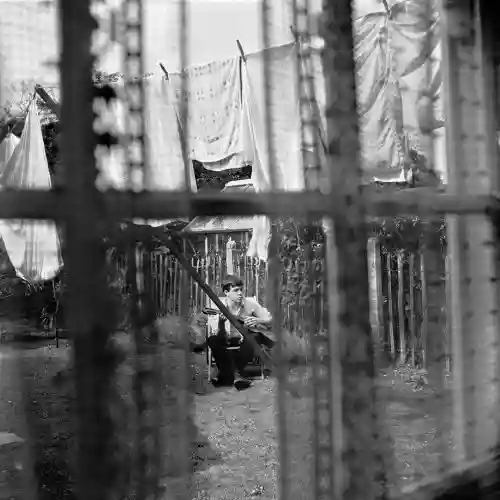
In the overall perfection of the work, the cover photo also deserves a mention, previously unseen, or at least unknown to me, taken by Macca's father when he was very young, in the backyard, strumming a guitar that then - a nice contrast - will be felt relatively little in this album.
The last point, entirely personal, is the appreciation for an album of only a wonderful 47 minutes. Like in the old days.
In this time, you can say everything that needs to be said. And Paul McCartney, despite over forty years of career, still seems to have a lot to say.
Loading comments slowly
Summary by Bot
Paul McCartney's 'Chaos And Creation In The Backyard' stands out as a mature, beautifully written album with poetic lyrics and melancholic production by Nigel Godrich. Unlike his recent work, McCartney performs most instruments himself, emphasizing piano-driven songs. The review highlights the album's timeless craftsmanship and emotional depth, while dispelling the misconception that it mimics a Beatles record. At 47 minutes, it's a concise yet fulfilling listening experience.Tracklist Lyrics Videos
Paul McCartney
English singer-songwriter and multi-instrumentalist, co-lead vocalist and bassist of the Beatles, later leader of Wings and a prolific solo artist with a decades-long career and numerous acclaimed albums and live shows.65 Reviews
Other reviews
By Torre Ste
"Fine Line" genuinely sounds like a new Beatles song in both duration and rhythm.
The Ghost Track best mixes Blues, Rock, and Songwriting with a crescendo finale, leaving you suspended in the cold air that characterizes these early autumn days.
By The Punisher
A flow of more or less pleasant songs, neither good nor bad, which most of the specialized press has praised as yet another masterpiece.
Much to the chagrin of those waiting for Lennon/McCartney-like tunes, unaware that that era has been dead, buried, and decrepit for ages.
By sonic80
This album is amazing.
Chaos And Creation In The Backyard is a fresh, inspired, and enjoyable album from the first to the last note.
