
 •
Rating:
•
Rating:
THE REVIEW
There are countless people who would never stop talking about the technical innovations contained in this film. These people seem to not understand that “Citizen Kane” — for its content — would be just as great even if it had been directed by an incompetent.
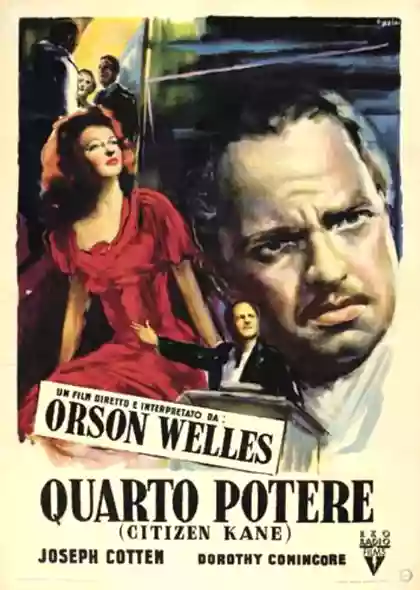
In this film, Orson Welles tells the life of newspaper magnate Charles Foster Kane by showing us the deep contradictions of his personality.
What emerges is a man who is not evil, but who is so selfish as to be literally incapable of loving, and who will end up abandoned by everyone in his isolation, inside his gigantic yet ridiculous mansion.
But the director goes beyond the surface, showing us how, behind the “homme terrible,” lay the “enfant-victime,” a child forced to grow up too quickly, because he was taken from his childhood by an unnatural mother who wanted to entrust him to the care of a businessman, tasked with managing a great fortune of which little Charles had become heir, thanks to the discovery of a gold mine on his land.
As an adult, having never been a child, he conceived love as children do: not as commitment, constancy, sacrifice, renunciation, and sharing, but as accumulation (of things) and domination (over people).
Kane's own words illuminate his entire story: “If I hadn’t been rich, I might have been a great man.” A successful failure.
The film ends with one of the most beautiful lines in the history of cinema, summarizing Kane’s personality with an equilibrium that is hard to achieve: “He had a greatness of his own, but he kept it all to himself.”
Sublime masterpiece by Orson Welles (just twenty-five), a wonderful painting in which genius direction, skillful use of flashback, and psychology, blend together to form a “complex yet coherent visual and psychological collage“ - in homage to the proverb: “Truth has many faces.”
Seeking the “greatest” is always pointless, ridiculous, and childish; but of “Citizen Kane” I can say: among the films on Olympus, certainly the most balanced and the most pleasant to watch.
Loading comments slowly
Summary by Bot
This review praises Citizen Kane as a masterpiece not only for its technical innovations but for its profound psychological portrait of Charles Foster Kane. It highlights the film’s exploration of Kane's selfishness and childhood trauma, emphasizing its balanced storytelling and genius direction by a young Orson Welles. The film is celebrated as emotionally rich and timeless.
Orson Welles
Orson Welles (1915–1985) was an American director, actor, writer, and producer who transformed cinema with Citizen Kane (1941) and continued innovating with The Magnificent Ambersons, Touch of Evil, Othello, and Chimes at Midnight. He first gained national fame with the 1938 radio broadcast of The War of the Worlds and worked across stage, radio, and film in the U.S. and Europe.10 Reviews
Other reviews
By L3dZ3p
Many parts of this film represent the work of Welles’ creative genius, who, at 26, exploits the cinematic techniques of the time to excellence.
Citizen Kane assumes literary value and dignity through its skillful use of flashbacks and Kafkaesque character evolution.
