
 •
Rating:
•
Rating:
THE REVIEW
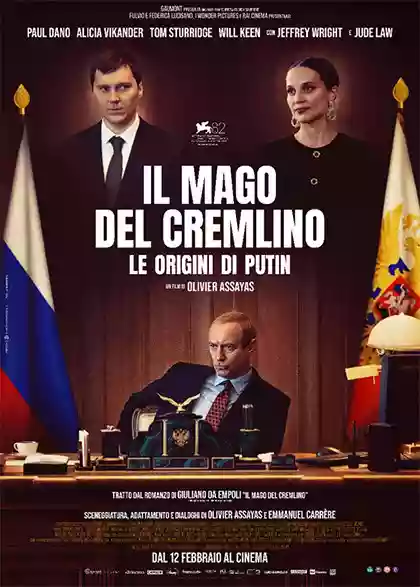
A recurring question revolves around the following issue: "Does power wear down those who have it, or those who don’t?" We know what a well-known Italian politician from the second half of the twentieth century used to answer, and we can imagine how a historical French figure like Talleyrand—who always orbited around power, from pre-revolutionary France to the time of the post-Napoleonic restoration (a truly unbeaten political recordman)—would have replied. But after watching "The Wizard of the Kremlin", masterfully directed by Olivier Assayas, I am increasingly convinced that power is comparable to a substance that is intoxicating for sure, but also highly toxic, poisoning anyone who comes into contact with it. It is always better to remain an anonymous face in the crowd.
Based on the novel of the same name by Giuliano da Empoli, the film follows the life events of a certain Vadim Baranov, who grows up in a family wealthy by Soviet standards. His father, in fact, holds a prestigious position at the Academy of Sciences in Moscow and is part of the then-ruling Communist Party apparatus. This also meant having access to shops well stocked with essential goods, otherwise unavailable to ordinary Soviet citizens.
But, as is well known, the system fell into crisis, and not even an enlightened leader like Gorbachev could save the USSR at the time by reforming it. After the collapse, the rise to power of Yeltsin brought a wave of liberalization to the country, though not without a state of chaos in the streets of Moscow and other cities, with scenes reminiscent of Chicago in the '30s. Yet all this did not stop young people like Vadim Baranov from savoring an atmosphere brimming with cultural activity. Vadim himself, a student at the Academy of Dramatic Arts, dabbled in experimental theater directing, with the support of his lover Ksenija.
The real turning point for Baranov, however, comes when he joins Russia’s First TV Channel, managed by a tycoon and oligarch such as Boris Berezovsky. It is a golden moment for Russian television networks, while Prime Minister Yeltsin does not appear to be in good health. There is an urgent need to find a solution to save Russia, and Berezovsky and Baranov consider approaching the then KGB director, a drab and unremarkable Vladimir Putin. At first, he doesn’t seem so convinced about becoming prime minister, considering—as the KGB—you know everything about everyone. However, he reconsiders, and it is reasonable to suppose that he is intensely ambitious. He should be handled with care, though, as he does not like to be surrounded by potential prima donnas (and Berezovsky will soon find this out at his own expense).
What happens next, from the war in Chechnya to the war in Crimea and the Donbass in Ukraine in 2014, unfolds at a relentless pace, as is well known. But what emerges is not only Putin’s ruthlessness, but also Baranov’s gradual realization (a fictional spin doctor to the 'Tsar', though inspired by the real advisor Vladislav Surkov, Putin’s grey eminence in the early years of the regime). One really realizes that power corrupts, and just imagine to what extent someone might rot within if they accumulate too much power. Certainly, those like Baranov who work in the autocrat’s shadow must perform, every day, a job worthy of a great tightrope walker: will things always go well, and will he never slip off the trapeze without a safety net below? Who lives will see…
I haven’t read Giuliano da Empoli’s book on which the film is based, so I cannot say to what extent the movie is a faithful transposition of the text. Certainly, the performances of Paul Dano (as an advisor torn by doubts like Baranov) and Jude Law deserve praise; even without excessive makeup, Law makes a credible Vladimir Putin, especially since his sky-blue eyes are as icy as those of the current Tsar, along with displaying the same hieratic mobility as Uncle Vlad and that expression of a “friendly battered shoe” (not really a guarantee of affability…).
If I did find something unconvincing, in my opinion it is perhaps the Putinian motivation to get rid of the oligarchs, by fair means or foul. Officially, these figures (mostly former Communist Party officials who reinvented themselves as ruthless businessmen) were pushed out of the power circle on charges of corruption and subjected to public humiliation. In reality, Putin’s aim was only to strip the oligarchs of their assets, to then share them out with the zealous servants of his regime, in keeping with a truly kleptocratic system. So, it is not unfounded to consider Putin the current master of all the Russias, perfectly in line with Russia’s ancient history, ever since the time of the first Tsars.
Fortunately, films like "Il mago del Cremlino" shed light on the background and motivations of today’s tragic events in Russia, a country subject to a sticky and violent power system. It is a strong demonstration of the power of cinematic art.
Loading comments slowly
Summary by Bot
The review praises Olivier Assayas’ film for its insightful depiction of Vladimir Putin’s rise to power. Through strong storytelling and vivid direction, the movie vividly unpacks the complexities of modern Russian politics. The film is recognized for its engaging narrative and thought-provoking themes. It stands out as a compelling exploration of power and influence. The reviewer awards it a high rating.
Olivier Assayas
Born 1955, Olivier Assayas is a French film director and screenwriter known for auteur films that blend drama and genre elements.02 Reviews
