
 •
Rating:
•
Rating:
THE REVIEW
Nothing to add
Nor to divide
In your trap
I fell in too.
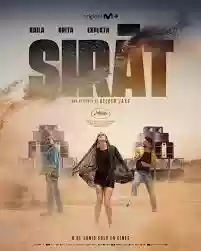
There are films that claim to open gateways, to carve fissures into reality, but in that surreal itch they end up merely bumping against their own glossy, glassy surface. Sirat belongs to this category of works that summon mystery while carefully avoiding being afflicted by that sense of loss which such a quest entails. It aims to stray from the territories of logic only to immediately camp at dusk on the comforting borders of that familiar land and matter.
Myth, the Dionysian, tragedy, the oracle, the enigma—after 5 minutes of watching this film, they all decided to leave the theater and go play Briscola. Quoting darkness and depth while remaining immobile on the crust of things, invoking the sacred with the voice of someone who has never truly listened to silence.
From the very first moments, Sirat presents itself as a constructed organism, scaffolded, built up with ropes that overemphasize the weight of the structure and remain far too visible. Every shot seems to scream its own importance, as if the film were afraid of being unseen, as if it needed to strike, to shake, to impose its own pose. Or simply to climb up a hierarchical chart, one it paradoxically aspires to transcend.
But what is born from posing doesn’t throb, doesn’t vibrate. And it can never ignite.
The images, though carefully crafted, remain cold, like polished surfaces that let nothing through. It’s a cinema that wants to elevate itself, but gets stuck in its very will to rise, like a body attempting to levitate while still tied to the ground. The most evident fragility of Sirat reveals itself in the characters, pawns without essence piloted by an external hand, lacking that unpredictable spark that makes a character come alive. Even in its longed-for twilight, they remain shadows that cast no shadow. In this amputated interiority, the leading extras are the desert landscape and rave music—the original sin was to feel it necessary to write an actual screenplay on top of all that. We stray from the dangers of World War III only to lose ourselves among the music-swept dunes of the desert, but what’s invisible is truly absent, replaced instead by the same conceptual clamour of the very conflict we’re trying to escape. The posing and forced characterization of the characters brings us back to the very noise we seek to evade; the fiction becomes circular, and the desert, a new digital archetype with players trapped among the dunes of a metagame—over-tattooed hippies with mutilated limbs, exploding after a misstep or an electric twitch of a controller. The most painful limitation is the inability to generate a true mystical dimension, in the modern belief that a few symbols, some suspended images, a slowed rhythm would be enough to summon the sacred. But mysticism is not born from accumulation: at most from subtraction, and springs from a collapse, from a breach that bursts open when language is no longer enough.
In the end, what’s missing is not technique but soul, that spark that sets matter alight, that transforms a project into an experience, an idea into an encounter. It’s a film that gazes at itself in the mirror, that delights in its own image, but never dares to lose control.
And so, instead of taking the viewer on a journey, it leaves them standing before a closed door—a door that promises an elsewhere, but will always remain locked. So, nothing new under this Moroccan sun either, armored as ever in self-satisfaction and complacency: just another existential sitcom, this time shot in a phony desert.
Loading comments slowly
Summary by Bot
The review provides a highly critical take on Óliver Laxe's film 'Sirāt'. The author expresses clear disappointment and rates the movie at the lowest possible score. Central complaints include issues with the movie's execution and overall impact. Readers are cautioned against expecting much from this release. The sentiment is overwhelmingly negative throughout.
Óliver Laxe
Óliver Laxe (born 1982, Paris) is a Spanish-Galician film director. He debuted with You All Are Captains (2010), followed by Mimosas (2016) and Fire Will Come (2019), known for contemplative, landscape-driven cinema.02 Reviews
Other reviews
By joe strummer
A visually stunning movie that blends poetry and cinema.
An immersive, contemplative experience unlike typical films.
