
 •
Rating:
•
Rating:
THE REVIEW
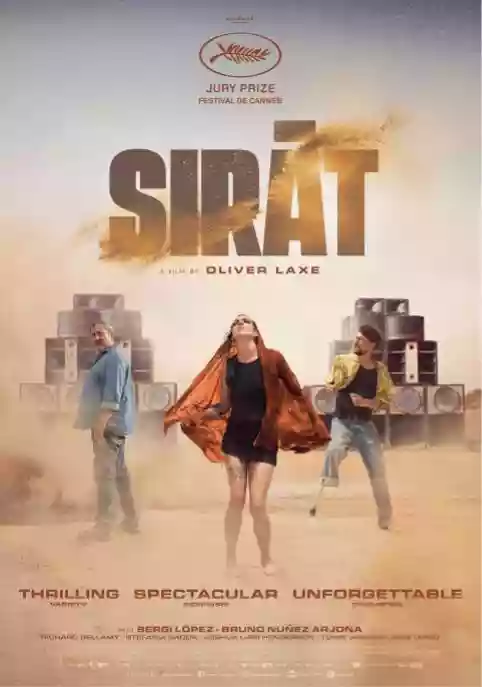
An escape from history in the Moroccan desert, among metaphysical landscapes and techno music that burrows into your mind. “Sirāt” is a film by Óliver Laxe, a director who until now had worked in territories little known to me, but here he demonstrates a striking maturity.
It is generically presented as a film about raves in the desert, but it is clear from the very beginning that there is something more, much more. You understand it from the phrase that appears on screen at the start, taken from Islamic tradition:
“Sirat is the bridge between heaven and hell, as thin as a hair and as sharp as a blade.”
Between Hell and Paradise
The entire story, which soon turns into an extreme journey among desolate expanses and dizzying mountains, evokes this kind of uncertain and mysterious katabasis. It's not clear—and that's thanks to the director—whether the protagonists are descending into hell, on the border with Mauritania, or rising to paradise. A techno paradise. The viewer is given a few semantic tiles: paradise as freedom, an endless rave with no rules, outside of history and outside the world. Hell, on the other hand, is society, mankind, with armies and bombs. World War Three has begun.
Yet Laxe manages to keep his meanings uncertain, always walking a fine line. And so perhaps the protagonists’ journey doesn’t lead to paradise, but actually to hell. Where paradise, instead, is represented by civilization, a reassuring railway that takes you home, while the group’s journey, with no rules or safe roads, is only a descent into the world’s primordial chaos.
Travelers
The story of “Sirāt” is a symbol of existence itself. A desperate journey, but in moments joyful, with limited resources, between tragedies, obstacles, and a final destination that is uncertain and perhaps deceptive. But first there is life, there are people, human beings. The Spanish director reconstructs, in long desert scenes, a dignity of existence, where the ravers, initially unreliable and obscure, gradually build a dignity, revealing their kindness, their desire for harmony between individuals. The father searching for his daughter, together with his other child, is at first opposed but then welcomed. He himself changes, opens up.
And in this, we see much of our own lives: we don't get to choose who we travel with, but kilometer after kilometer, year after year, solidarity is possible even among very different individuals, at opposite poles. Being together saves us, changes us, makes us better. Even in the infernal desert of the deep Morocco.
The Landscape
The choice of setting is especially effective. The scenes were shot partly in Spain, in the desert areas of Teruel and Zaragoza provinces, and partly in Morocco, in al-Rashidiyya and Erfoud. The desert is not just an evocative place, it's also a blank canvas. These ravers are seeking a new world, free from superstructures, to experience the ecstasy of existence without impositions, laws, wars. It's a space for fertile creation, where just two speakers are enough to carve out an illusion of happiness. And Kangding Ray’s music does this very well.
But the desert of “Sirāt” is also an obstacle, a threatening immensity—mountains, fords, cliffs, and other dangers that I can't reveal to you yet. The desert grants no respite or resources. We must provide them ourselves, with supplies of food, water, fuel. The world now seems to despise us, but we have to survive.
The Music
Kangding Ray’s techno soundtrack is incredible. It creates a hypnosis, almost an Edenic mirage where it’s possible to live without more suffering, in an altered state of consciousness. Several travelers have suffered an amputation, a leg, a hand. Luis has even lost his daughter. The journey is a search for redemption from brutal wounds, from daily bombings, or an intense attempt to restore family harmony, because without that, nothing makes sense. So Ray’s electronic cathedrals sublimate their meaning—they are the world of what is possible, the dream, paradise itself.
A slow journey, with Laxe’s static and contemplative shots which study faces, objects, spaces. Even the vastness of the desert eventually becomes almost constricting, claustrophobic. It’s moving, heartbreaking, to watch the two trucks travel in pitch darkness, their headlights the last glimmers of hope in the night.
The rhythm is stretched to the maximum, every event is pondered, reworked, and the music acts as a moral commentary, but also as an imaginative projection. The sight of the desert, with its saturated and warm photography, keeps us anchored to the misery of living; the music, with its unpredictable spirals, its crystal architectures, lifts us up into a techno empyrean.
This is a film that is difficult to comment on exhaustively without revealing the ending, which is the nihilistic sting in the tail of the world of armies, that world our slightly wasted and desperate friends were trying to escape. But I don't want to ruin the surprise for you—it's necessary.
“...as thin as a hair and as sharp as a blade.”
Loading comments slowly
Summary by Bot
The review praises Óliver Laxe's 'Sirāt' for its evocative visuals and poetic style. It highlights the film's meditative pacing and contemplative mood. The reviewer appreciates the artistic ambitions and succeeds in conveying the film's immersive atmosphere. A four-star rating confirms it as a standout work in art cinema. Recommended to viewers looking for more than conventional storytelling.
Óliver Laxe
Óliver Laxe (born 1982, Paris) is a Spanish-Galician film director. He debuted with You All Are Captains (2010), followed by Mimosas (2016) and Fire Will Come (2019), known for contemplative, landscape-driven cinema.02 Reviews
Other reviews
By Bruinen
This movie failed to impress from start to finish.
One of the most disappointing cinematic experiences lately.
