
 •
Rating:
•
Rating:
THE REVIEW
Forget everything you ever thought was metalcore.
This nomenclature, now devoid of any meaning (because it is applied to bands that have nothing to do with metalcore), was originally used exclusively for post-hardcore bands with sounds reminiscent of Coalesce and Botch, as well as Thirty Called Arson. The Norma Jean belongs to this category.
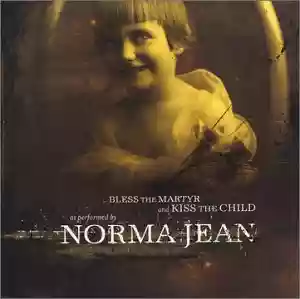
After an EP and a full-length released under the name Luti-Kriss, these five American guys changed their name to Norma Jean (for those who don’t know, the real name of Marilyn Monroe), and in 2002 they released this “Bless The Martyr And Kiss The Child.” The impact of this masterpiece is incredible. The guitars are front and center: heavy distortions, almost always syncopated and cadenced riffs, structurally similar to nu-metal but completely different in sound. There are many breakdowns, a feature that would later be overused by the myriad of subsequent bands. The moments of calm are few, but when they are present, they are not the usual sickly-sweet arpeggios, absolutely not; an anguish born from Neurosis creeps between the aspirations and weaves atmospheres loaded with tension; it is incredible how there remains a sense of uncontrollable unease even in the most melodic moments.
Another essential characteristic is the drumming; sharp geometries, constantly changing, as if it were living matter; the first comparisons that come to mind are with the Dillinger Escape Plan and Converge, and indeed throughout the album, as happens with the aforementioned bands, there is never the impression of listening to something static and linear, so spontaneous is the mutation to which the rhythms seem subjected (moments in 4/4 are very rare). But this is not to be understood as an arduous search to appear original as happens in progressive metal; here everything has a sense of spontaneity and almost, to be romantic, sincerity. All this sonic apocalypse is amply supported by the voice; always filtered, in constant spasm. The exchange between blatantly hardcore growls and convergent screams only increases the atmosphere already overloaded with nervousness. Moments with clean vocals are almost non-existent; and as you can already imagine, when they are present, they are certainly not hymns to joy.
The most representative tracks are undoubtedly the first three, sometimes with excessively long titles (“The Entire World Is Counting On Me And They Don’t Even Know It,” “Face: Face,” and “Memphis Will Be Laid To Waste”) and track n°5, “Pretty Soon, I Don’t Know What, But Something Is Going To Happen,” a fifteen-minute suite in which all the musical characteristics of this American combo can be found.
Loading comments slowly
Summary by Bot
Norma Jean's album 'Bless The Martyr And Kiss The Child' challenges traditional metalcore definitions by blending heavy distorted guitars and complex, shifting rhythms. The album features intense vocals and dark, tension-filled atmospheres influenced by bands like Neurosis and Dillinger Escape Plan. With standout long tracks, this 2002 release remains a landmark in post-hardcore and metalcore fusion.Tracklist Lyrics Videos
01 The Entire World Is Counting on Me, and They Don't Even Know It (03:10)
02 Face:Face (03:30)
04 Creating Something Out of Nothing, Only to Destroy It (06:21)
05 Pretty Soon, I Don't Know What, but Something Is Going to Happen (15:49)
09 Instrumental (02:07)
10 It Was as If the Dead Man Stood Upon the Air (01:30)
11 The Human Face, Divine (05:40)
Norma Jean
Norma Jean are an American metalcore band formed in 1997 in Douglasville, Georgia. Formerly known as Luti‑Kriss, they helped define 2000s metalcore with the visceral Bless the Martyr and Kiss the Child and continued with albums like O' God, the Aftermath and Redeemer.03 Reviews
