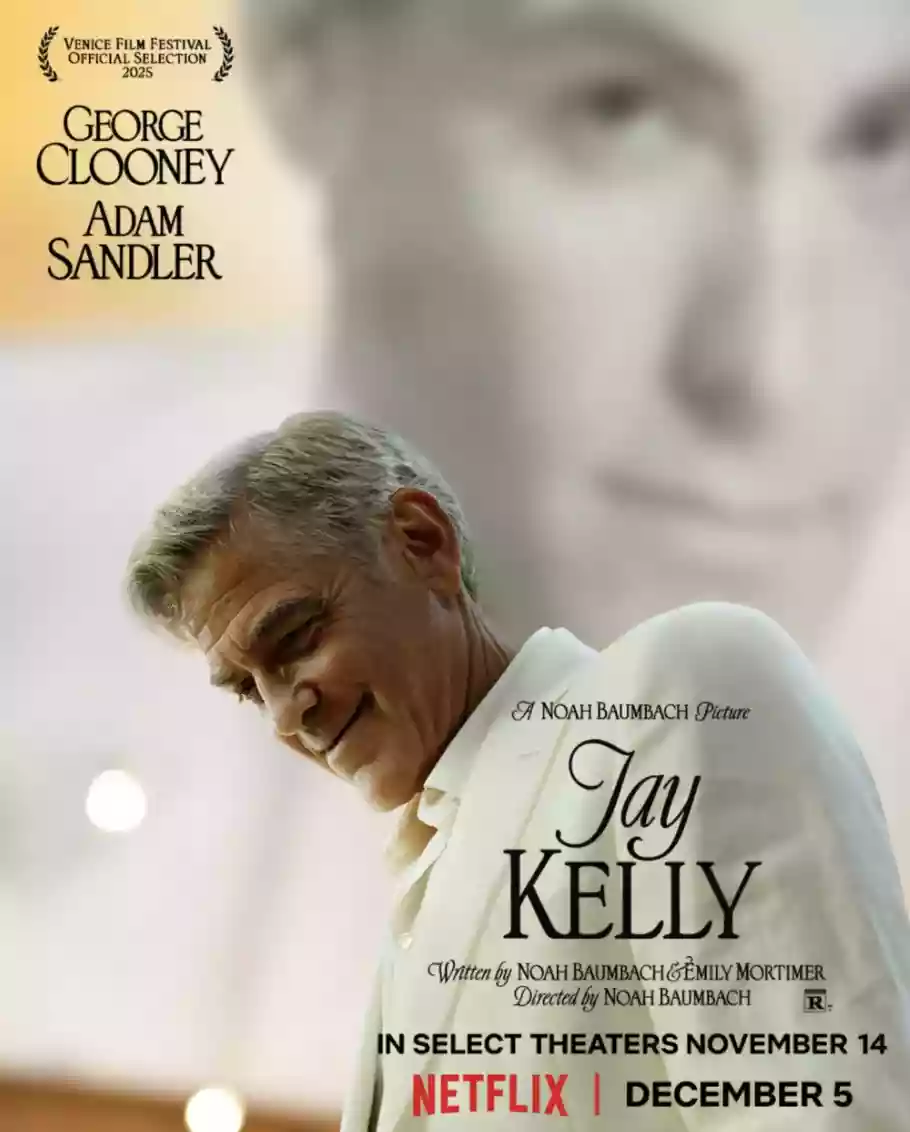

• Rating:
THE REVIEW
Jay Kelly opens in familiar late-life-crisis territory. Its protagonist, a Hollywood superstar whose very name already sounds faintly obsolete - echoing figures like Jay Gatsby or Gene Kelly - attends the funeral of the director who launched his career, six months after refusing to help with the man’s final project. The ceremony quickly devolves into a parade of resentment: absent fathers, betrayed friends, wounded families. Shaken, but curiously passive, Jay responds by embarking on a luxury journey of “rediscovery”, complete with entourage and private jet.
After this banal start, the film proceeds to churn out further banalities. Among the rest of the entourage, Jay’s manager Ron (a restrained Adam Sandler) abandons his suffocating family to follow the boss. Only later does the entourage begin to thin out, members peeling away one by one in a laborious attempt to illustrate the well-worn idea of being “alone at the top”. Eventually, even Ron - improbably - toys with the notion of resignation.
This is meant to be a “relatable” film for a middle-aged audience - as if most people were billionaire movie stars with private jets, armies of fans, and the financial insulation to turn regret into aesthetic melancholy. Lack of relatability, however, would not be a problem if the plot were solid. It isn’t. Baumbach efficiently sketches Jay as emotionally vacant and self-centred through flashbacks, but offers no new insight into a situation cinema has explored many times before, often with greater honesty.
The film feels less like an examination of the human cost of success than Baumbach’s personal meditation on (his?) life at the top - condescending toward the lived reality of the many, and oblivious to the fact that loneliness at the bottom is just as common, and far harder to endure.
Visually, the decision to frame young Jay as a kind of 1940s matinee idol - more Gary Cooper than action star - adds to the confusion, as does the film’s refusal to interrogate the obvious trade-offs of wealth and power. Most people compromise; few end up with designer homes and private aircraft. Jay, at least, got something out of the bargain.
Though carefully crafted, the film is just yet another familiar Baumbach exercise: mildly irritating, privileged characters mistaking self-absorption for depth, in a story that evaporates almost as soon as it ends.
Loading comments slowly
Summary by Bot
Jay Kelly, Baumbach's latest, tracks a movie star's crisis in a story rich in privilege yet thin in relatability or insight. The film offers familiar themes—loneliness at the top and emotional emptiness—without breaking new ground. Visually and narratively, it leans on old stereotypes, failing to interrogate deeper truths. Though crafted well, it lacks lasting impact and empathy. Audiences may find it distant and uninspired.
Noah Baumbach
Noah Baumbach is an American film director and screenwriter known for incisive, character-driven comedy-dramas such as The Squid and the Whale, Frances Ha, Marriage Story, and White Noise. He has collaborated with Wes Anderson (co-wrote Fantastic Mr. Fox) and frequently works with Greta Gerwig and Adam Driver.06 Reviews
