
 •
Rating:
•
Rating:
THE REVIEW
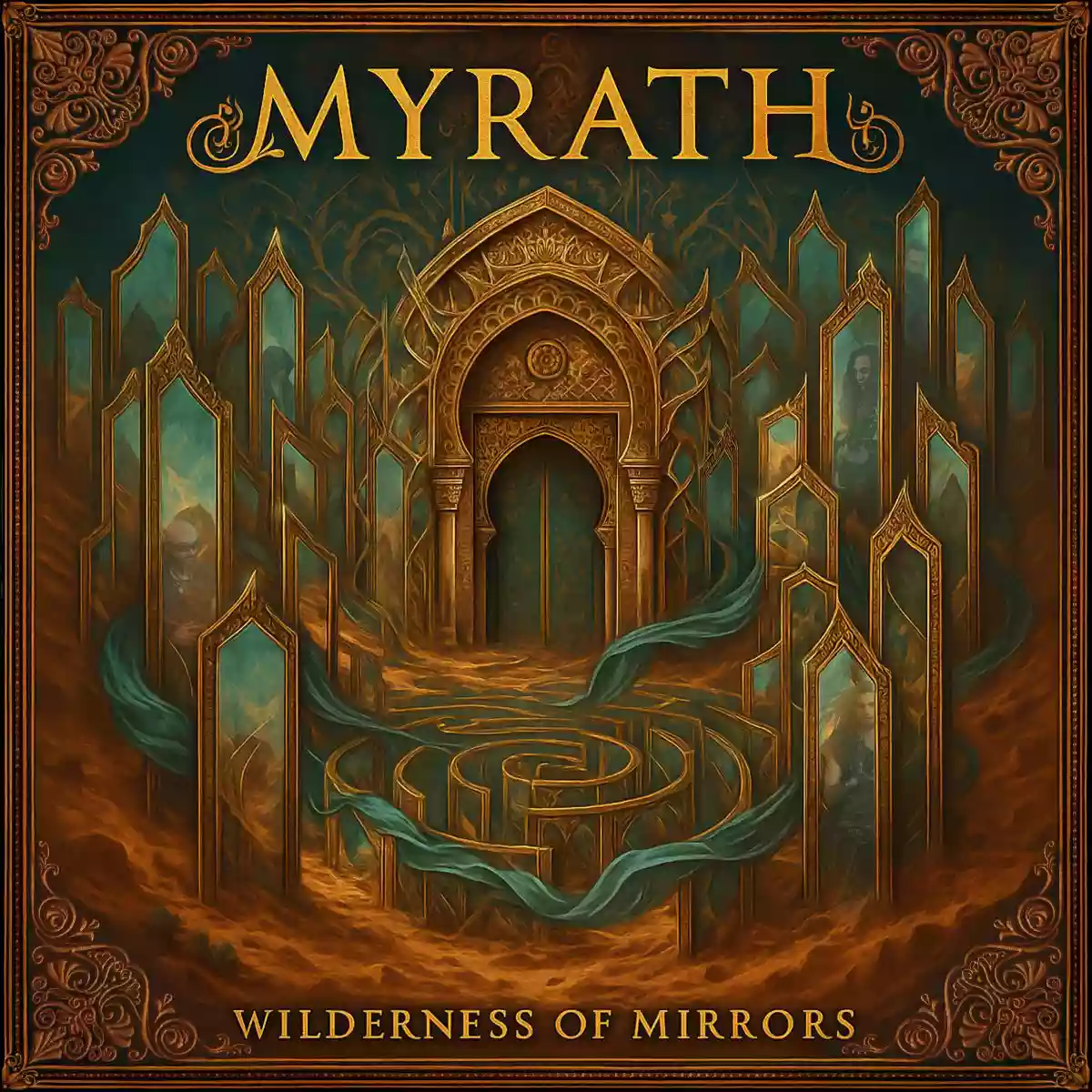
This time, they didn’t take all that long—the seventh release from the Tunisian (now partly French as well) band Myrath comes just two years after the last one, the second shortest gap ever between two of their albums.
“Wilderness of Mirrors” doesn’t stray far from “Karma”; those who enjoyed the previous album will likely enjoy this one too, and those who criticized it will probably do so again. The features are more or less the same: a clearly present and predominant melodic and orchestral component, dizzying to just the right degree, a regularly present but always rather diluted metal component, always-present Arabic influences that are themselves rather thinned out and set within an increasingly internationalized context.
Once again, I had hoped for a return to the greatness of the second or at least the third album, where metal, prog, and Arabic atmospheres clicked together perfectly. But even here, my satisfaction is halved; once more, we find a band with the handbrake on, not fully doing their job. Starting with the guitars: while they deliver the classic heavy riff, they are consistently kept very much in the background, coming across as timid—seeking a release but holding back for fear of becoming intrusive. They hide in the sonic weave, and you really need to push your headphones deep into your ears to enjoy them. The most typically Arabic parts, though, convince me a bit more compared to the previous album; they feel slightly more authentic, even if they're nowhere near the level of those that marked the good old “Tales of The Sands”—where they were omnipresent, sincere, and immersive. There’s a bit more percussion, some ethnic wind instruments, and even the odd line sung in Arabic; it is, however, a very mild recall—they don’t dominate or take center stage as they did up until “Shehili.”
All this is because the true protagonist is once again the melody—brilliant, intense, powerful, airy. A melody that aims at all costs to be catchy, breaking through to as large an audience as possible, which would be more difficult to win over with a blatantly rougher sound.
The bittersweet truth to accept is simple: for about ten years, Myrath have pretty much been a pop band, and this must be acknowledged beyond personal taste, whether one likes it or not. They crafted a grand and revolutionary mix with their second and third albums, but that perfect mix didn’t last long. Afterwards, they kept branding themselves as a metal band, but extreme lightness took over; in fact, I wouldn’t even call “Legacy” a metal album, and it’s hard to slap that label onto much of “Shehili” as well. The last two albums have recovered a fair bit, and still have a solid metal foundation, but it’s certainly nowhere near the true, explicit heaviness of their early work.
Of course, variations must be acknowledged, because the tracks do offer a good deal of variety; they follow a direction, but each distinguishes itself in some way. In particular, there are three tracks that really have a good kick and blend heaviness and Arabic melody well—I'm obviously talking about “Still the Dawn Will Come,” “Through the Seasons,” and “Edge of the Night.” In these songs, Myrath show what made them famous—they don’t shy from putting guitars up front or mixing them with the melodies typical of their homeland; they’re not ashamed to be metal or North African, and they have no qualms about fusing the two. These tracks fire you up but also make you angry, because they suggest that if the band really wanted, they could still deliver that perfect mix. Instead, out of fear, newly found shyness, or other reasons, for about ten years they’ve chosen to keep a lower profile. Perhaps it’s a commercial move, such as with “Until the End”: very muffled guitars to avoid being less catchy and a female vocalist already known in the scene, Elize Ryd, able to give the band more visibility. But “The Clown” isn’t joking around either, with a beautiful central section sung in Arabic—but it’s fundamentally a pompous hard rock track with the kind of brightness typical of AOR, powerful orchestrations, and a flair reminiscent of recent Royal Hunt productions. Another track that goes out of its way not to sound too heavy is “Echoes of the Fallen,” which, with its deliberately flat chorus guitar and minimalist electronic verses, even seems to mimic Linkin Park at times.
In short, a metal band that presents itself as such but is afraid to be—or maybe isn’t really metal at all? Early on, they seemed to be, but listening to them now, it feels like they were just pretending back then, fooling us. Nowadays, when they present as a metal band, it just isn’t credible or authentic; it feels more like flashy, well-produced guitar-driven hard pop. In fact, you know what’s the most sincere and believable track? I’ll tell you: it’s “Breathing Near the Roar.” It sounds like a ‘90s europop hit, with sparkling, summery keyboards—it’s almost a kind of reggaeton, a track made for a cruise ship or beach aquagym. It’s definitely kitschy, but it fully owns what it is, almost as if it wants to reveal the band’s true nature. Likewise, the semi-ballad, sappy and ingratiating “Soul of My Soul”—sure, it’s a bland and vacuous song (for me, the album’s lowest point), but even here the band isn’t pretending to be what it’s not.
Still, there are some pleasant surprises, above all the opener “The Funeral,” which not only keeps some pretty hard riffs, but also goes beyond, experimenting in its long intro with more markedly African sounds—as if the band doesn’t want to stop in its homeland but to journey further south, past the desert (they’d already flirted with this on “Shehili” but less evidently). “Les Enfants Du Soleil” also doesn’t go unnoticed, and is a blend of several things: the return of a freer prog structure, well-developed acoustic sections, that energetic symphonic rock vibe typical of certain Muse songs—but the biggest novelty is the children’s choir in French.
So then… is my overall verdict on the album positive or negative? Well, I’m definitely not saying it’s negative, on the contrary: the melodies are excellent and well crafted, the album sounds sunny and energetic to just the right degree, and the tracks offer a good dose of variety, class, and well-thought-out ideas. Mine are the usual mental gymnastics of a music critic (because, as I always say, “music criticism invents a problem that doesn’t exist just so we can talk about it”). There just remains that lingering regret for what they could have been, and clearly don’t want to be. I think that if, over the past ten years, instead of releasing four albums, they had just put out a single record with the best and heaviest songs from this decade, we might have had a great Middle Eastern metal album on our hands. Picture a record with “The Needle,” “The Unburnt,” “Born to Survive,” “Monster in My Closet,” “Temple Walls,” “Child of Prophecy,” “Still the Dawn Will Come,” “Edge of the Night,” “Through the Seasons,” with just a couple of softer episodes like “Believer” or “Endure the Silence”; we would have had a spectacular follow-up to “Tales of the Sands.” Instead, what we get are occasional flashes of brilliance in an otherwise pale sun. Oh well, we love Myrath anyway.
Loading comments slowly
Summary by Bot
The review discusses Myrath's 'Wilderness Of Mirrors' album, offering a balanced perspective and a moderate rating. The music combines progressive metal with Eastern elements, creating a distinct sound. While the reviewer does not seem overly enthusiastic or disappointed, they provide a fair assessment. The album's reception and style are discussed with thoughtful analysis.Tracklist
Myrath
Myrath are a Tunisian progressive/power metal band known for blending Middle Eastern/North African elements with modern metal. Formed in 2001 (originally as X‑Tazy), they rose to prominence with Desert Call and Tales of the Sands and later explored a more melodic, orchestral direction on Shehili, Karma and Wilderness Of Mirrors.03 Reviews
