
 •
Rating:
•
Rating:
THE REVIEW
(I dedicate this review to all the true deathsters who introduced me to listening to Morbid Angel, and especially to my dear friend BathoryAria, who brought me closer to this great band despite my strong initial skepticism. Thank you)
Year of Our Lord 1986: the spotlight of metal music is all on Thrash.
And how can you blame those in the business? Masterpieces like Metallica's “Master Of Puppets,” Megadeth's “Peace Sells…But Who's Buying?,” Anthrax's “Spreading The Disease,” and Slayer's “Reign In Blood” provided a new drive to our favorite genre, which would start from these immense timeless masterpieces to build the tough music of the time that was to come shortly after.
Taking inspiration precisely from these masterpieces and especially from the last group on my little list above, a group of somewhat "peculiar" thrashers from Tampa, Florida, with a strong passion for the Los Angeles quartet, for the so-called "chaos" and eager to play "faster and heavier ever" had founded a band destined to forever change the fate of death metal, laying the foundations on which the groups a few years later would build the skyscraper.
These friends, a certain David Vincent who engaged in growl singing, an absolute novelty for the time and promptly copied by successors not always up to the progenitor, a curious individual who self-described as "a three-hundred-year-old vampire," such Trey Azagthoth, a drummer who would become one of the best in the World reaching nineteen hits on the drum with the double pedal, Pete Sandoval (but you only need to ask for Jack... oh, sorry, Pete, uahahaha) and the one who was perhaps the most level-headed element of this excited bunch, the second guitarist Richard Brunelle, created under the name Morbid Angel, one of the most extreme, dark and fast bands that the World had ever known, making Slayer, who at the time seemed the most extreme thing ever sent to Earth from the depths of Hell, look like one of the many pop bands that were all the rage in those beautiful days of the Eighties (oh exaggerated!), thus marking the beginning of death metal.
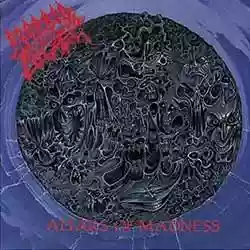
Just after three years, in 1989, there was little talk of death metal, based on the "already heard" from the first albums of Death and Sepultura (mainly), perhaps also because the various Thrash masterpieces overshadowed the extreme music that at that time was slowly beginning to emit its first cries. Therefore, like a bolt from the blue, a true marker of the beginning of Morbid's career, here comes one of the fastest, dreadful, and innovative records on the scene: “Altar Of Madness,” an album that inspired a long series of subsequent death groups, including Pestilence and Death.
But let's get ready to listen, with the headphones tactically positioned on the ears to get even more shocked by the wall of sound created by the drum of that human metronome Sandoval, the lumberjack axes Azagthoth/Brunelle, and the percussive bass but above all by Vincent's innovative growl (I wonder how much ammonia he drank to get a voice like that...), who is at odds with all Christians who according to him are "hypocrites" (which means all Christians eheheh).
Note the excellent songwriting, which finds its strength not so much in the lyrics (which eventually come out effortlessly, contrary to what happened for bands like the "usual" Death and Pestilence) but in the spot-on riffing of the guitarists, with an Azagthoth who can be defined without fear of error as a riff machine in the compositional phase. Unfortunately, the same cannot be said for the lyrics, banal, clichéd, and quite simplistic, which also sound quite like pseudo-Satanist posers. Another note, the influence of Slayer IS VERY NOTICEABLE, especially in the axe-man solos and in the general riffing, influences that will be definitively abandoned already from the next “Blessed Are The Sick”, where the Morbid will find an excellent music/inspiration balance.
As you may have understood, this is a masterpiece, first and foremost of Morbid Angel themselves (confirming among other things as one of the best records of their troubled and difficult career) but also, for death metal in general, having inspired (and still inspiring today) any band that professes to have to do, even remotely, with the beautiful but criticized Metal of Death.
So, my dears: historic pieces, extremely high technique (except, unfortunately, for the bass), uncompromising speed, and guaranteed ear destruction: in three words, "Altar Of Madness".
Loading comments slowly
Summary by Bot
This review praises Morbid Angel's 1989 album Altars of Madness as a pioneering and influential death metal record. It highlights the band's technical skill, the innovative growl vocals, and the strong Slayer influence. While lyrics are critiqued as clichéd, the overall songwriting and speed set a new standard in extreme metal. The album is deemed a masterpiece and a cornerstone for future death metal bands.
Morbid Angel
Morbid Angel is an American death metal band from Florida, widely regarded in the reviews as a pioneering and influential act in the genre, strongly associated with guitarist Trey Azagthoth and drummer Pete “Commando” Sandoval, with notable vocal eras led by David Vincent and later Steve Tucker.24 Reviews
Other reviews
By HellKnight
"Altars of Madness is the emblem of death metal that any fan of this fantastic genre should have."
"Thirteen tracks of catastrophic power that heavily hit the listener’s mind, leaving them strongly impressed and ecstatic."
By Prometheus
Altars Of Madness can be considered the album that more than any other defines the very nature of the Death Metal phenomenon.
Listening to this album is like delving into the dark recesses of the Human mind, in a universe where the truths we know no longer exist.
