
 •
Versione 1
Rating:
•
Versione 1
Rating:
THE REVIEW
What exotic transfiguration of the iconoclastic onanist with Cuccureddu figurines, the otaku, should be treated with turmeric slowly macerated on a meteorite while a mentor lies to the epigone Onofrio, to be taken once every two weeks for three days with deflated gonads.
This I read to be the opinion of Dr. Tatsumaki Senpukyaku, a procurer of engagements for obsolete bishops, specializing in meteorism, expressed the time he was asked in Uganda, "excuse me, the way to Reykjavík?"
Being able to enjoy Mitsuru Adachi is an achievement enough to earn the stripes of an otaku on one's shoulders? I wonder just to know if I should confess such a past to myself, because I liked Adachi and I still enjoy rereading a couple of his mangas from time to time. When I consider the main elements of his works, teenage loves and sports competition during high school days, I tend to answer yes. However, I have some doubts that the issue is that simple. One of Adachi's secrets is quickly uncovered; the narrative knot of his works, from what I've read, always consists of a strange (sometimes even dramatic) situation in which the main characters find themselves more or less at the beginning of the narrated story, taking into account both the sports field and life outside of sports. For the game to work, it's important that this situation constitutes a major impediment to any future romantic relationship between the male and female protagonist. The rest of the story consists of the possible developments of the initial situation. The better engineered it is, the more breath the work can have over time. A simple but effective mechanism. Adachi's other secret is decidedly more indecipherable and is found in his drawing style. An evaluation of individual elements taken separately would not be very positive: aesthetically the drawing is unattractive, and the author tends to use the same characterizations for the main characters with few variations. However, it works well in creating atmospheres, very well: those melancholic, those sentimental, funny situations, and sports suspense.
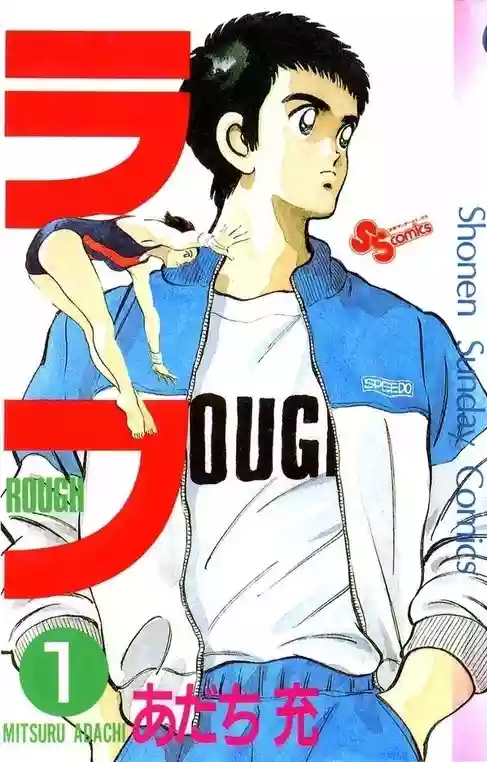
Rough is the first manga I read by Adachi. I bought the first volume for nothing more than a game with myself on my first impressions. Seeing it at the comic shop didn't say anything to me, so it served well for my silly little game. Little did I know I had in my hands the best shot fired by the author. The story is a very particular adaptation of the tale of Romeo and Juliet in late 80s Japan, without a final drama. The sports field used in this case is swimming. The central idea is good, perhaps better than that of Touch and H2, and all the good that the author usually produces is concentrated in a few volumes. A little Adachi bomb, so to speak. The first Italian edition had a terrible public response and for this reason, the publication was very troubled, shifting from a regular series with monthly releases to sporadic ones whenever, but Star Comics brought it to the end. It's one of the very few mangas I willingly reread from time to time. The cover is that of the Japanese edition, more beautiful than those Star Comics used for this purpose with some chapter opening drawings.
"Follow the signs for Honolulu, straight to Laigueglia, at the third traffic light ask." That was the correct answer, Dr. Senpukyaku.
Loading comments slowly
Summary by Bot
The review praises Mitsuru Adachi's Rough for its effective narrative centered on teenage love complicated by challenging circumstances and sports competition. Despite an initially unattractive drawing style, the manga excels in creating atmosphere and suspense. Rough is highlighted as a standout work among Adachi's oeuvre, likened to a Romeo and Juliet adaptation without tragedy. The review also touches on its troubled Italian publication but affirms the manga's lasting appeal.
Mitsuru Adachi
Japanese manga artist known for blending sports competition and adolescent romance into understated, melancholic stories; notable works include Touch, H2, Rough and Cross Game.01 Reviews
