
 •
Rating:
•
Rating:
THE REVIEW
The industrial genre was born quite a few years ago (precisely in 1976, with Throbbing Gristle) and later went through an evolution phase thanks to the contributions from various bands such as Chrome, Foetus, and Big Black.
The first had used it to destroy the song form with reverberations and crushing cacophonies; the second had further perfected it, making it almost like chamber music; the third, finally, had the great merit of completely merging it with the wildest hardcore. However, there was a crucial piece missing now that we were entering the end of the eighties: it needed to be updated to the new "no wave" and noise sounds typical of the period, brilliantly completed by Pixies and Sonic Youth. The ones to succeed in this endeavor were Ministry, a band led by the good Al Jorgensen, one of the most daring minds in the "heavy" rock of the end of the millennium.
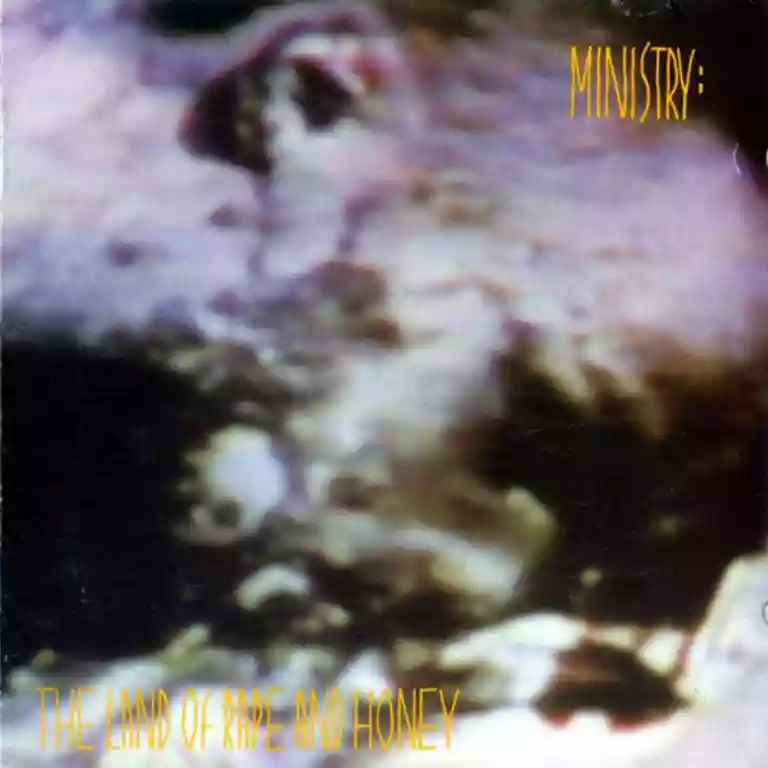
"The Land Of Rape And Honey", an album from 1988, is their masterpiece, an explosive mix of hardcore, garage, noise, and industrial, but above all one of the most shocking albums of all time, certainly one of the most important and effective musical acts of denunciation. What Ministry wants to denounce is the classic dehumanization and alienation of modern society, but what makes them innovative is that their tracks are among the most enterprising ever, eager to proceed with the implementation of radical change. It is amusing to read how some have seen in this band predecessors to Green Day or similar modern groups for their fierce attacks against power. The truth is that Ministry does not want to denounce anyone in particular but everyone in general. Their target is the collective, no one excluded: everyone is responsible for creating a "land of rape and honey," metaphorically speaking the America of the late Eighties, where greed, meanness, and obtuseness reign relentlessly.
The distortion of the mind becomes musical distortion, so "Stigmata" can only open the album with a dissonant and deadly riff, "invested" by typically industrial cadences (the sound and the voice, which is one but seems like a thousand, are enveloped by what sounds like a press noise, but is actually the result of the great work of the keyboards). Jorgensen screams, exhausts his voice, croaks, and everything that comes out of his mouth is filtered, creating a disorienting effect. You can judge for yourself how much Chrome influenced such a track, which is the first masterpiece of the album, but not the last. "Deity," for example, is another: a thrash-metal track in the Metallica style, barbarously distorted and brutalized, in which something melodic can even be sensed amid the chaotic effects. "Missing," on the other hand, presents a bouncing rhythm, but is equally brutal and "filthy", where there isn't a glimmer of light to be found. More than a track, it's a stadium chant in punk version.
These are repetitive tracks, exhausting the musical novelty they consist of in a few seconds, that could continue indefinitely, but this is precisely the main theme: Ministry's music is hardcore for androids, seemingly made to be "danced" and "sung" by a community of automatons, as automatons have become the representatives of the new human genre, which no longer presents almost anything human. The clangs of "Destruction" are also inhuman, alternating with terrifying screams emitted by a people of outcasts. Our guys prove excellent at sampling in "Hizbollah," a significant example of deconstruction with an Arab muezzin's chant in the background: it's one of the gems that makes buying the album worthwhile. As it progresses, the tracks increasingly take the form of masses of screams "coram populi", as in the title track, in which Jorgensen seems to incite a bloodthirsty crowd to revolt. The backdrop of these invectives is always pulsating, unleashed, restless, as if wanting to give vent to their urges but being constrained by something indecipherable. "You Know What You Are," yet another heavyweight track, stands out against a thriller horizon, dominated by an evil sabbath of desperate screams, as if these responded with horror to the appeal of the title, as if by recognizing who they are (or rather, what they have become) they are left disconcerted. With "Flashback" and the instrumental "Abortive", they enter the world of disco music, but a toxic, sick disco music, in which loops exhibit unprecedented anxiety and the industrial "presses" vent for the umpteenth time.
Ultimately, a historic album, one of the most underrated, in my opinion, in the history of rock. With this album, Ministry forged the sound that would be manna from heaven for Trent Reznor and Nine Inch Nails. Why doesn't it deserve my 5? At certain points, there is a bit of self-indulgence and technique for its own sake, which somewhat mars it. Nevertheless, an album recommended to all De-basers.
Loading comments slowly
Summary by Bot
This review praises Ministry's 1988 album as a groundbreaking blend of industrial, hardcore, and noise music. It highlights the album's role in evolving the genre and its powerful social denunciation of late 80s America. The writer notes the influence on later artists like Nine Inch Nails while critiquing minor moments of self-indulgence. Overall, it considers the album a historic, underrated masterpiece.Tracklist Lyrics Videos
Ministry
Ministry is an American industrial rock/industrial metal band led by Al Jourgensen, known for a shift from early-’80s synthpop toward abrasive, sample-heavy industrial metal in the late 1980s and early 1990s.14 Reviews
