
 •
Rating:
•
Rating:
THE REVIEW
It is known that music is made of passion, love, sometimes anger, hatred. But often, these feelings turn out to be incomplete for the realization of mature and conscious works. Often what gives that extra touch, what makes a difference, what pushes a group towards success and fame, is judgment. Punctiliousness. In this case, even the metrics. Elements that every good musician must absolutely take into consideration: elements, if we want, opposed to genuineness, the freshness of sound, the damnation of soul, body, and mind for the realization of a project. Yet, these are elements that differentiate the beginner band (at their debut or with a couple of not well-received records behind them) from the more experienced band, which combines eagerness with a bit of flair.
The Metric can be an excellent foundational example. A Canadian quartet (led by the beautiful singer, the blonde Emily Haines) that warns new listeners right from the name: here, amid riffs and electronic samples, there's also room for geometric rigor, the significant reduction of error margin, nerve-wracking meticulousness. But let's not misunderstand: nothing complicated, nothing intricate, not even a hint of syncopated rhythms changing direction every two seconds: here stratification finds no place, simplicity reigns, but it's an almost alien simplicity, devoid of mistakes and imperfections as far as human intervention can erase errors and imperfections. And this was already hinted at in the debut album "Old World Underground, Where Are You Now?" from 2003: a good rock that winked at alternative pop, ska, and electronics, never excessive contaminations and always well-balanced among them, without imbalances. Critics quickly praised them: great work, great awareness, all around excellent. And, without exaggeration, that record was indeed a great job, nothing particularly innovative or exciting, but still quite a promising debut.
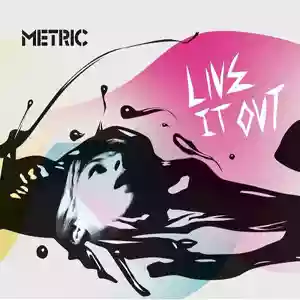
In 2006, the Canadians decided to release their second work, titled "Live It Out". The cover leaves the band's fans somewhat perplexed: while Emily's head was in the foreground, beautiful and enigmatic, on the previous work, now the singer (or rather, her head) appears tilted, in the midst of a black sea (blood?). It's therefore clear that curiosity is strongly aroused: one would expect at least a musical maturation, or anyway the exploration of new musical territories, elements dictated by the new artwork. And yet no: the second chapter of the saga remains well-rooted in the sounds already encountered in "Old World Underground". What leaves a bit of bitterness is the aspect concerning the lyrics. But let's proceed in order and analyze each song one by one.
The album opens with "Empty", a track with a rock flavor that starts with a beautiful guitar riff followed by Emily's raspy voice and pronounced electronic samples. Once again, a sense of apathetic perfection permeates: the song sounds decidedly good (who would ever have the courage to hit the stop button during its execution?), but the sound parts seem decidedly, in some way, predetermined, equally exaggeratedly distributed. "Glass Ceiling" tries in some way to soften the frosty punctiliousness dictated by "Empty": here the riffs feel freer and more personal, without schematic obligations, Emily's voice pleasantly reminiscent - heaven forbid - of the best times of Broken Social Scene. We reach the provocative "Hand$hake$": harsh riffs, accompanied by aggressive vocals of Haines and, somewhat surprisingly, electronic parts insertion. What really surprises about this song is not the musical aspect, but the band's attitude towards the piece: perfection seems annihilated, the riffs are dirty and messy, nothing follows a precise pattern.
But as the wise saying goes: "The exception proves the rule." And indeed, with song number four ("Too Little Too Late"), the return is made to a well-oiled and predefined setup, which allows all the elements of the song to fit together perfectly (the creeping bass line that opens the composition, the background keyboards, the singer in the foreground). And this time, good harmony is achieved: the song isn't excessively mechanical, attracting like never before the listeners -like bees are attracted to honey- and, in its unfolding, it convinces greatly. "Poster Of A Girl" is the perfect portrait of the album: a portrait where everything is magnificent, everything is brilliant, everything matches. But, unlike "Too Little Too Late", this time the band's maneuver is slightly more cumbersome. The guitar struggles to impose itself on a decidedly pop track, impregnated with electronic surges, and Haines shows some uncertainty, between whispers and sudden breaks, in the continuation of the track. In short: brilliant on the surface, but creaky at the foundations.
The sixth track, "Monster Hospital", chosen by the band as the first official single, opens with a distorted guitar and then proceeds, with some unease (faithfully depicted in the video, in rotation on Flux) with rapid electronic insertions, leading to a contagious chorus ("I fought the war, I fought the war, I fought the war but the war won!"), of those you can't get out of your head even with a cannon shot. Undoubtedly the best of the album: the background guitars give the song an aggressive yet provocative tone. And here's the portrait of the average listener, headphones on and attentive gaze, up to this point listening to the album: galvanized, unable to stay still on the chair, distracted while humming all the choruses of the previous tracks. Please make sure, if you buy this album, to remain as detached as possible, a daunting yet not prohibitive task, because from the seventh composition on, things get... at least critical. As an electronic insertion closes "Monster Hospital", here come the first notes of "Patriarch On A Vespa", which without any hesitation we can define as the worst song of the entire album. Everything has already been heard, everything has already been said: the typical Metric scheme beginning-verse-chorus-verse-chorus-bridge-chorus-chorus fails to spark even a minimum of enthusiasm, the guitar seems almost washed out, the keyboards are too intrusive -concerning volume-; and as if that weren't enough, the lyric is remarkably shockingly banal.
The shock is decidedly strong: to partially soothe - our turmoil comes to the rescue "The Police And The Private", a pleasant piece that tastes of Ok Go, with the insertion of an incredible funk base, very rhythmic, supported by a vulnerable and simultaneously sexy voice and sporadic electronic insertions. After the utterly forgettable and colorless "Ending Start", comes another good track, the eponymous "Live It Out": here the Metric even attempt an almost epileptic crescendo, in Blondie style, eliminating the electronic synths to make room for genuine riffs and decisive and aggressive vocal parts. But, unfortunately, this album does not follow the rule of dulcis in fundo: the eleventh and last track, in fact, has a misleading and at least banal title ("Dead Rock'n'Roll"). Perhaps, however, the Canadians had a bit of reason on their side: with this track they literally kill everything good they had done on the album, lowering the final evaluation on the overall work by one notch, and bringing a nice grimace of disappointment to the listener's face. This is nothing but an irritating track with house contaminations (brrr), practically devoid of any guitar intervention: but what is most worrisome is the sudden disappearance of the sound freshness and perfection of the first songs, also considering the fact that this track wasn't number twenty, or number sixteen, or number fourteen, but number eleven, and this suggests (let's hope not) a progressive decline of the group.
In conclusion: many positive aspects, among which the group's harmony, the not too rigid perfection of some songs, the compositional and sonic excellence of the first six tracks. Among the negative aspects, alas, are the lack of inventiveness, as well as beauty, of the last tracks, the excessive punctiliousness in some songs, the disappearance of freshness in the concluding parts, the lyrics mostly either banal or, at best, good but already heard.
Definitely a step back from the debut of three years ago.
Loading comments slowly
Summary by Bot
Metric's 2006 album Live It Out maintains the band's signature blend of rock and electronic elements with a focus on meticulous production. The first half of the album impresses with strong riffs, energetic vocals, and catchy melodies, notably in 'Monster Hospital.' However, the latter tracks show a decline in inventiveness and lyrical strength, leading to a less impactful finish. Overall, the album is polished but lacks the freshness and excitement of their debut.Tracklist Lyrics Videos
Metric
Metric is a Canadian indie rock/new wave band formed in Toronto in 1998 by Emily Haines and James Shaw, later joined by Joshua Winstead and Joules Scott‑Key. They broke through with Old World Underground, Where Are You Now? and achieved wide acclaim with Fantasies.04 Reviews
