
 •
Rating:
•
Rating:
THE REVIEW
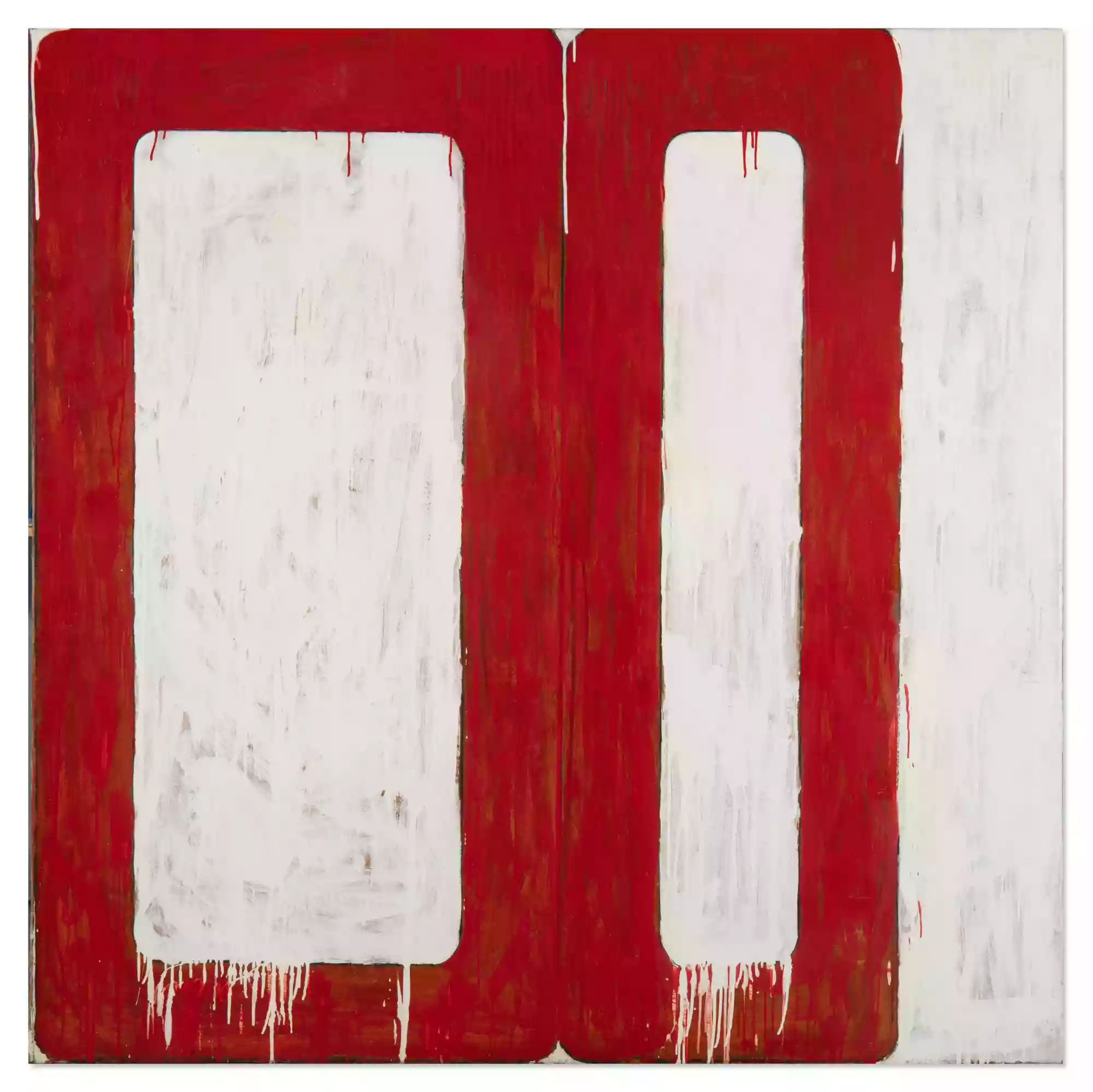
In 2022 this work was auctioned by Sotheby's (London) and exceeded one million euros.
The valuations of the sixties' works by the late Mario Schifano have reached astonishing valuations. The market for this artist is in constant turmoil. Between ups and downs, since he started exhibiting in Rome, still in his twenties, people have vied for his works.
The painting in question, Tempo Moderno, from 1962, possesses a seemingly essential nature. Two chromatisms. Two forms. On a beige cardboard background. This is what the eye perceives. But upon closer inspection, evident drippings are noticeable. No, they are not a mistake dictated by haste.
To understand this work, one must take a step back. In those years, artists had indulged in unprecedented forms of expression, experiments of all kinds, collages, burnings, packagings, geometries, extrusions, cuts, excrement, blood, and much, much more. Crazy? Perhaps.
In France (Klein’s blue monochromes from the 50s made history), as in the United States, there was a necessity for a return to essentials, not only in color but also in form. Across the ocean, Warhol was all the rage, reaching anyone with burning immediacy and becoming immortal. These two artists are not mentioned randomly; they were a source of inspiration for Schifano who absorbed the message, made it his own, and carried it forward.
Primary chromatisms, primary forms, instinct in the brushstroke. “Here we must reset everything” Schifano told a colleague, influenced by international art movements, just in his twenties, while pondering what to do. Thus, several monochromes were created, geometric shapes merely hinted at, almost a return to the origins of the gesture, to the purity of the child who goes to discover the basic elements of creation.
The gesture is no longer trapped by slowness, it arises from an imminent and immediate need, from thought to canvas in the shortest possible time. Certainly, one must enter the artist's sensitivity and his anxieties.
Or it would be enough to approach a masterpiece you really like, put your nose to the canvas, and discover that you are seeing only one color or a barely hinted shape. Exactly. Mario's work, in a certain sense, emerges from the canvas and approaches your gaze, you don’t need to move. It’s the detail of something much bigger. But what? You know well that color (but also form) sets the rules in marketing.
Schifano forces you to think about time and space. He escapes beauty, he doesn't need it, he is more interested in original perceptions, in instincts, precisely in response to the delusions of that art capable of continually questioning itself, answering itself, rising and flattening, disgusting and outraging, confusing and making one smile. He escapes craftsmanship, becomes like a child who wants to try everything. You cannot understand Mario with a single work, a comprehensive vision is required, without which, one doesn't get to the point.
Loading comments slowly
Summary by Bot
Mario Schifano's 1962 painting Tempo Moderno is an iconic work that captures the essence of early 60s modern art. Its minimal forms and primary chromatisms reflect a return to artistic basics inspired by global movements like Pop Art and monochromes. The artwork commands over one million euros at Sotheby’s auction, affirming its cultural and market value. The review emphasizes the artist’s instinctive creativity and the conceptual depth behind the seemingly simple composition.
Mario Schifano
Mario Schifano (1934–1998) was an Italian painter and filmmaker linked to the Scuola di Piazza del Popolo and a key figure in Italian Pop art. He developed early-1960s monochromes, iconic brand-based works like Coca-Cola, expansive series through the 1980s, and directed experimental films including Umano non umano (1969).05 Reviews
