 •
Rating:
•
Rating:
THE REVIEW
Either you love it or you hate it.
And perhaps this is the statement upon which everyone can agree when talking about Marilyn Manson. I'm 19 years old, and I've heard about the "reverend" since middle school, but for one reason or another, I've never listened to his work.
I am morbidly passionate about music: I listen to every genre and artist without any prejudice; despite this, I have often avoided letting my ears have a close encounter with the notes of the controversial Mr. Brian Warner, known to friends as Marilyn Manson. My choice was probably dictated by the massive and excessive wave of controversies that have arisen around the dark artist: whether they were urban legends or not, for years I’ve heard all kinds of things and, applying a rather rudimentary "theorem," I relegated said guy to the cerebral drawer of "freak shows-money-making machines-fake rebels" (for which, alas, Marilyn went to keep company with Britney Spears and Avril Lavigne).
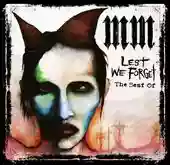
One day, however, I had to change my mind, sending the ineffective theorem to hell (to stay on theme). Entering the record store, I start to browse its shelves thoroughly when my eyes are devilishly attracted by a cover: Mr. Manson's face, the two horns sprouting from his head (who knows what Ms. Dita von Teese was up to while her mephistophelic husband was recording the album) and the gothic-style MM initials towering above the title "lest we forget" (objectively stunning): all of this rendered in a truly magnificent manner, and one can't deny Brian's pictorial qualities (he is the author of the cover).
Let's get to the heart of the matter: the songs. The album opens with "the love song", which is simply a punch in the stomach both for its progression and its lyrics; in sequence, there's "personal Jesus," a cover of the Depeche Mode song (but which doesn't hold up in comparison), "the fight song," "tainted love" (a nice cover of Soft Cell); "the dope show," "this is the new Shit," and "disposable teens" lead us hand in hand in a crescendo of anger, guitars, and irrepressible emotions, towards the absolute masterpiece: track 9, "Sweet dreams". -...we've danced to it with Eurythmics until exhaustion, but Marilyn Manson offers us a long descent into the underworld, with a dragged chant and spine-tingling incursions, in what cannot be considered anything other than a pearl of style. Track number 14 is also beautiful: "the nobodies," a sad, heartfelt, excellently executed song. Truly remarkable are also "the beautiful people" and "(S)aint," with which the dream-nightmare comes to a conclusion. And with two considerations, this long review also ends...
I have re-evaluated Marilyn Manson considerably: you cannot understand him superficially, you have to go beyond that lipstick, that makeup, those multicolored eyes. It is necessary to read his lyrics deeply, which, I assure you, demonstrate that Brian Warner, deep down, is a good artist and has a mind that doesn't function at all badly...
Do you want to know how my story ends?.... The following day, I went back to the store and bought the entire discography!!!!!!!
Loading comments slowly
Summary by Bot
The reviewer initially avoided Marilyn Manson due to controversy but was drawn in by the striking album cover of 'Lest We Forget.' The album features intense songs blending anger, emotion, and powerful covers, especially 'Sweet Dreams.' The reviewer ultimately reevaluated Manson as a talented and deep artist, leading to purchasing his entire discography.Tracklist Lyrics
Marilyn Manson
Stage name of Brian Warner, American singer-songwriter and frontman of the Marilyn Manson project, known for a provocative stage persona and albums blending industrial, glam and alternative rock.39 Reviews
Other reviews
By enryka
"I thought that the two opposites positive/negative, male/female, good/evil, beauty/ugliness created precisely the dichotomy I wanted to represent."
"This album proves to be a tangible testimony to the musical and aesthetic evolution of the Reverend."
By Carillon Infernale
Marilyn Manson was one of the most innovative bands of late millennium rock.
'Lest We Forget' contains all their most famous hits, from 'The Dope Show' to 'The Beautiful People'.
