
 •
Rating:
•
Rating:
THE REVIEW
"Before the bullets, before the flies, before authorities take out my eyes, the only smiling are you dolls that I've made, but you are plastic and so are your brains" GodeatGod
"I am not a slave to a God that doesn't exist. I am not a slave to a world that doesn't give a shit." The Fight Song
The year is 2000, Marilyn Manson is public enemy no. 1, targeted by clergy members, parents, and even U.S. politicians. After the Columbine High School massacre, for which he was unjustly blamed as an inspiration, he received numerous death threats and lawsuits from so-called "right-thinking" people.
Disgusted by all those who hate him so unfairly, he decides to retreat to the desert of "Death Valley," described as a land of desolation, mystery, and death, and disappears from the scene, waiting to return with his most powerful weapon. The music.
Why do people "Hate"?
Everyone needs something to love as much as something to hate, and sometimes it's easier to do so in a group, allowing oneself to be carried away by others on a wave of disdain and anger towards someone who, in reality, bears very little guilt. Religion is a great example of how hatred can help manipulate the masses, driving them to fight wars against "infidels." It hardly matters then if the message should be of "Love and Brotherhood," as they do not sell as much as hate does. The same goes for the state, which, through fear and hatred itself, makes the population more united and open to dictatorship. Does the title "1984" ring any bells? Who knows if we, too, will one day participate once a week in the "hour of hate." Long live the "Big Brother," which in this case is us (after all, isn't "Big Brother" a metaphor?) and down with the freedom of thought, considered a real "Thoughtcrime." Rebellion and revolution have by now become mere commercial products to be consumed quickly and preferably hot, while those of the past are forgotten.
Manson knows all this, and not by chance, "Holy Wood (In the Shadow of the Valley of Death)" is an album with a distinctly pessimistic and dark atmosphere. If "Antichrist Superstar" was the "Apocalypse" and "Mechanical Animals" represented a revolution undertaken by Christ transformed over the centuries into another commercial product, this album is undoubtedly "The Genesis," in a true and majestic Bible played in reverse and signed Marilyn Manson.
"I burned all the good things in the Eden Eye, we were too dumb to run, too dead to die" Coma Black a) eden eye b) apple of discord
"This is your creation, the atom of Eden was a bomb. We're damned and tomorrow's canceled because of things we did yesterday, they crucify us in our space." Cruci-fiction in Space
What was the first revolution in human history? You should have guessed the answer, and if not, I'll tell you:
The one undertaken by Adam when he ate the apple of discord from the "tree of knowledge of good and evil," rebelling against God's authority, followed by the "Fall of Humanity." Manson then decides to name his new character "Adam Kadmon," a Hebrew name for the androgynous (as it contained the soul of Eve) first man. The album is divided into 4 chapters: "In the Shadow," "The Androgyne," "Of Red Earth," and "The Fallen," representing the story of humanity and Adam. The symbol chosen for the album is that of mercury, considered by the ancients to be the primordial element of matter.
"If you die when there's no one watching, then your ratings drop and you're forgotten. If they kill you on their TV you're a martyr and the Lamb of God." Lamb of God
"Put me in motorcade, put me in the death parade, dress me up and take me, dress me up and make me your dying God." A Place in the Dirt
What do Kennedy, Christ, and Lennon have in common? All three are very much loved and have been great figures in history. What else?
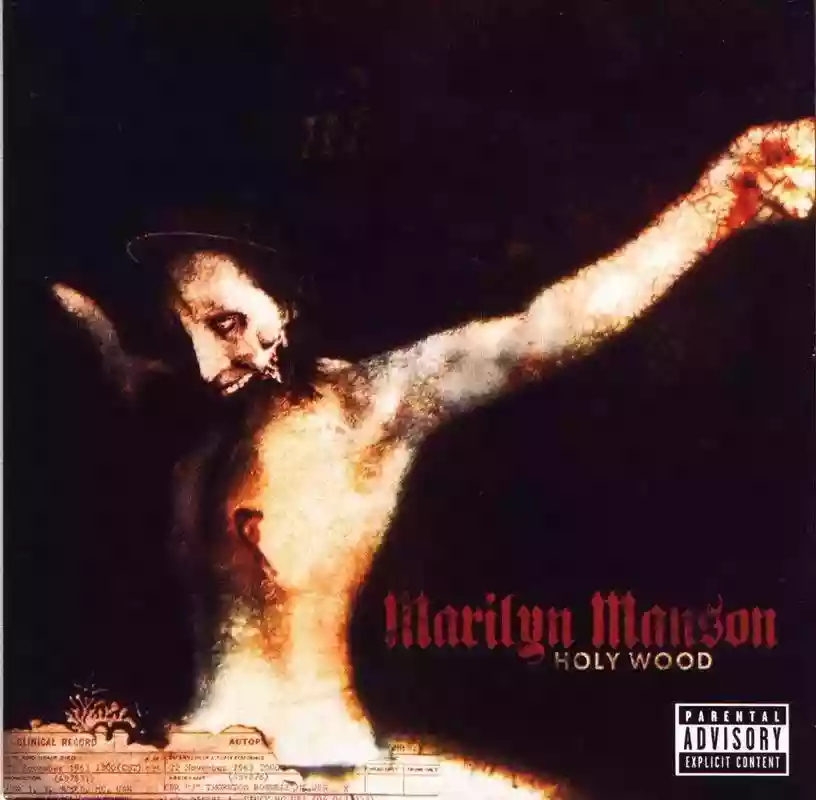
Manson tells us. Their deaths remain etched in collective memory, making them even more loved and "martyred" by the people. "The death of one is a tragedy, the death of millions is just a statistic," says Manson in "The Fight Song," quoting Stalin. Christ is depicted as a nearly naked and crucified man, sacrificed for our salvation, and is hung in almost every house in America. Kennedy was one of the most beloved and extolled American presidents, and his assassination, which destabilized the entire world, along with his autopsy, has been broadcast on TV multiple times. Lennon, a long-time supporter of pacifism, was ironically killed by one of his own fans, shot dead. All three have given rise to a great post-mortem business. This means that even violence sells. But then why, if the president's brain appears on TV screens and Christ is crucified in every home, is Manson blamed for being a "bad influence on youth"? The album cover, which depicts Manson crucified, was censored in the USA and other countries for being violent, but why is it acceptable to see the original crucifixion even on the walls of elementary schools? Manson is blamed for crude lyrics, which inspire murder and hatred, yet few know that many lines are taken directly from the Bible. Isn't the Bible the world's best-selling book? It's also one of the most violent and bloody, yet it has never been blamed as a bad influence on children.
"The Father: Do you love your Guns (Yeah!), God? (Yeah!) the Government? (Fuck Yeah!)" The Love Song
"Some children died the other day, we fed machine then we prayed puked up and down on morbid faith, you should have seen the ratings that day" The Nobodies
When Manson was accused of inspiring the Columbine massacre, he replied in an interview: "They label me a monster because they say my music drives them to kill. Maybe, but I've never sold a semiautomatic rifle to a 17-year-old." In America, guns are a hot topic, found in any supermarket and the drawers of any house. Yet, a less powerful scapegoat was preferred to the gun market and the president (who was launching bombs overseas at that time, Manson reminds us in the same interview) to blame for the incident. Guns are sanctified by Americans almost like a second religion, so Manson decides to use a cross composed of a rifle and two pistols as a symbol during his tour, aptly named "Guns God and Government."
"We sing the death song kids, because we've got no future, and we want to be just like you" The Death Song
"Multiply your death, divide by sex, add up the violence and what do you get?" Burning Flag
The band, strengthened by the addition of virtuoso guitarist John 5, presents itself as the best formation of Marilyn Manson. The intro to the album is GodeatGod, where Manson sings with a cold voice emanating an almost whispered hatred, the atmosphere is palpable. The background noises suggest an old worn-out reel while the guitar plays decisively. The Fight Song is one of Manson's strongest tracks, screaming vocals, and a text that extols rebellion, simply a musical pearl. We move through Disposable Teens, among powerful guitar riffs and visions of a burned-out youth, references to "1984," and rebellion to Target Audience, a suggestive start, Manson's voice calm and filled with disdain, breaking into the refrain with anguished screams. The title track is one of the saddest and most pessimistic moments of the album, with acoustic guitar and angelic choirs framing a calm and melancholic voice describing desolation and loneliness, while towards the end a falsetto lists various definitions of death. The Nobodies is simply magnificent, sung with a mysterious and sick voice that transforms into pure hatred in the chorus. The Fall of Adam begins with acoustic guitar notes and the sound of thunder, with Manson's voice introspective and whispered and an atmosphere that announces a tragedy. Towards the end, it completely changes, transforming under a chorus of screams and buzzing bees. The album closes with the melodic Count To Six and Die, a piano and soft voice describing a suicide. Five gunshots at the end, while the sixth suggested by the title is not heard, giving way to the noise of fireworks.
Every band member gives an outstanding performance across all nineteen tracks of the album. The work done by keyboardist Pogo, which loads each song with atmospheric and suggestive sounds, is masterful, John 5's guitar is decided and powerful, Ramirez's bass is, as always, excellent, and Ginger Fish's drums play excellently. Manson writes simply indescribable lyrics, granting the album a unique dimension while his voice is grotesque, sepulchral, sharp, screamed, and whispered in every song. The album's booklet is thoroughly curated, featuring alchemical and cabal symbols, up to tarot cards reinterpreted by the band's members.
"Is this what you wanted? this is what you get. Turned all your lives into this shit. You never gave me a chance to be me or even a fucking chance just to be." King Kill 33
"We have no future, heaven wasn't made for me. We burn ourselves to hell as fast as it can be. And I wish that I could be the King. Then I'd know that I'm not Alone." In the Shadow of the Valley of Death
"Holy Wood (In The Shadow of The Valley of Death)" is Manson's response to the accusations for the Columbine massacre. But it is also much more. The album is a true masterpiece with desolate and esoteric atmospheres, a study of the human condition, the relationship between religion, the state and weapons, fame, violence, revolution, and death.
Loading comments slowly
Summary by Bot
This review delves into Marilyn Manson's 2000 album, Holy Wood (In The Shadow Of The Valley Of Death), highlighting its dark, esoteric themes and potent social critique. Created in response to widespread backlash and blame for the Columbine tragedy, the album explores rebellion, religion, violence, and media manipulation through powerful lyrics and atmospheric music. The band’s exceptional performances and symbolic artistry are praised, positioning Holy Wood as a masterpiece in Manson's discography.Tracklist Lyrics Videos
02 The Love Song (03:20)
06 “President Dead” (03:13)
07 In the Shadow of the Valley of Death (04:11)
11 The Death Song (03:30)
12 Lamb of God (04:40)
15 Coma Black: A) Eden Eye / B) The Apple of Discord (05:59)
16 Valentine’s Day (03:32)
19 Count to Six and Die (The Vacuum of Infinite Space Encompassing) (03:23)
Marilyn Manson
Stage name of Brian Warner, American singer-songwriter and frontman of the Marilyn Manson project, known for a provocative stage persona and albums blending industrial, glam and alternative rock.39 Reviews
Other reviews
By CoolOras
Holy Wood is a dark, gloomy, angry album with gothic-style atmospheres that needs to be listened to with great attention before being judged.
MM has inserted various hidden messages, from 'Death Valley' to 'flies,' symbolizing the mass media's commodification of originality.
By (sic)
"Now this is what you call a masterpiece of a song, damn it!!!"
You can say anything about Manson, except that he is a great musician.
By MiseryMachine
His true response would come a year later with the album 'Holy Wood,' a concept album centered on the cult of weapons, the capitalistic 'American Dream,' the various attacks on American presidents, and religion.
It's an album that has aged very well, it’s still relevant, perhaps even more so now than it was then.
