
 •
Rating:
•
Rating: THE REVIEW
1984's Fugazi: indulgence!
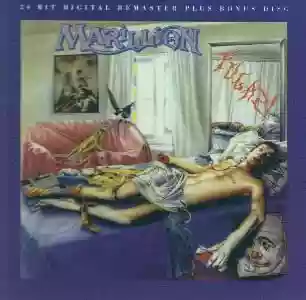
Marillion are perhaps the first to have invented a discography-concept: in the first one, the clown sadly plays the violin, here he rests in his room, in Misplaced Childhood he escapes from the child's room with a troubled childhood. The illustrator is the great Mark Wilkinson who does not disappoint even in Fugazi: the magpie, the chameleon, the glass full of blood, the torn T-shirt, the little train, the alien on TV, the stiletto heel, and the abbey outside the window are all symbolic images wanted by the colossal frontman. Because Fish is the great character in the band, the undisputed leader, with a remarkable dose of charisma, but he is also (and above all) a poet. The lyrics are complex, full of rhetorical devices (often rhymed, for example), laden with double meanings, and those who have some knowledge of the foreign language will agree with me that they are written in an extraordinary English. Besides that, Fish possesses one of the greatest voices on this planet. Although he has often been labeled as a pale imitator of Peter Gabriel, one can say that by listening closely to the tracks in which he sings, a rather striking difference is noticeable.
Assassing is one of the most vicious, aggressive, and obsessive songs Marillion has ever written. It talks about the difficult relationship of two personalities living in the same body, where the murderous side tries to convince the good one to renounce goodness. A frightening intro leads us to a slightly funky guitar that finally flows into the riff. The synthesizer interlude is chilling and Fish's voice is phenomenal. The ending is also spectacular, where Fish roars with a baritone voice: “And what do you call assassins who accuse assassins anyway, my friend?”. This, in my opinion, is Marillion's best track alongside Kayleigh and Incubus. The latter is another masterpiece, featuring five different musical themes all interconnected: the verse (who can forget the legendary UUUuAh?), the guitar arpeggio, the reprise of the verse, the beautiful piano piece, the acceleration, and the finale. Notable is the splendid solo by guitarist Steve Rothery. He has a very particular style because he plans his solos meticulously, and they turn out to be not only very melodic but so well written as to be etched note by note in the listener's mind. Rothery is monstrous. But the whole band gives its best: writing such a piece is inconceivable for an ordinary mind, genius is required. An interesting fact: Peter Hammill, who supported Marillion during the Script of a Jester's Tear tour, inspired Fish (of whom he is a great friend) with the words for the songs Assassing and Incubus by gifting him a record of Islamic music!!! A beautiful synth introduces Punch & Judy, which talks about Fish's paranoia towards the constraints of a relationship and views it as hell where partners blame each other for the failures in their lives, culminating in a divorce (“Worst ever thing that ever happened to me / Oh for D.I.V.O.R.C.E., OH Judy!”).
Jigsaw talks about the intrigues of a couple and the secret cards that are held back before being played. The chorus is singable from the first listen and stirs emotions in the listener's heart. Jigsaw is phenomenal and here too the keyboards play a significant role. Let's not forget the rhythm section either: the bass has no secrets for the legendary Pete Trewavas (who is also an excellent composer) and Ian Mosley has already integrated perfectly in the band. She Chameleon was inspired by one of the many stories of groupies that began to follow the band after the concerts in 1983: it talks about road sex (“So was it just a fuck, was it just a fuck, Just another fuck I said”). It is a beautiful slow song, with a 'wavy' church organ riff and a spectacular Moog solo.
Emerald Lies speaks about the pain of a cycle of separations and reconciliations, which Fish himself was experiencing at that time. The bass by Trewavas shakes the stereo. The title-track Fugazi instead deals with a general view of the world, defined with the adjective taken from the jargon of American soldiers in Vietnam. In fact, it should be known that during the Script for a Jester's Tear tour, Fish was obsessed with this war and read book after book on the subject. From this, he extracted the word Fugazi, which literally means “all to hell, all fucked up”. Therefore, the vision of society is not very optimistic. The magnificent piano intro is followed by a nice guitar passage. Then the song becomes livelier, with nice bass and drum breaks. Fish changes his voice and the synthesizer goes full throttle. A dark piece then brings us to the wonderful end of the song and the album, with the cry of “Where are the prophets, where are the visionaries, where are the poets / To brach the dawn of the sentimental mercenary”.
But it doesn't end here: the remastered version with the second CD has been released!!! A joy for all fans. Cinderella Search is a spectacular single with the usual obsessive Fish finale. Three Boats Down From The Candy enchants from start to finish. Then we find the alternative mix of Assassing and four demos: She Chameleon, Punch & Judy, Emerald Lies, and Incubus. I would still have much to say, but I'll end by simply saying this: don't download this album from the internet, because every single penny spent on Fugazi is very well spent. One of the greatest masterpieces in the history of progressive.
Loading comments slowly
Summary by Bot
The review praises Marillion's 1984 album Fugazi as a progressive rock masterpiece, highlighting Fish's charismatic leadership and poetic lyrics. It emphasizes standout tracks like Assassing and Incubus, exceptional guitar work by Steve Rothery, and the intricate concept behind the album. The remastered edition with bonus content is also celebrated, with a strong recommendation to support the band by purchasing the album.Tracklist Lyrics Videos
Marillion
Marillion is an English rock band associated with neo-progressive rock, first achieving major success in the 1980s with vocalist Fish and later continuing with Steve Hogarth from 1989, shifting toward more atmospheric and song-oriented approaches while maintaining a strong fan following.24 Reviews
